I’m going to preface this post by saying that I don’t know what I intended when I began to write about our trip to San Pedro de Atacama, but that the end result was a Word document of 24 single-spaced pages across a dozen or so anecdotes. I’ve struggled with how to best group them into a few (likely four) blog posts, and I don’t know if I’ve found the optimal solution or not. Perhaps that doesn’t matter. This opening post is an introductory one, the story of how we got to San Pedro, of our lunches, of the Airbnb, and of leaving at the very end. The next one will be focused on a coherent arc that took place in San Pedro, while the final two will be focused on the desert beyond the town. Please forgive the fractured chronology. Don’t worry; I’m not trying to be Christopher Nolan.
Arrival:
We all had slightly different plans for how to manage the 5am flight, from don’t sleep until the plane, to getting in bed at 8pm the night before, but the result was that we were all, once again, horribly sleep deprived. I was running on two to three hours as we reached the Santiago airport, well before any light did.
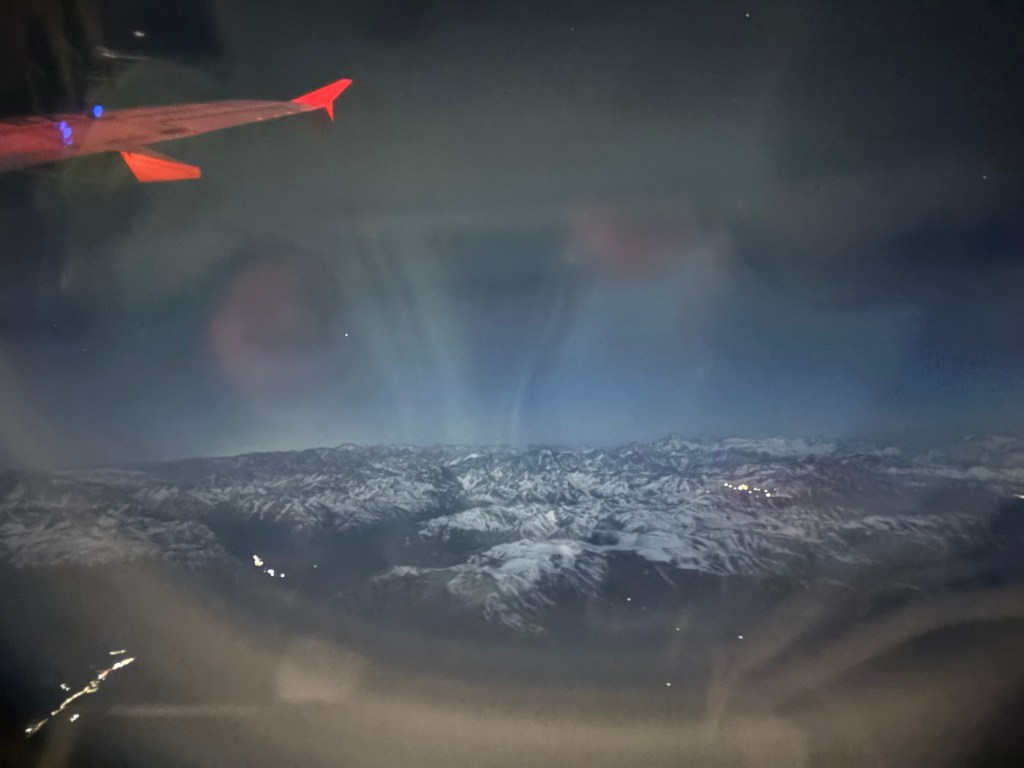
We were flying to Calama, the closest big town to San Pedro de Atacama, a town in the north of Chile that served as the gateway to exploring the Atacama Desert. Our two-hour flight was relaxed, with nearly no other passengers, so we sprawled out and claimed our own rows. When flying north or south in Chile (the only possible directions to fly), since the country boasts the Andes as an eastern boundary, you will almost always have some utterly glorious mountain views. Though I wanted to sleep, my interest in witnessing the sun rise above the Andes, and in seeing beyond the first layer of the cordillera for the first time, superseded it. I was particularly eager for Aconcagua, the biggest mountain in the Americas. It ended up still being night as I beheld it all, making it seem even more wild and inaccessible, like the domain of some elevated species.
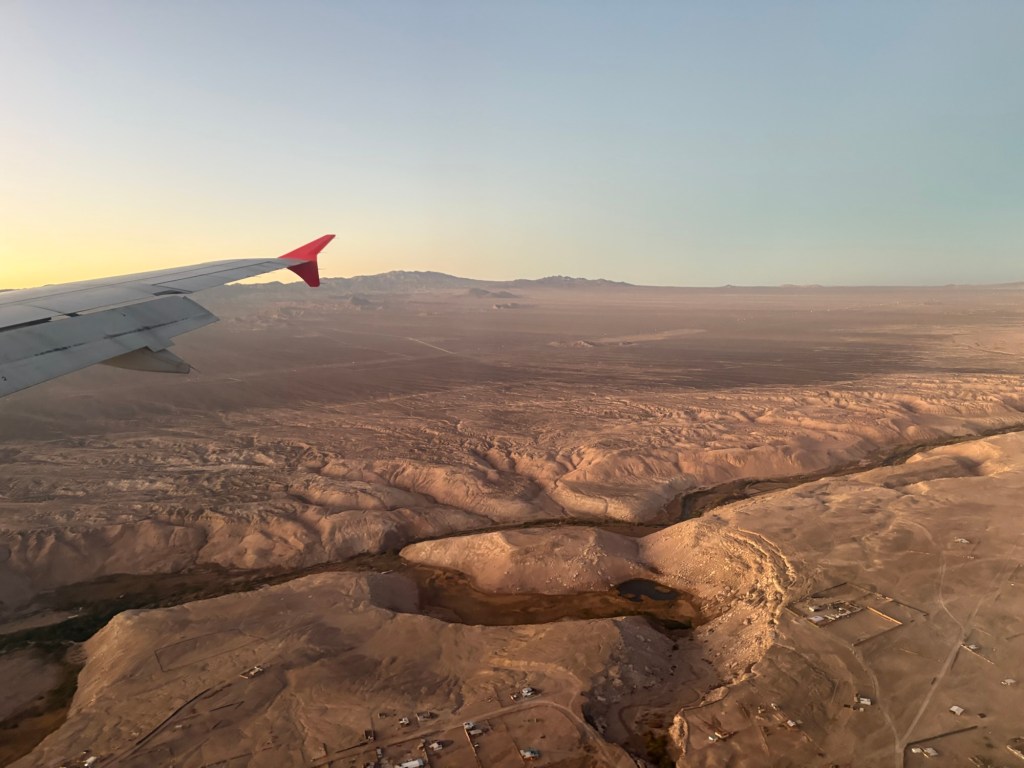
At some point I did drift off into sleep, but Mette woke me up just before we touched down in Calama. She pointed out the window, where I was treated to a very different view: the first light over the desert. We could have been landing on Mars.
Once again, we had tried to book the rental car the day before, but this time we had run into some trouble. Nothing seemed to line up with what we needed: September 11 to 15, cardholder under 25, automatic, and cheap. Not even Fer’s connection in Calama (it seemed he had an amigo or a primo in every hamlet of Chile and half of the ones outside of it) bore fruit. Finally, we had gotten something, but despite our early arrival, we couldn’t pick it up until 11am.
So again, we waited in a hotel, although it couldn’t have been more different from the one in Pucón; it felt like a casino, maybe because we were in the desert and I implicitly associated it with Vegas. We arrived a good two hours before the pickup, and there was plenty of time to sleep on the couches and hope that the staff wouldn’t kick us out for being vagrants. This time around, I had made the reservation, so I handled the interaction at the front desk and was largely competent, nodding, smiling, and occasionally asking questions about the policy (and not telling her that my friend Suditi would be arriving that night, putting us up to six people in the car).
We stopped at Jumbo, which is like the Chilean Walmart (except maybe the ratio of food to not-food is switched, and the actual Walmart-owned brand in Chile is Lider, so what am I even talking about really) and loaded up on food, as there were no supermercados in San Pedro. From everything we had heard, it was an expensive town. In the pursuit of cost-effectiveness, I got bamboozled by the classic 64 pack of Kirkland granola bars in the Internacional section, telling my friends about how clutch and how good of a deal they were. As there was no price tag, we only found out at checkout that they ended up being over $20—which ended up being the cost of three to four lunches in San Pedro.
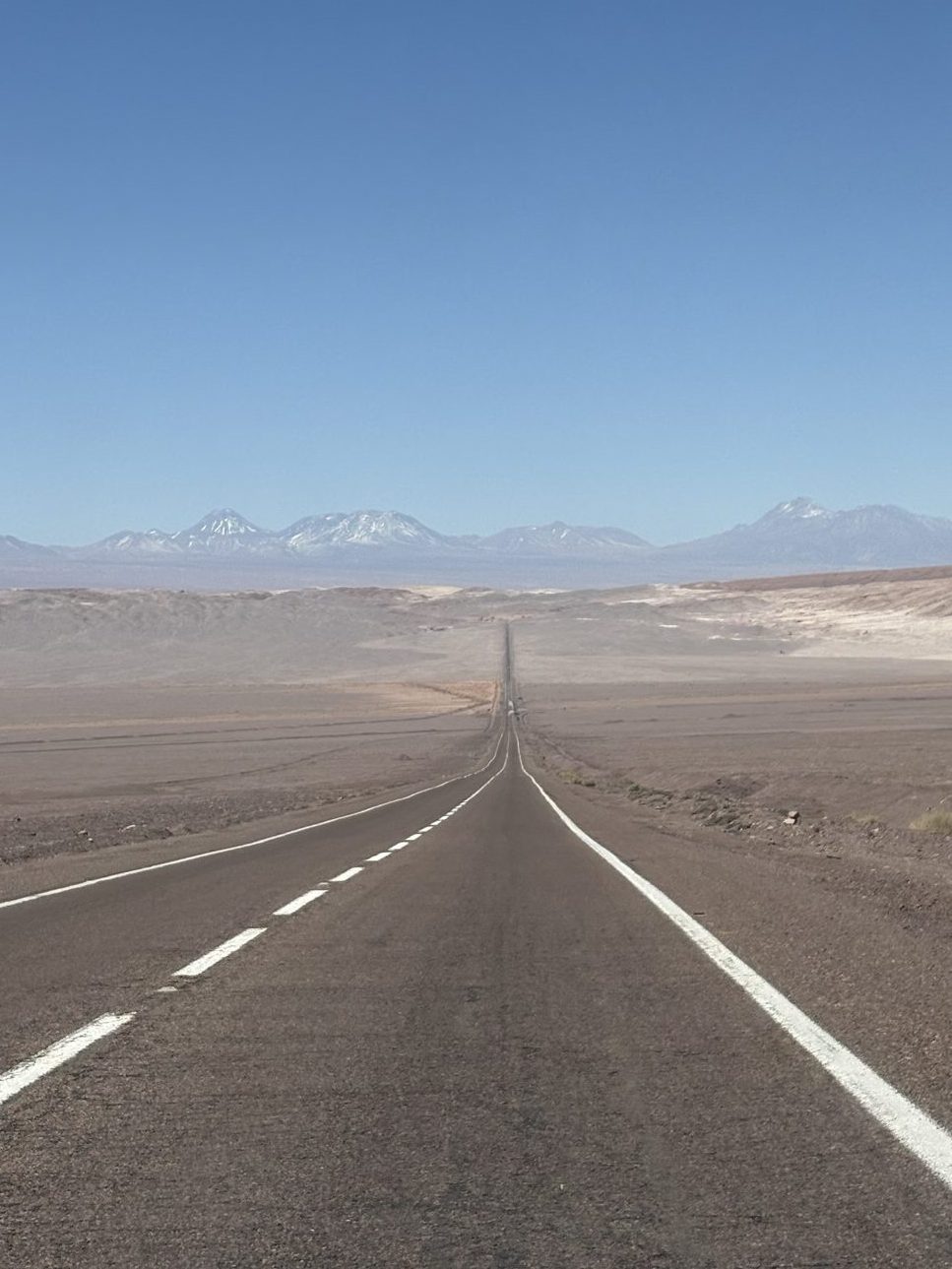
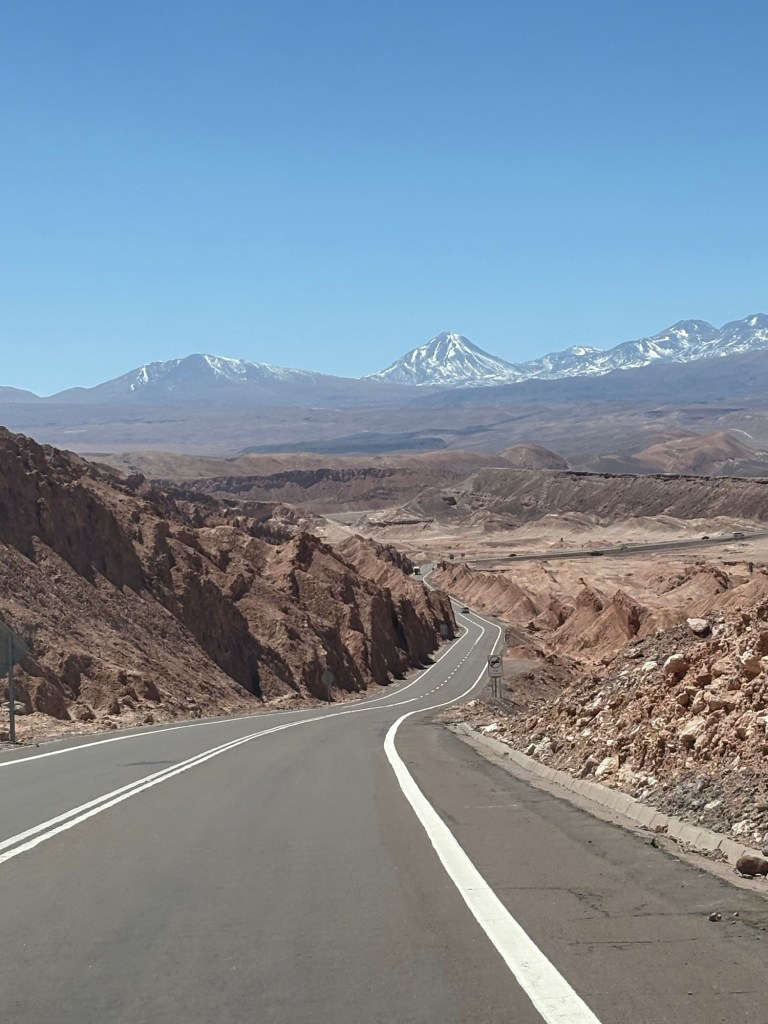
Elena drove for the first leg, and I sat in shotgun, while I think everybody else passed out in the backseat. It was just under two more hours to get to San Pedro de Atacama, and we didn’t pass a single settlement the entire time, just the occasional roadside shrine with crosses and flowers. In the distance, 6,000-meter (20,000 feet!) volcanos loomed like fallen gods.
The Atacama is the driest desert in the world, because of the combination of the rain shadow of the Andes and the anti-cyclone off the coast of Northern Chile (which I had learned in my geography class two days prior). In some places it hasn’t rained in over 500 years, or at all. Looking out of the car window, it was impossible to even imagine rain here. I don’t think we had a single day with clouds, without the sun beating down on us—though because we were up at 2,500 meters of altitude it was never sweltering. In fact, it was quite cold at night. During the day, it would depend on how high up you were; it could be hot or cold, but always incredibly dry. Your clothes would dry out on the line in under two hours.
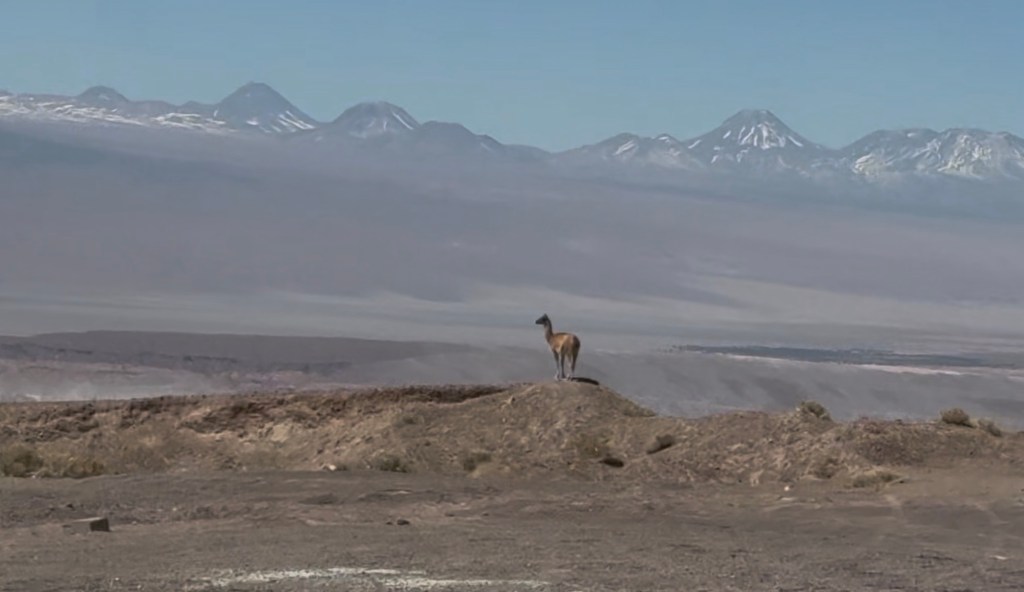
At one point, as the road snaked left and right and winded up and down, we whizzed our way through a sort of chute, with walls of rock surrounding us—and as we emerged on the other side there was a llama waiting for us, standing tall on a little butte. It was crazy luck —but as it turned out, wildlife was common here; we would go on to see alpacas, vicuñas, and flamingos.
The closer we got to San Pedro, the better the drive got; the road sloped further up and the volcanoes on the horizon were close enough that we could start to imagine they were real. By the time we were about ten minutes away, the rock formations had become simply outrageous (we were close to the Valle de la Luna, a famous part of the desert that we later explored, sort of), and there was no choice in the matter: we pulled over to a turnoff, stepped out of the car, and took a photoshoot like the tourists we were. That is, everybody but Hodei, who stayed asleep in the car.
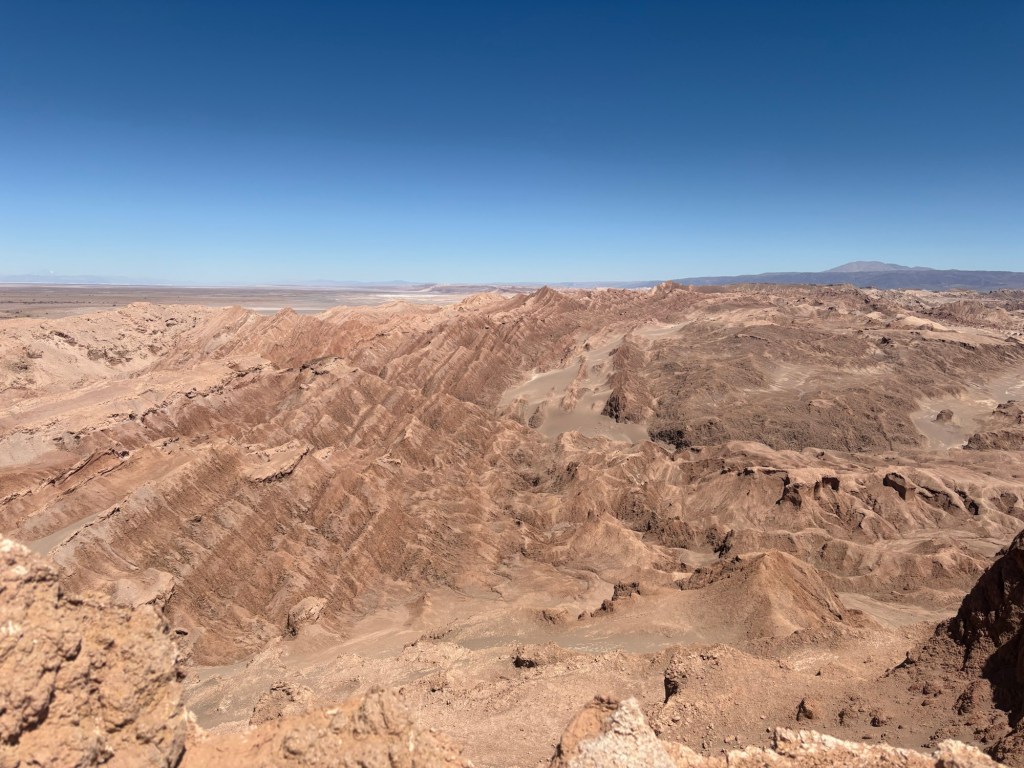
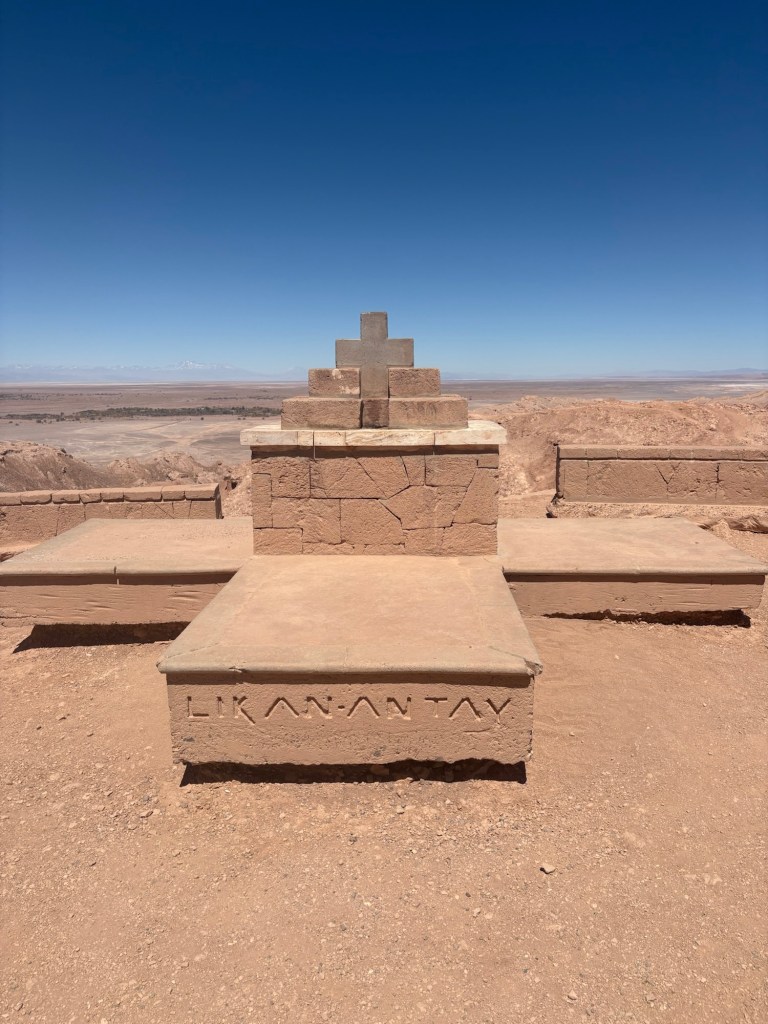
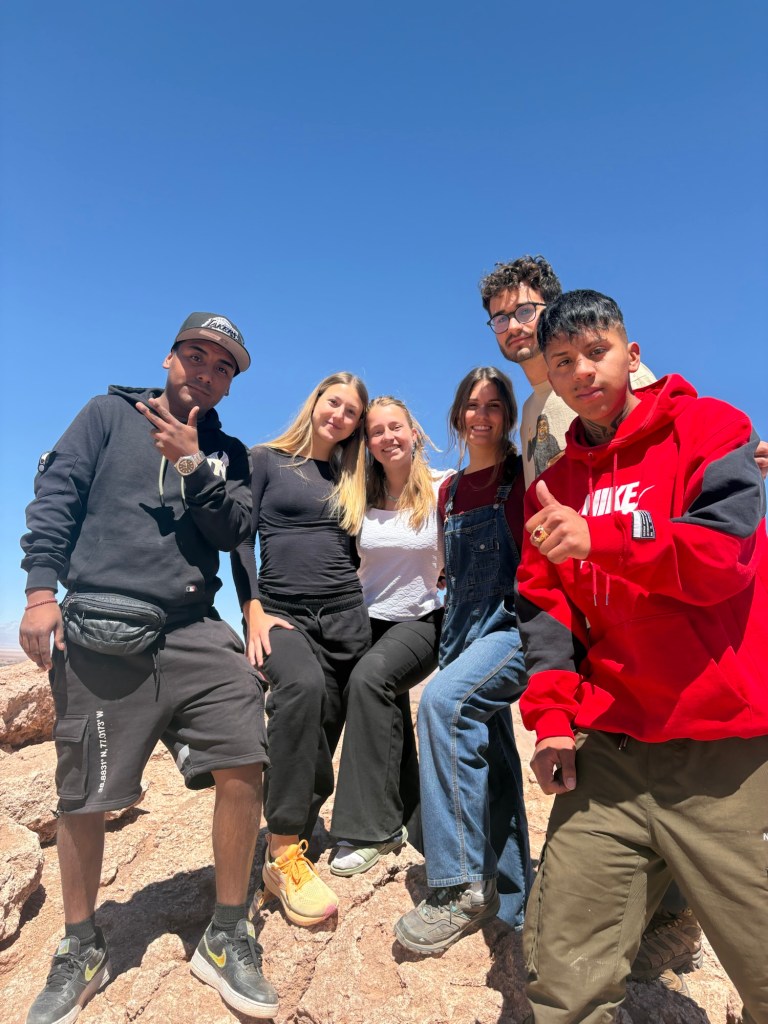
At a certain point, two guys came up to us, asking to take a picture with Mette, Anna, and Elena. We weren’t entirely sure why, though it could have been because two of them were blonde, uncommon in Chile and doubly so in the north, which was phenotypically darker than the rest of the country. At any rate, we were obviously not from Chile, which probably drew interest. They were locals, from Calama, yet like us, it was their first time going to San Pedro de Atacama, despite the towns being two hours apart. Such were the economic realities for the area— Calama is a mining town, while San Pedro is a hub for tourists, more expensive than the rest of the region.
Menu del Día:
Though when we arrived in San Pedro, tired, hungry out of our minds, we stumbled onto possibly the best culinary deal across all my time in Chile (outside of going to a feria and getting a kilo of produce for $1). As we drove in on one of the town’s dirt roads, the directions to the Airbnb wound up taking us right past a soccer field, and next to the soccer field were a bunch of little restaurants with signs for “Menu del Dia.” We didn’t hesitate. The Menu del Dia turned out to be a large starter, an entrée, and two sides for $7. And the portions were large; the starters would be like a large bowl of cazuela (a flavorful soup) or ceviche. Yes, ceviche is still good in the desert somehow—the principle I grew to adopt in Chile was if there is ceviche on the menu, you must order it.
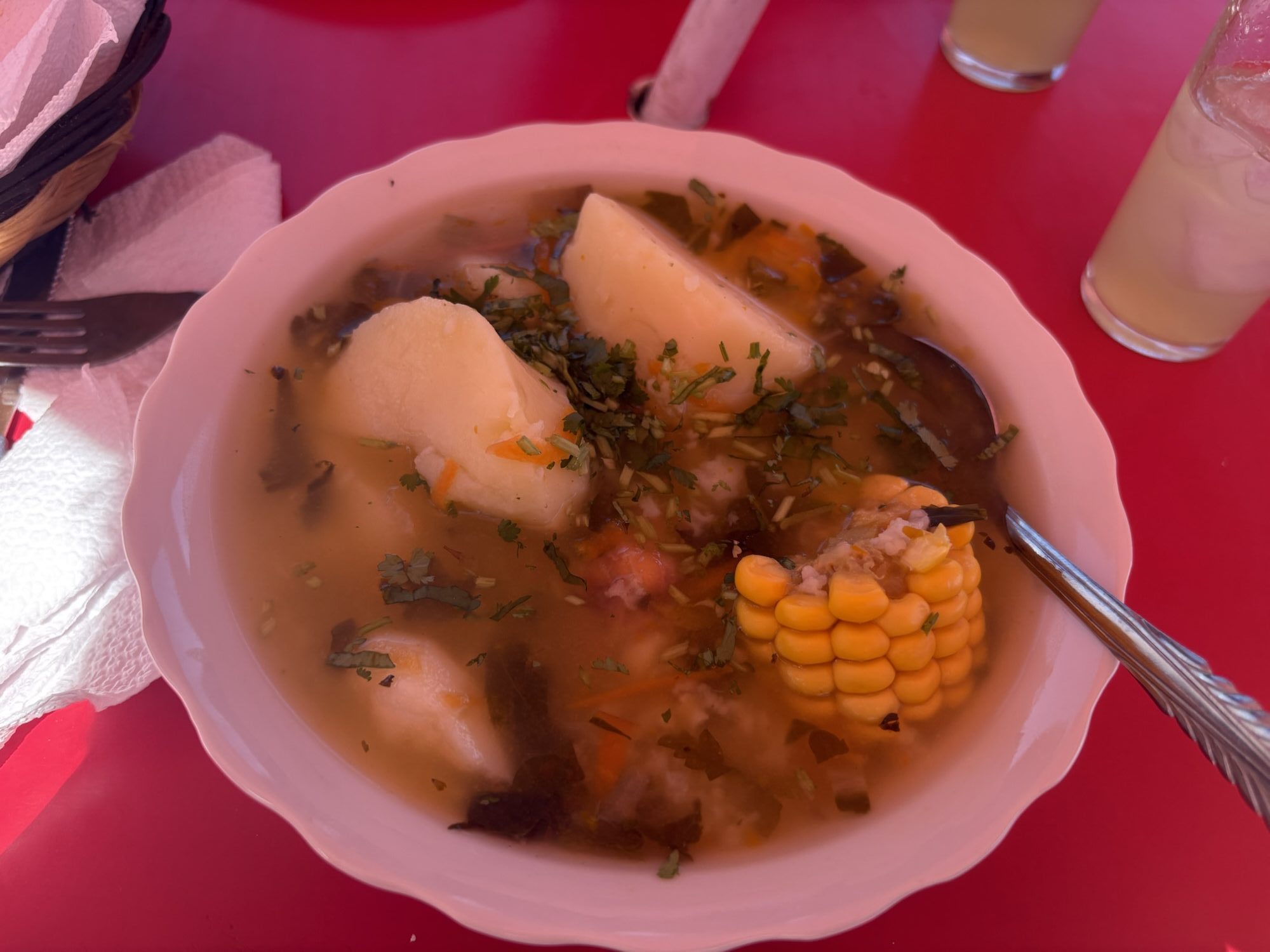
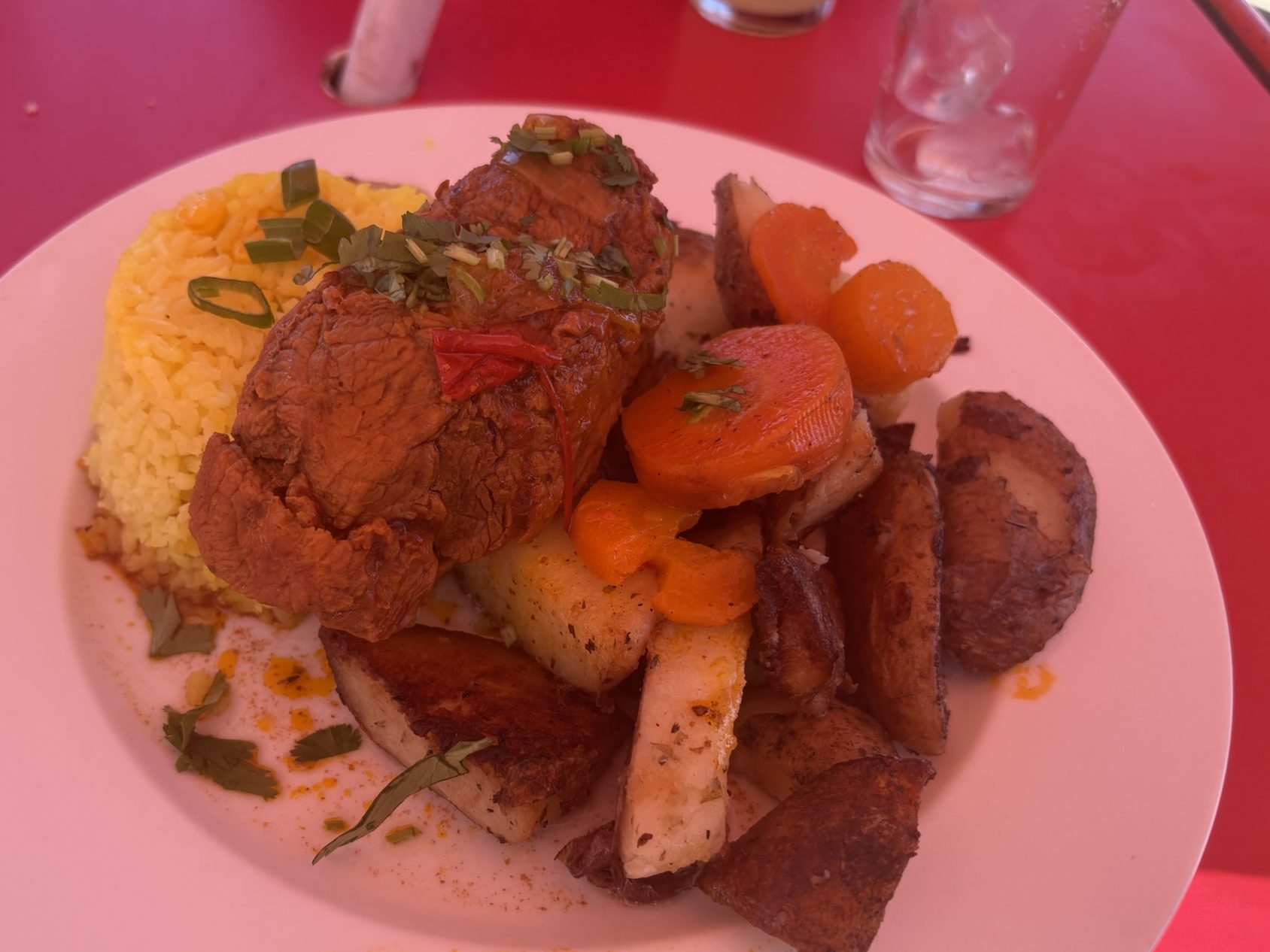
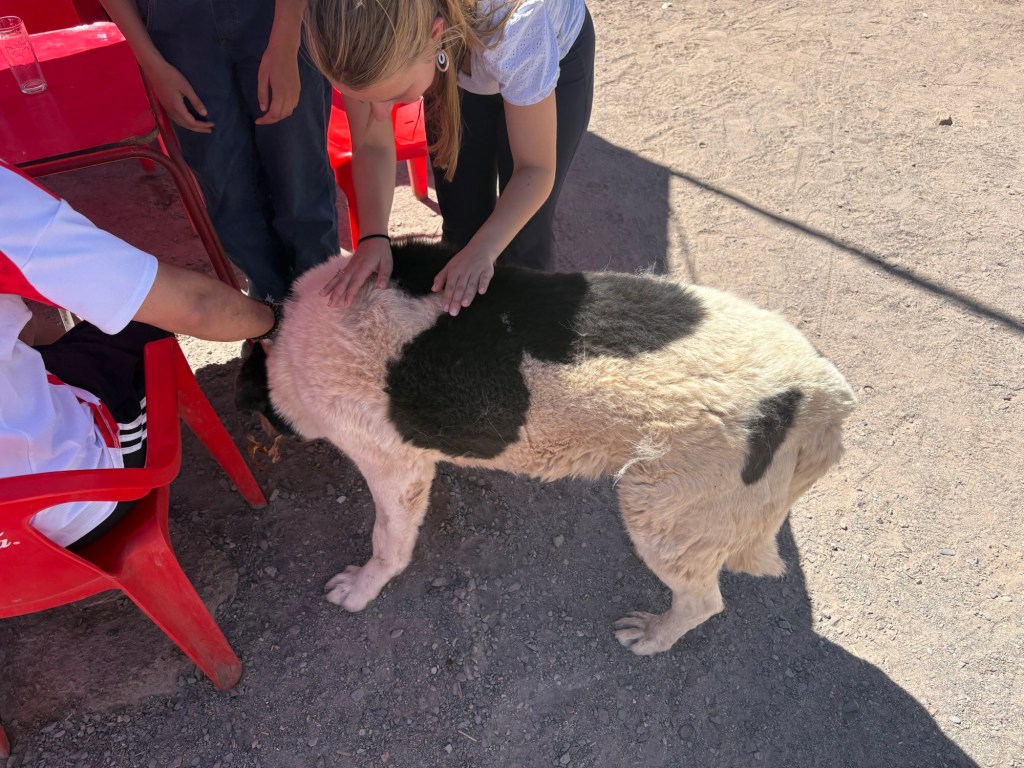
We ended up going to the Menu del Dia three times for lunch on the trip, experimenting with different entrees and combos and occasionally throwing in a beverage, like the delicious honeydew juice. It was always a phenomenal experience: we would sink into the plastic chairs, exhausted from a day of exploring; make conversation until the food arrived (for some reason, usually something foul and raunchy that garnered us looks); and then the talking would be replaced by the noises of us inhaling our lunch. Dogs would come by to be pet—or really, for food, which was why the restaurant owners would shoo them away. One time, a man stopped by with a guitar, playing a song (badly, alas) that he said was typical to the region; it sounded a lot like “El Carretero”by Buena Vista Social Club.
Airbnb:
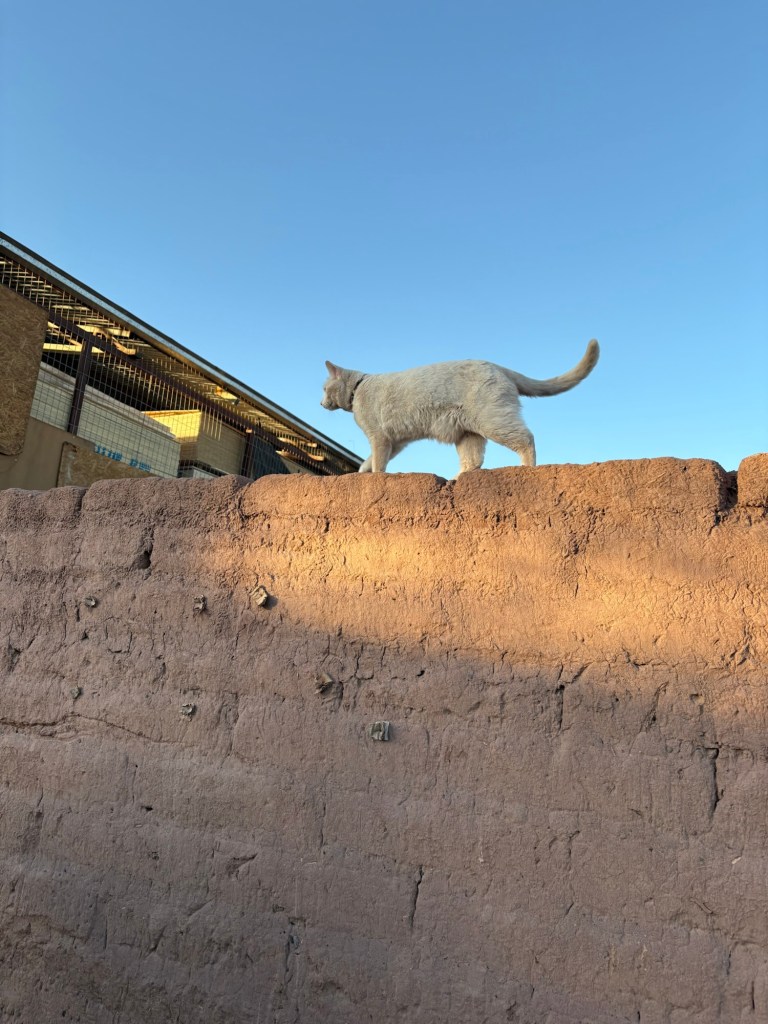
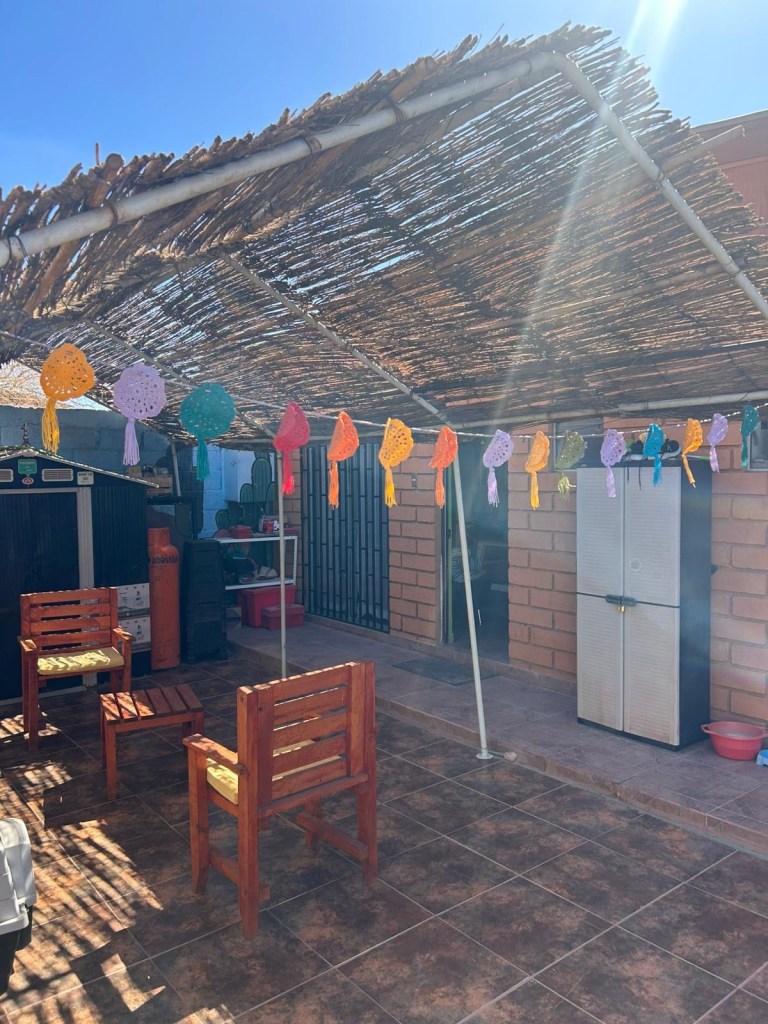
Our Airbnb was just three minutes away, a small, shared unit with the owners next door. To fit both our car and their car into the narrow driveway, we had to do some maneuvering. Usually when we came back, there would be a dog or a cat roaming, and sometimes their kids would be kicking a soccer ball.
Inside, there was just enough space for six people to exist. A bunk room for Anna, Mette, and Elena; another room for me and Hodei to share a bed (he kept waking me up in the middle of the night with strange and hilarious noises that I wanted to record but that also perturbed me enough to remain still), and space on the couch for Suditi. The shower had excellent pressure and was perfect for enjoying a post-hike beer.
Over our stay, out of sheer bad luck, we broke three dishes. Every time it happened, we sent Hodei next door to talk to them because, as a literal Spaniard, he was the most fluent in Spanish. But the first time he did, our host gave him a blank look. We all thought this was hilarious; the meme in our house that he was impossible to understand because of his quick and low way of speaking, so this only added to the legacy.
Fortunately, they were super chill about it, but we still felt bad, so one time when the kitchen sink got so clogged it just wouldn’t go down, instead of bothering them, we took the potentially disastrous course of action of trying to fix it ourselves. It was nearly overflowing; we called it a “tremendo poot caldo,” which was a combination of a few inside jokes. The main one was that poot was how Hodei pronounced “pool” for the first time in English—his English comprehension was C1 on the fluency scale, but his pronunciation couldn’t have been more than A2.
Brief tangent here: we had a lot of inside jokes, as any friend group does, but perhaps more so because Spanish was a second or third language for most of us, and we were constantly making fun of each other’s speaking capabilities. For my first month, I couldn’t open my mouth without them making fun of my gringo accent(in Chile, gringo is specifically somebody from the U.S; it’s not race-based nor does it apply to any other nationality). Furthermore, because it wasn’t our primary language, I think that inside jokes were an easy way to achieve connection despite communication barriers.
Poot, caldo, whatever you want to call it, we decided we would unclog it by unscrewing the bottom piping from the sink. The sludge that had built up below was truly unfathomable. I think I was the only one who even dared to touch it, collecting all the goop in a bucket while Mette took pots full of the upper water and dumped it into the road. It was mildly stressful but mainly hilarious doing it.
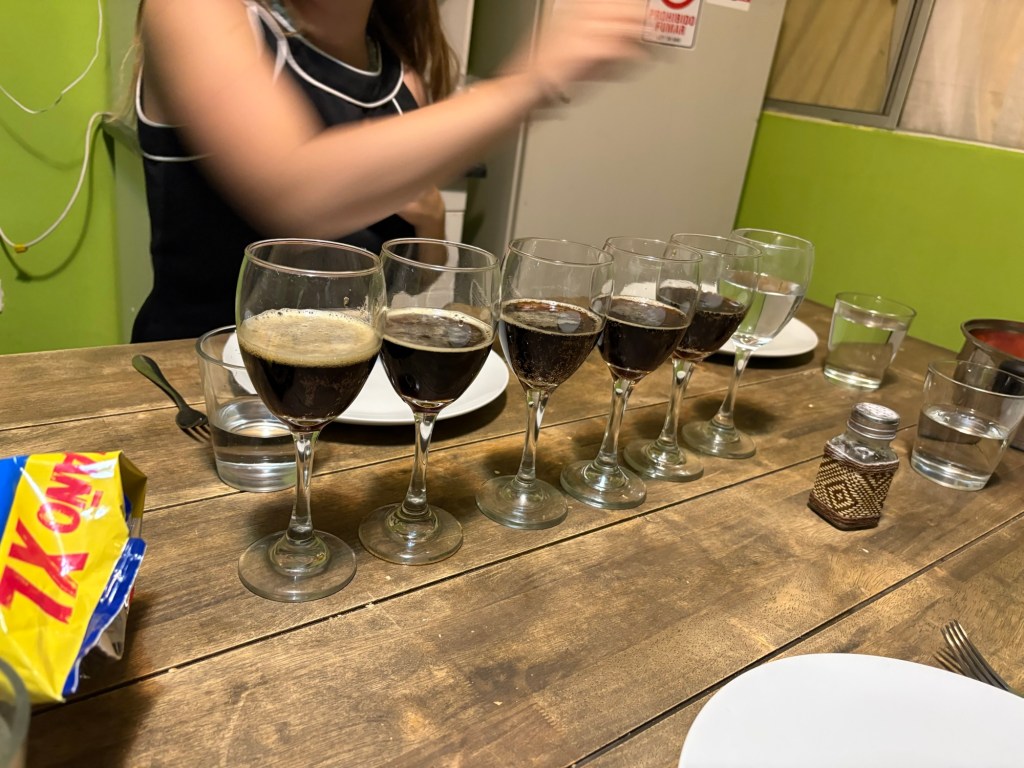
Probably because we were drunk. After every single day of exploring, we would try a new artisanal beer, just one tallboy split among five wine glasses (Elena couldn’t, as she was celiac, a tough one in Chile) but since we were at 8,000 feet of altitude that would be enough for some tipsiness. Two would have you pretty lit, all things considered. I think that helped us, honestly, with the plumbing job, because we nailed it. Afterwards, I had to wash my hands a bunch of times over, but thankfully I had a functional sink to do it in.
I think that about tells the story of the Airbnb. We stayed five days; all in all, it was a lovely spot, it was mainly a home base. Most of the stories occurred outside of it, which I’ll get to in the next posts.
Is there anything else to mention?
Permit me two more moments. One time when everybody else was gone, Mette and I had a conversation about romance and study abroad. It seemed to us that every other exchange student we had met was either: A. In a serious relationship of several years, or B. Was leaving behind a new fling that had only just begun to crystallize. Somehow the former category seemed more active in pursuing romance than the latter. We reflected on the silliness of it all.
The other thing wasn’t a moment, but rather something of note. Well, not even that, but I want to subject you to these details if you’ve made it this far. My hiking boots smelled so bad that I had to keep them far outside every day. Only later did I learn that I could take the insoles out to let them dry, which would have at least minimized the degree to which taking them off was an act of chemical warfare against the Geneva Convention.
Departure:
Of course, when we left San Pedro on the final day, we were behind schedule. Not me this time, though; I wouldn’t be flying back to Santiago with everybody else. From Calama, I would split off from my friends and go to the similarly named Caldera, a mere ten hours south of Calama by bus. I was going to visit my friends Raul and Montse to take part in some fiestas patrias activities, before taking another twelve-hour bus down to Santiago for dieciocho.
My bus was at seven, so I wasn’t moving with too much haste in the hours before we had to go, exploring the markets one last time as I tried to find a small gift for Fer (his birthday was coming up soon). I also bought myself a nice hat and re-bought the bracelet that I had lost. As I was doing this, my friends found out that their plane was an hour (or perhaps a half-hour) earlier than they had realized, and suddenly we were in quite the rush.
We had to drive two hours back to Calama and get gas and return the car and then get to the airport. Anna, of course, was our driver, as she had been for most of the trip. She’s Italian and drives like it, speeding by everything, ignoring the occasional stop sign or speed bump, and yelling cazzo, merda or va fan culo (I think I’m spelling those right) at the other drivers. She was undoubtedly a skilled driver, but I wasn’t always relaxed when she was behind the wheel.
But she was born for today’s assignment. I’ve never seen any driver so locked in. I swear we didn’t go any less than one hundred seventy kilometers per hour the entirety of the stretch, which might be only a slight exaggeration. She was passing trucks and cars like nothing. While she pulled off a lot of maneuvers that were cutting it close, I knew she had faith in her abilities, so I wasn’t too terrified—except for one when she passed into a blind turn. Luck was on our side, but if it wasn’t, I wouldn’t be alive to write this right now.
We also had six in the car, but that almost didn’t matter, because we were speeding anyway, so if there were carabineros, we were screwed regardless. We prayed they weren’t on the road and prayed we would make it and listened to Adele all the while as we hurtled back to Calama.
Thanks to Anna’s F1 abilities, we made it. They dropped me off at the hotel where it had all started. It was like Villarica all over again, with me hanging back to have my own little adventure—this time intentionally. I was excited. I love travelling with this group—we travel similarly, and nicely, together—but it’s so nice to also have your own moments to explore.
First, though, I had to make my bus, which with my prior experience, was not a given. Especially in Calama, which was the least walkable town in Chile I visited. And while I felt completely safe, as I made it to the bus station, I felt eyes on me. People were watching; I stuck out as a gringo with two bags struggling to find the bus stop—I had to double-track myself on the sidewalk like four times.
To be fair, it turned out to be a confusing situation: it was just an office, with a parking lot in the back and literally nowhere to sit. Everybody was sitting in the tiny room or on the sidewalk, so I decided I would wait somewhere better, as I had an hour and a half to kill. So I continued walking, passing a discoteca that was bumping even at six in the evening, and a rather suspect bar—no windows, with men at the outdoor tables being served by women in bikinis. Just further, though, was an ornately decorated Peruvian restaurant. I didn’t think twice.
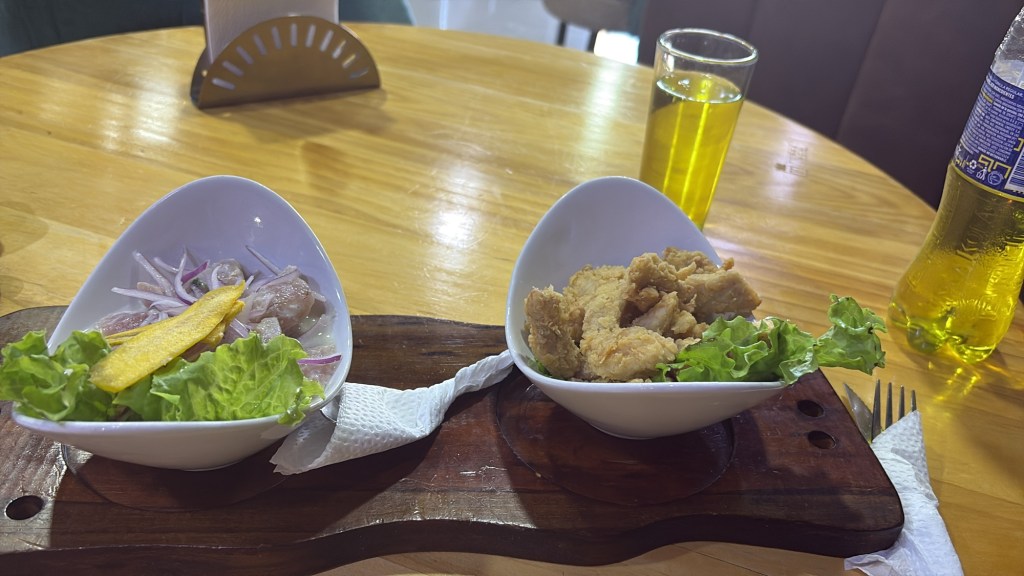
I was the only one there, and I decided to treat myself to some expensive ceviche—like the cost of three Menu del Días. It was divine. Peruvian ceviche is different, with a more spicy and complex flavor profile than Chilean ceviche. I wasn’t sure what else to do as I waited, so I called my friend Sofia from back home. She’s fluent in Spanish, and for the first time I was able to have a proper conversation with her in the language. Here it was: tangible proof that my skills had really increased.
Though I think the servers at the restaurant thought it was funny—a gringo talking in choppy Spanish to someone back home.
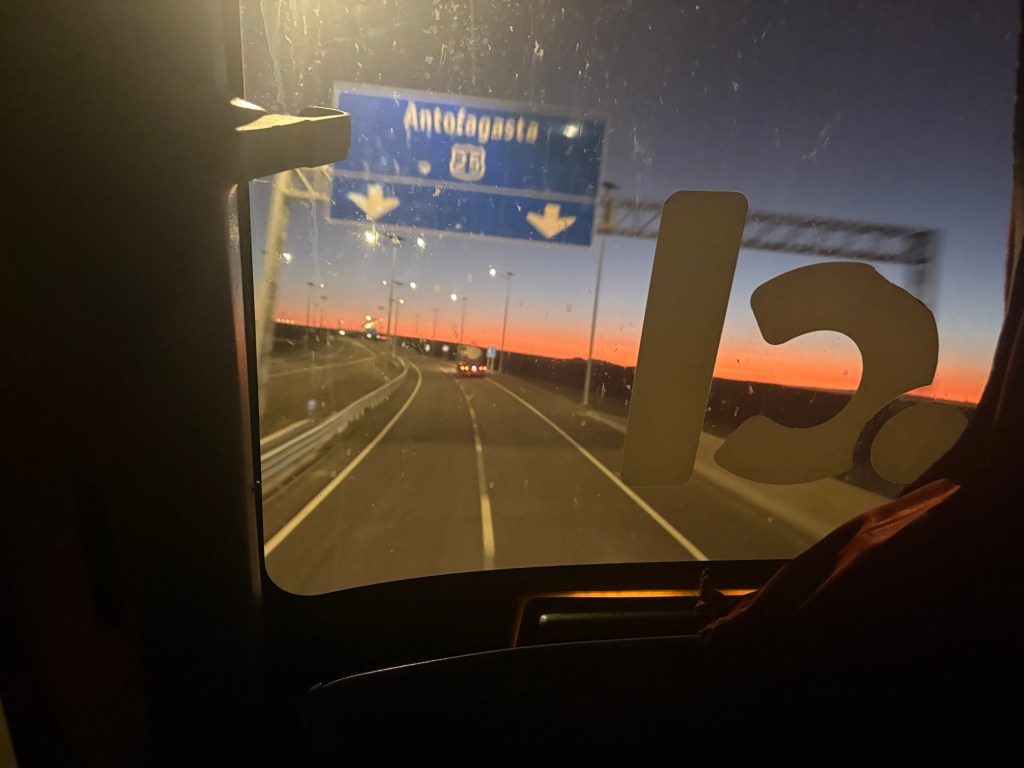
Finally, I went to go to my bus. Of course, it came late, and I had the sinking feeling that I was about to be stranded once again. But just after I had double-checked with another passenger that I was in the right place, it arrived. My seat was a comfy semi-cama in the front row of the top of the bus, the best seat in the house. We drove off—literally into the sunset. It was the perfect way to say goodbye to San Pedro.
Next up was Caldera—although you, dear reader, will have to first make it through three more posts about San Pedro.


Leave a reply to Anonymous Cancel reply