
Note: I will probably use the terms “soccer” and “football” interchangeably here, to highlight my diverse coalition of domestic and international subscribers (all 21 of you—shoutout to you utter legends).
Tuesday, September 9, 2025. Chile vs. Uruguay, World Cup Qualifiers.
I was hyped for this game for a multitude of reasons. It was my first ever international match, a qualifier for the greatest sporting event in the world. It was my first ever match in South America, so I was expecting a crazy atmosphere. And it was taking place only a few kilometers from my house in Santiago. In fact, the stadium, Estadio Nacional, was on my daily biking route to school.
It turns out, though, the Chilean national team was quite bad (and still is right now), a far cry from its Copa-America-winning squads of 2015 and 2016. Like, last place in CONMEBOL bad. Like, recently lost to Bolivia at home bad, which hadn’t happened to any country in South America in 30 years (poor Bolivia). Furthermore, it had already missed out on the World Cup, and Uruguay had already made it, so there was literally nothing on the line in this game.
Before I get to that, I should tell the story of physically getting to the game, which is probably more interesting anyway. The squad was Dylan and Hodei, two housemates, and our landlord Fer, a Chilean guy in his late thirties who was quite the character. There are a multitude of good Fer stories for another time.
Fer had decided that we should walk, which was not an insignificant stretch, about 2.5 kilometers from our house in Providencia. We probably could have taken the bus, but the weather was perfect for a stroll. Besides, it’s so refreshing to be at a stadium that doesn’t rely on car-centric infrastructure like the U.S; I still have nightmares about the hours I spent in the car waiting to get out of Dodger Stadium after Camp Flog Gnaw.
Anyway, Hodei, Dylan and I donned our newly bought Chile national team jerseys (I put the readings for my Historia social de latinoamérica class on hold) and began the walk to the corner of Avenida Salvador and Avenida Irarrázaval where we were to reunite. It was about a kilometer stretch, and we were behind schedule to meet Fer’s rendezvous time, so we had to rush. We had done this walk a few times for our pickup soccer games, and it was always stressful (as we were always running late) weaving through the throngs of families exploring artisanal shops and restaurants on Avenida Italia, a street that had quite the suboptimal ratio of pedestrian traffic to sidewalk width.
Despite our fears of tardiness, we arrived at the corner right at the same time as Fer. After dapping him up, we decided a cervezita to enjoy for the remainder of the walk wouldn’t be a bad idea—a perk of not driving. Fer ordered for us from the minimarket but took forever to choose which beer, holding up the cashier and making for a somewhat goofy interaction. I don’t remember what we ended up having, probably Escudos or Cristals.
The rest of the walk, through the calm upper-middle-class neighborhood of Ñuñoa, was pleasant. As we arrived at the stadium, making sure to down our beers before passing the carabinero (police) checkpoint, I realized that despite our initial rush, we were arriving incredibly early for the 8:30 kickoff. We were going to get there at least two hours early, which was a bit ridiculous, considering it was a Tuesday night and Dylan and I both had homework.
Fer’s insistence on arriving early, though, ended up being a good thing, because they wouldn’t let us in at the gate. In Chile, every citizen (or person with a student visa, which was impossible to obtain—I was there on the 90-day tourist visa) has a number called a RUT, which is like a social security number, except that you use it for literally everything: to get groceries, to climb at the climbing gym, to lock your bike at the campus bike depot. Us extranjeros were RUT-less, which meant that everything came down to the passport. Usually just a photo of it would suffice, and walking around with your passport all the time just isn’t the greatest idea. Today, however, Estadio Nacional had some high-level security, and nothing short of our actual passports could get us in—not even Fer’s best persuasion tactics.
As a Chilean, he was totally fine to enter, so we decided that he would go find seats while we would Uber back to the house and get the passports, undoing the forty minutes we had walked and the one dollar-ish per person we had all saved.
Our driver was chill and told me what apúrense meant when I asked Hodei (Fer had sent it in a text; it meant hurry up). Although I was shotgun, and he kept grunting right next to me in a way that was vaguely uncomfortable.
On our route back, we were suddenly getting cooked by the traffic pattern. Avenida Salvador had switched its direction again; it had a schedule that depended on the hours of the day. Across my five months in Santiago, I could never figure it out. All I knew was that when I wanted to take the bus to school, the line ran the other way, and that when I wanted it to take me downtown, it would only go towards school.
Anyway, we had to take side streets, and because everybody was getting out of work, there was un taco grande. Taco, in Chile, can refer to the Mexican dish or to the shoes (high heels or cleats) but usually it refers to a traffic jam, an example of one of the legions of chilenismos, words that only work in Chile and not in any other Spanish-speaking countries.
This taco was particularly cursed. Our traffic light stopped functioning and didn’t change for over three minutes. I knew it was out of the ordinary because there was a public safety worker on a motorcycle in front of us, not a carabinero but some sort of official, (probably from the same crew that gave us a noise citation several months later, now that I think about it) who took a picture of the stoplight on his phone.
The whole time we were waiting for the light to change, our driver was listening to this bizarre radio station. The hosts would talk about a theme for fifteen to thirty seconds, and then some heavy metal music would kick in and they’d all yell “PATA EN LA RAJA! PATA EN LA RAJA!” with an intensity worthy of Ragnarok. This happened, I kid you not, fifteen times at least, and all the while we were stuck at our red light.
At first, it wasn’t that funny. But after five or six instances of PATA EN LA RAJA, it was getting harder to not burst out laughing. The problem was that it came with just the right amount of regularity to anticipate it, but not enough to get desensitized, and soon with every PATA EN LA RAJA we were dying of laughter. Everyone except the Uber driver in the seat next to me. I felt bad that I was laughing at his chosen station, but I was powerless next to the power of PATA EN LA RAJA.
Mind you, I didn’t even know what pata en la raja meant. It turned out to be “kick in the ass.”
Finally, after what was probably twenty cycles of PATA EN LA RAJA, the light changed. With the traffic pattern, it was a bit of a maze to reach Pedro Leon Gallo, our street, but we finally arrived and rushed inside to find our passports. The taco and the light fiasco had delayed us to the point that there was no time to spare—it was an in-and-out mission. Our Uber driver had only just started to have a smoke outside, and I think he was disappointed that he wouldn’t have time to properly savor it.
The route back to the stadium was much less eventful, and we arrived at 8:05, which gave us about twenty-five minutes to get through and get food. Thank God we had left so early; I wondered what Fer had been up to in the stadium just waiting for us for over an hour.
There was some dilly-dallying on the parts of the ticket agents, but we made it in. Again, security was high, with two checkpoints and no beer being sold in the stadium (only non-alcoholic for 3.000 CLP, about three dollars).
For some reason, there was a promo going on with Lays, the chip brand, and just by standing in line we got free chips and a free Lay’s scarf. Kind of an odd souvenir, obviously worse than a Chilean flag scarf, but I’m never one to turn down getting dripped out in corporate snack memorabilia.
We probably should have rushed to our seats, but we were lured in by a shawarma truck. As soon as we ordered, we received a text from Fer who told us that “they were killing him” trying to get the seats and that “he couldn’t hold them off much longer.” When we read this, we felt like total assholes—and we were kind of being assholes, too, because we had just texted him joking that instead of coming back, we were getting sushi with the rest of the house.
Such was our relationship with Fer, though: he loved to troll us, so we would troll him back. Obviously, we had not actually gotten sushi, and as it turned out, they were not actually killing him (although, because I had yet to go to a game in Chile, I had sort of believed it at first). When we arrived at our seats, arms full of shawarma, kickoff had just begun, and we found him in a nearly vacant section.
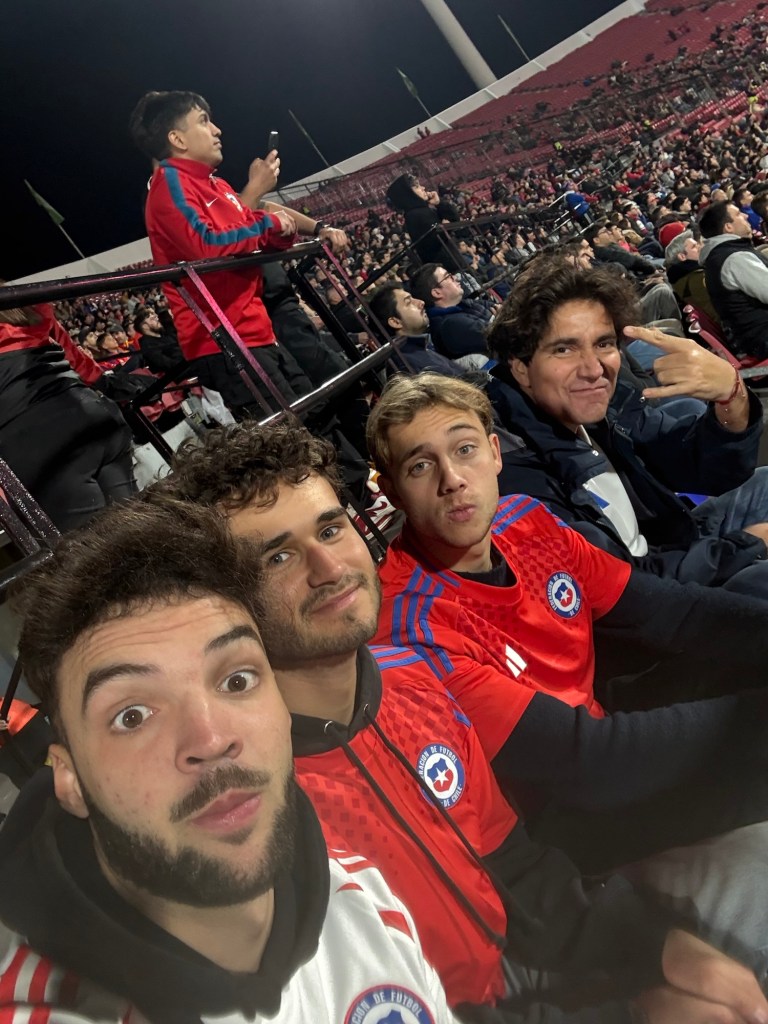
In fact, the stadium was more empty than full. I think what happened was that they had made the seats too expensive. I have no idea why. The atmosphere would have been so much better (and the stadium more profitable) if they had just sold the seats cheaper. Ours were about 30 luca (one luca is one thousand Chilean pesos, or about a dollar), which were cheaper than most, so tickets were hefty. Only the cheapest sections were anything close to full.
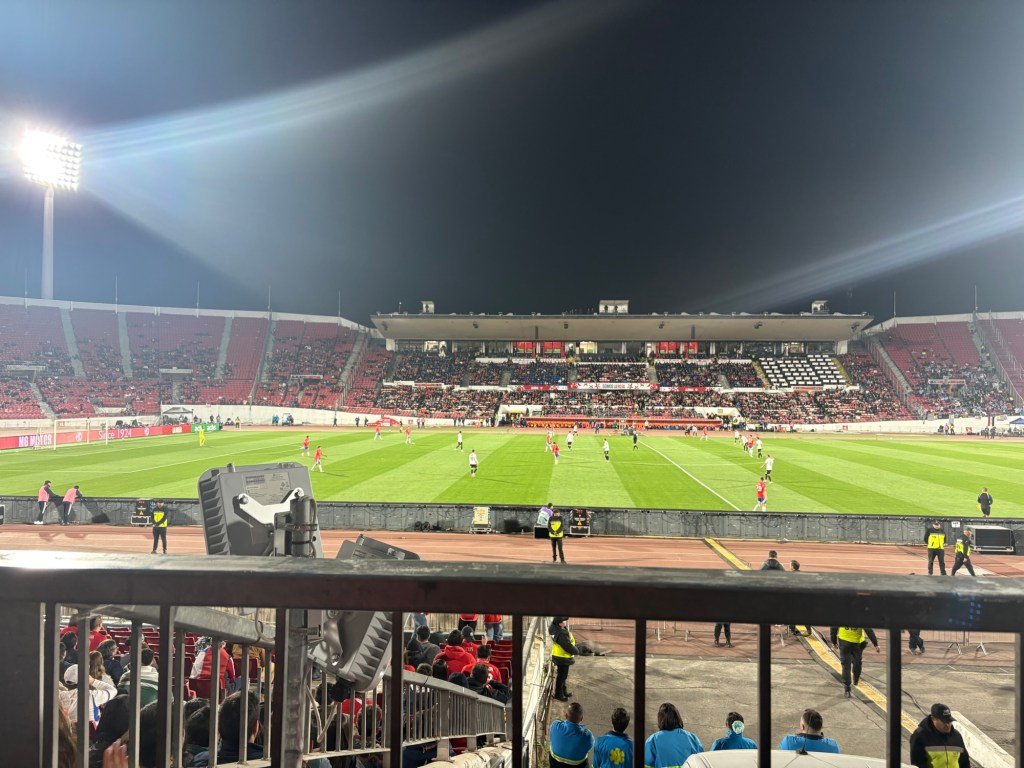
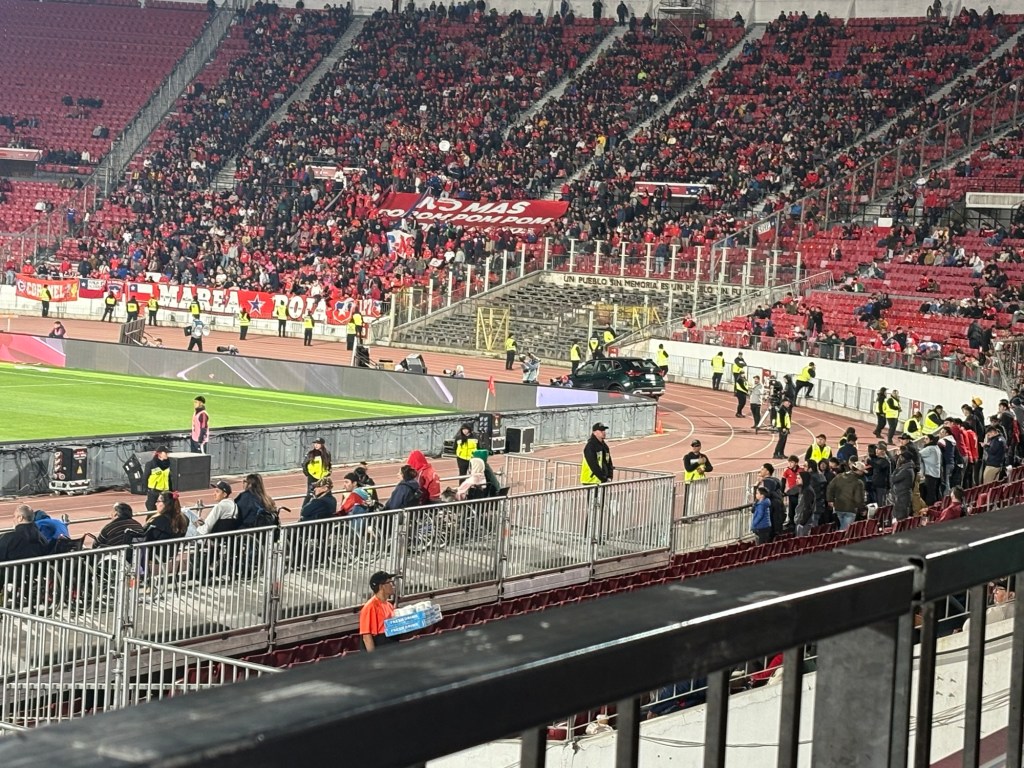
Of course, these sections were where the majority of the songs were coming from. Even at less than half-full, Chilean fans were far more passionate than ones from the United States. Songs were emanating from the stands for basically the entire game. I can only remember one of them, and only barely; it had a refrain of soy un chileeeeenooo. I remember the sensation more than the words—it sent a shiver down my spine.
The national pride involved with football, especially in Latin America, is something special. It was especially exhibited at this point in the year because of what would be going on in the upcoming week. Anticipation for Fiestas patrias, the weeklong celebration of Chile that culminated on dieciocho (September 18, like a July 4th but on steroids), buzzed in the air of almost every interaction.
Before that, though, was the upcoming Thursday, September 11, which in Chile is commemorated for a very different, but equally tragic reason: it’s the anniversary of Pinochet’s coup. Usually on this date, Chileans take to the streets of Santiago and other cities in a national day of protest.
In Estadio Nacional, where we were, there was a section that served as a grim reminder of Chile’s past. The seats were preserved from the time of the dictatorship, which lasted 1973-1990. The section reads Un Pueblo Sin Memoria Es Un Pueblo Sin Futuro, or “a people without memory are a people without a future.”
We could stand to learn a thing or two. I know Pinochet still has his fans (hello, Jose Antonio Kast, the new president) but Chile does as good a job at commemorating, recognizing, and “never again”-ing some of the dark sides of its past as any country I’ve seen.
You’ll notice I have yet to mention the game, and that’s because there wasn’t really anything worth mentioning. The best way to describe it would be fome—the chilenismo meaning boring. It was a 0-0 tie, the dreaded result of football. Sure, Chile and Uruguay got a few shots off, but nothing more. Sure, Uruguay had already qualified and Chile had already not qualified, but at least seeing something electric during the game would be nice. For my soccer fans out there, I did get to see Darwin Nuñez on the field (I almost didn’t know it was him, because of the short hair) and Marcelo Bielsa on the Uruguay sideline.
At least the fans weren’t fome. We were endlessly entertained by the fans behind us who were uttering a never-ending stream of obscenities, particularly at the Chilean centerback, a player named Maripan. Every five seconds it would be “Maripan culiao” or “conchatumadre” or an amalgamation that seemed to be just all the above: “weon Maripan culiao conchatumare weon.”
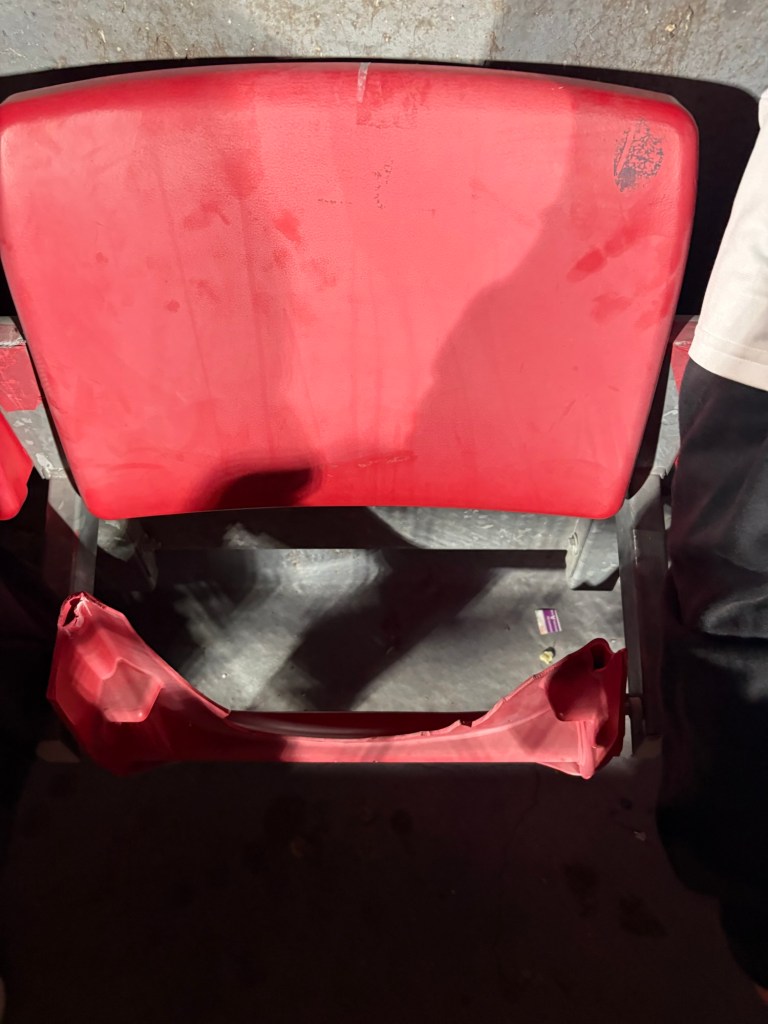
All told, perhaps this chair that Fer had inexplicably reserved for us, and that we had, inexplicably, taken turns sitting in instead of switching seats, sums it up best. It was just one of those days.


Leave a Reply