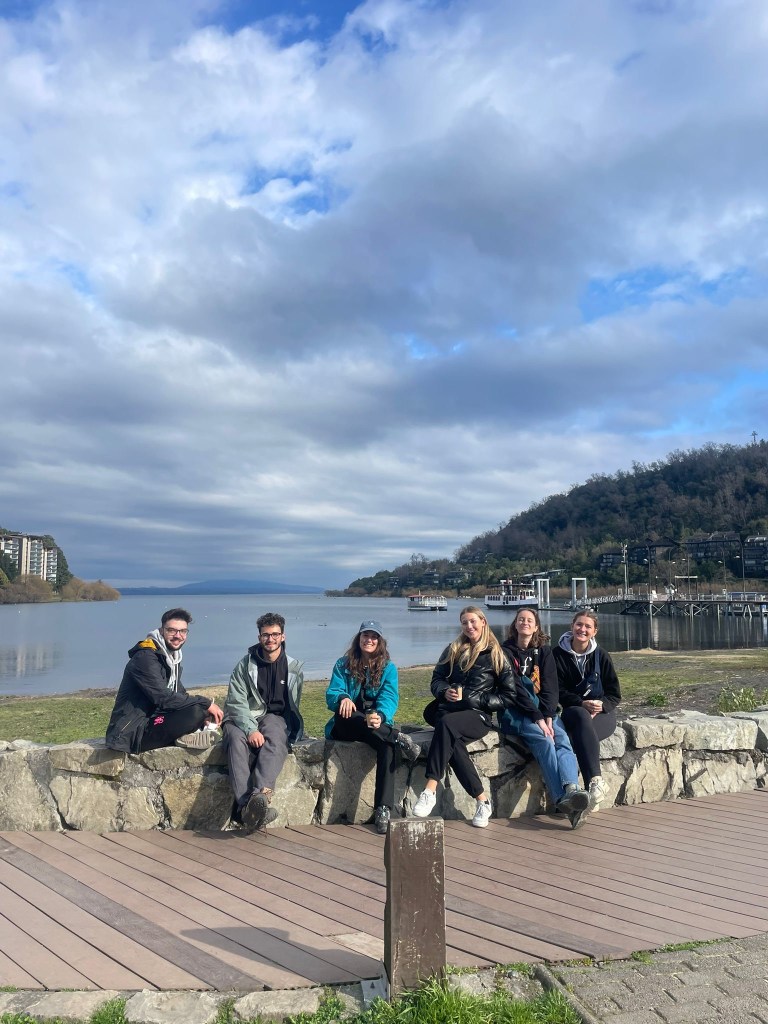
Around a month and a half ago (as you can see, I am very behind in my writing, and yet I’m surprised it was only a month and a half ago), I went on a trip with my friends to Pucón, a town in the south of Chile. It was a lovely trip with some twists and turns, although first I figure I should explain that description “in the south of Chile” because with a country so endowed in latitude, that can mean just about anything.
Pucón is in the southern half of Chile, though by no means in the southern third. Yet it’s quite far south for the part of Chile that is reasonably populated, not including the city of Punta Arenas thousands of kilometers further. Nor including the few people in between from the Aysén region, whom I know exist because my housemate Kevin is one of them.
I suppose I’ve complicated this matter more than it needed. What’s important is that it’s south of Santiago, which you can think of as the origin, or point (0,0) of Chile, if Chile were a coordinate plane with a compressed x-axis and a heavily elongated y-axis. Santiago is basically the center of everything, in geographical and especially in political and economic terms.
And again, I’ve complicated things.
What matters for the story is that it’s ten hours south by bus. We left Thursday night to arrive bright and early on the morning of August 15th, which was a feriado, or holiday, here in Chile: El Día de la Asunción de la Virgen.
The overnight buses here are quite accommodating and have become a mainstay in my adventures—as well as a source of them, as you might read in a future post. The basic seat offered is a semi cama, which is usually spacious enough, depending on the company, and reclines to 150 degrees. The salon cama, a slightly more expensive option, reclines a further ten degrees. I have yet to try the elusive full cama.
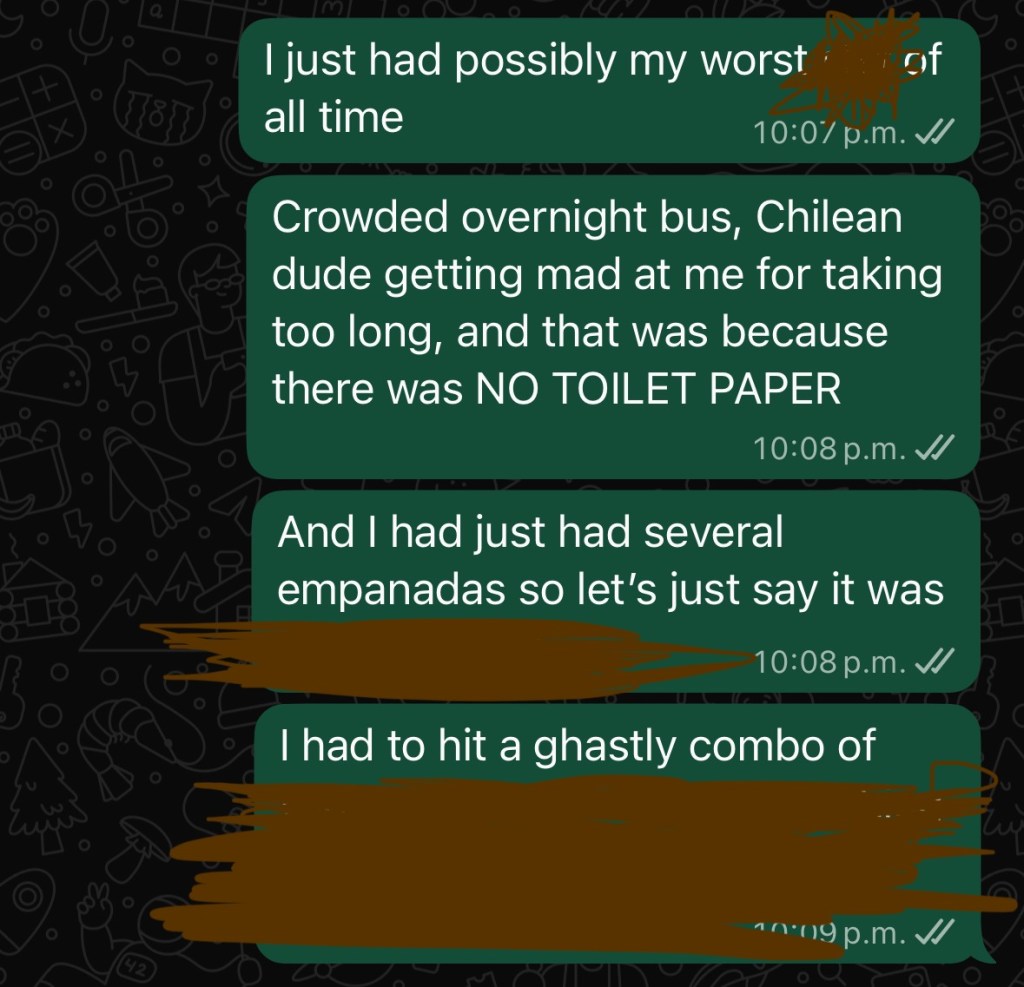
There are also bathrooms, but the toilets are strictly for urination, and they don’t stock toilet paper. If, hypothetically, you find yourself in a situation where you have learned these details too late, and a man is yelling at you to hurry up, know that there are solutions, though unseemly, available to you. Hypothetically, they would not be pleasant, especially if you had to deploy them at the very start of your trip.
Like a plane ride, or certain types of fungi, the overnight bus (the bus by day is a different matter) is teleportative in nature, although its nature is not particularly fast. You enter from the nocturnal chaos of a scrum of bodies at a busy Santiago terminal, pass ten hours in the dark—whether your curtains are drawn or not, you won’t see beyond your window—and emerge in a small town starkly different in climate, culture, and pace.

As you traverse this liminal space, you have several options to entertain yourself: reading, music, contemplating the void. The one I opted for on this particular night was sleep.
Unfortunately, sleep didn’t opt for me, and upon arrival, I was operating somewhere in between the world of the living and the world of the dead. Putting one foot in front of the other required all of what little cognition remained.
Our bus had taken us to Villarica, a bigger city (although “bigger” is quite relative) on the other side of Lago Villarica. From here, we could catch our first glimpses of the similarly named Volcán Villarica, one of 2,000 volcanoes in Chile, but among the most active. For me, the opportunity to scale this monster was the main attraction of the trip.

Pucón awaited us 30 minutes away, on the volcano side of the lake. Apparently, we could have gone straight from Santiago to Pucón without the need for the transfer, but our planning could be characterized only by its lack of anything resembling the word. Plus, when confronted with a million different bus options that all seem somewhat similar, sometimes it’s easiest to just pick the cheapest one and see what happens.
This philosophy extended to our rental car and housing selection, which we hadn’t arranged before leaving Santiago. The idea was that these things would just sort of work out.
When we did arrive in Pucón, we had to wait until 9 AM to be able to get the rental cars (at some point between last night and this morning Elena had evidently booked them), which left us with an hour and a half to kill walking around, a good portion of which we spent helping a man in a wheelchair get across town to the grocery store. With him in tow, our overfull backpacks screaming “tourist,” and numerous stray dogs trailing us, we must have made for an interesting sight for the locals on their way to work, though just as likely we could have been entirely unremarkable.
As it was, the only other locals we saw were on a construction site—where we found the man in the wheelchair—and in my hazy state every sight was interesting, and unremarkable.
The car rental office was in a luxurious, old-fashioned lakefront hotel that felt Wes Andersonesque. It’s always an interesting feeling stepping into one of these establishments when you didn’t, and will never, book a room.

While it’s obvious we didn’t belong, they didn’t stop us from exploring, so I wandered my way past the lobby, walked out the double glass doors into a courtyard that reminded me of the Breakers (that Vanderbilt mansion in Rhode Island of middle-school-field-trip fame), and jumped down the stone wall that led to the beach. I must have passed a half-hour or two sitting on the lifeguard tower with Mette, admiring the view.

There were seven of us, so we got two rental cars: a sedan and a sedan-sized pickup truck. I say “we,” but it was really Elena, Silvia, and Anna that ironed out the details; in my state I was little more than glorified ballast. But after a café trip and a double shot of espresso, I committed to the fact that I would just sleep that night, and that conversationally, today wasn’t going to be my best performance.
The Airbnb was, once again, the cheapest option possible, some turnoff along the main way out of town, deep in a forested labyrinth of dirt backroads where there were more animals than people. Mette had booked it some hours before. There was no WiFi or heat, and the wood stove lacked kindling, so we had to get creative both nights because both days we forgot to buy any. The owner’s dog was possibly the largest I’ve ever seen; he could play fetch with large rocks. Thankfully, he was quite friendly.
The first stop of the day was Ojos de Carbugua, a multi-tiered waterfall park like what I had seen in Costa Rica, except the rainforest was temperate rather than tropical. The network of paths allowed us to circumnavigate the falls and see them from at least ten different viewpoints, which probably would have been glorious to a one-year-old without object permanence. With my lack of sleep, that’s essentially what I was, so it was perfect.
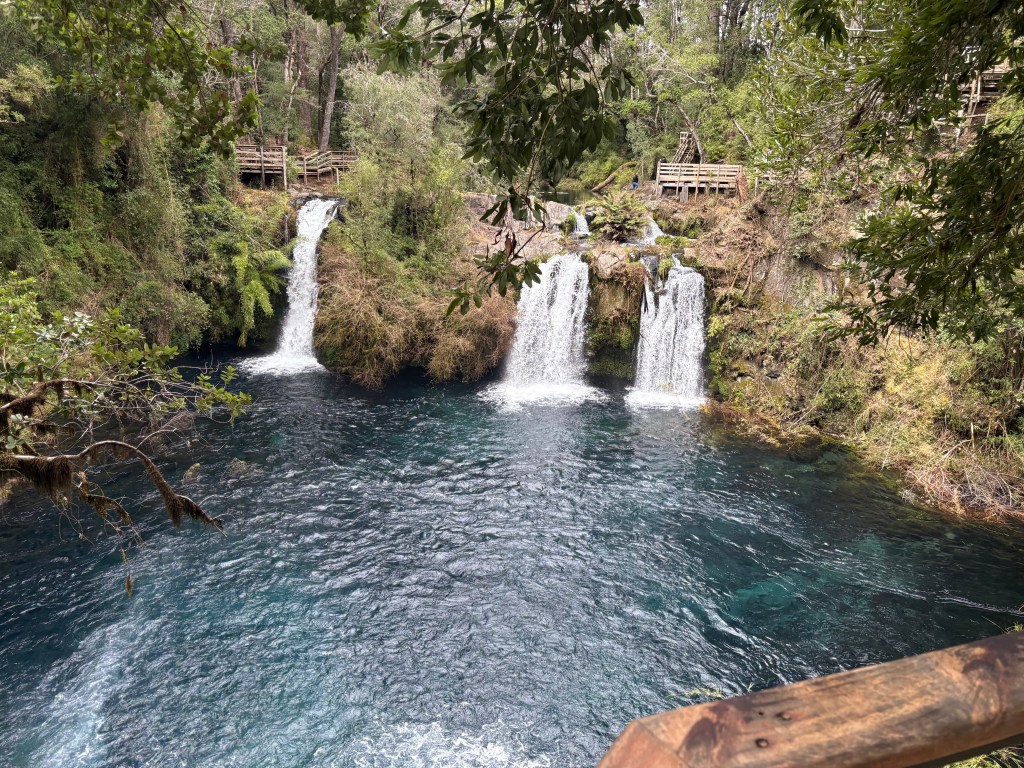
The entry was only two thousand pesos (approximately two dollars) per person, which is quite good in a country that seems to put a gate in front of every natural attraction. That’s a pessimistic, and not entirely accurate viewpoint, as there are more free things than you could see in a lifetime in Chile, but it’s true that if you want to see a lineup of heavy hitters, you’ll have to pay up at some point.
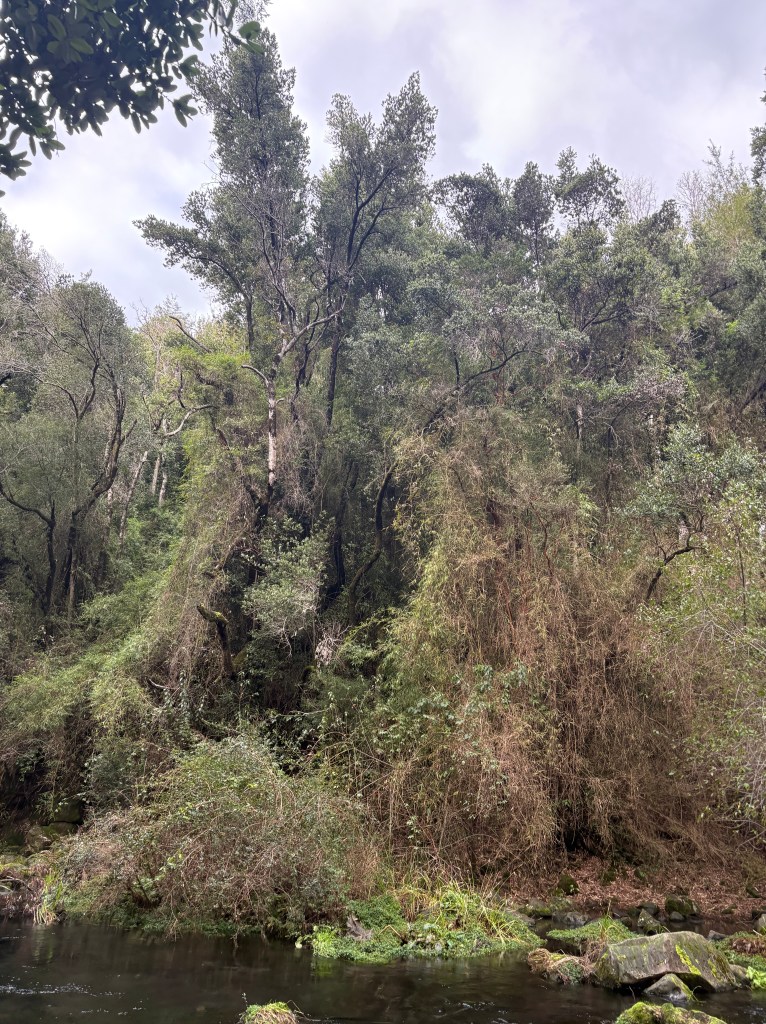
For only ten hours south, the climate had changed a lot from the dry Mediterranean scrub in the valley of Santiago. The skies were cloudy, constantly threatening rain. It was considerably colder and considerably greener, forested everywhere—a difference I noticed especially on the roads between attractions. On the drive to, say, Valle Nevado, a ski resort just east of Santiago, you’ll have an open view the entire way up. Here in Pucón, the wide-open expanses were much less frequent, making them all the more magnificent.
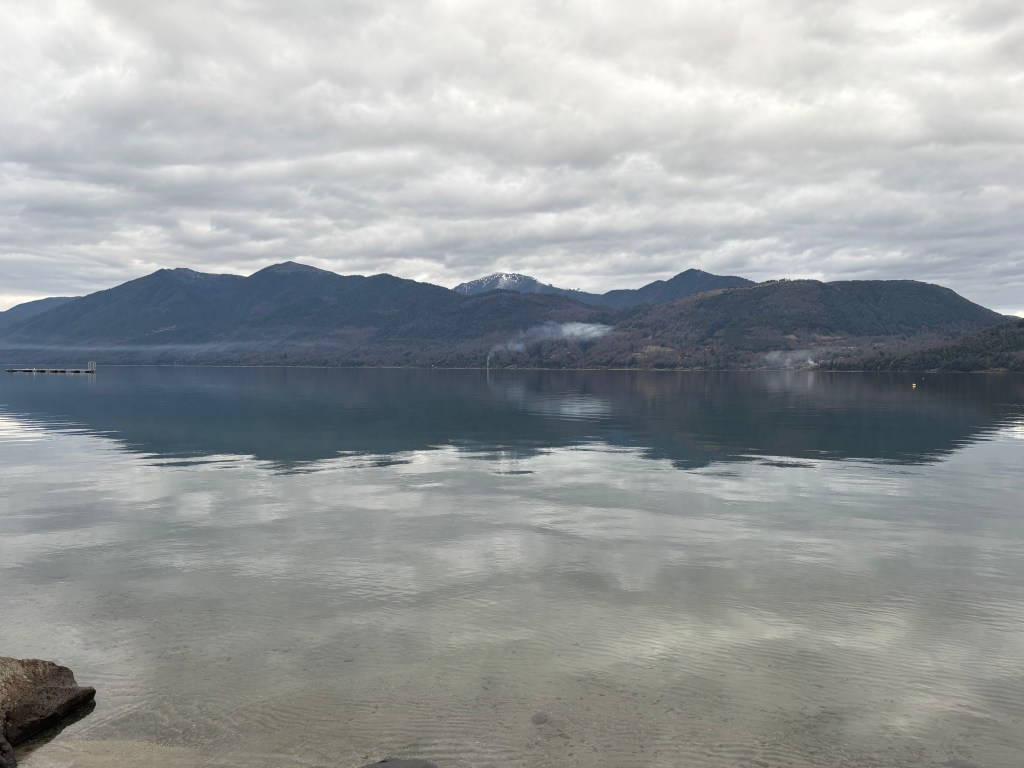
Next on the day’s menu (figuratively, of course; the literal menu, for me, was the near-twenty slices of ham that I had bought at the Lider on the outskirts of town) was Lago Carbugua.
Pucón is in what some unofficially call the Los Lagos region of Chile, hence all of the lakes. Officially, it is in the Araucanía region, which is a Mapuche word that reflects their continued presence and importance in this part of the country.
The gloom in the air lended Lago Carbugua a melancholy sort of beauty. The beach was wide and at such a gradual angle that if you wanted to submerge yourself you had to run a good twenty meters out.
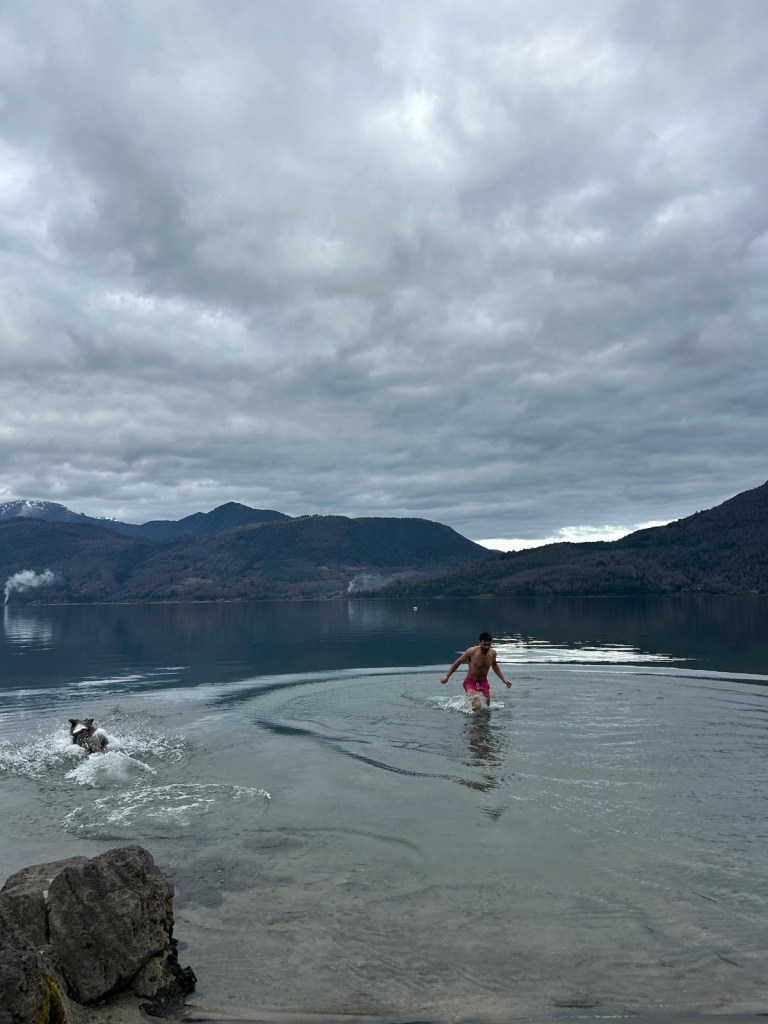
Which, of course, I did. I have a principle that if I see a lake, and if it’s not teeming with seaweed or chemicals or crocodiles, I will jump in. Despite the cold, I had to follow through for the sake of my own ethos. Although maybe I was just doing it to get the final jolt to keep me awake until we headed back to the Airbnb.
Thankfully, another principle that I have is that I never regret jumping in said lake, and today was no different. Not to get all pretentious, of course, but you do feel more alive after an icy plunge, and more connected to the nature around you besides. This principle also applies to swimming in the ocean, to going on hikes, and to buying somewhat fancy cheese.
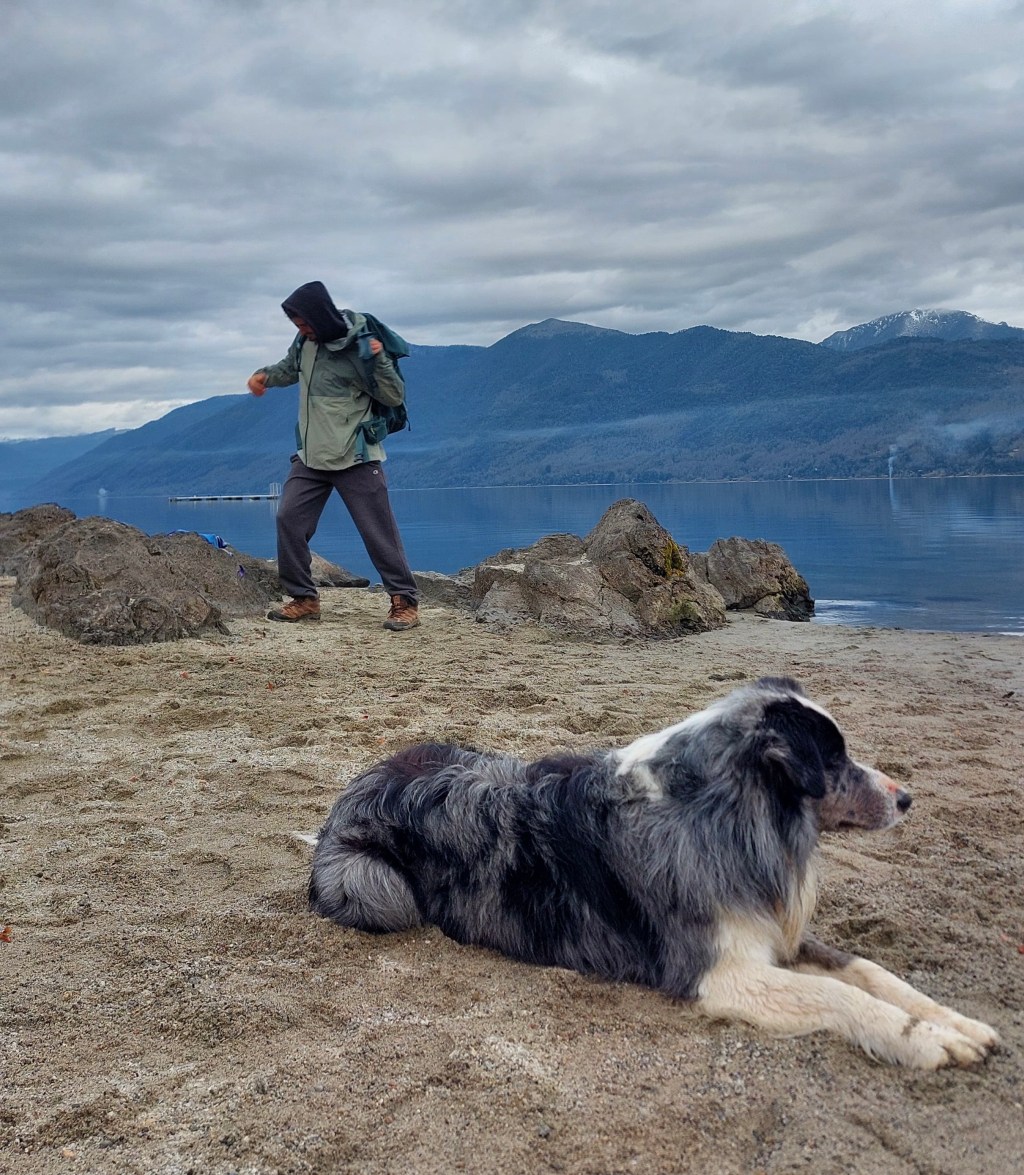
We stayed until dark. I jumped in again. We passed the time making ridiculous conversation, I’m sure. The only thing I can concretely remember is meeting perhaps my favorite stray dog that I’ve encountered in all my travels in Chile, and I have encountered a lot. His special talent was that if you tossed a stick high into the sky, he would catch it every single time. Here are some photos of us both being animals.

We returned to the Airbnb in varying degrees of exhaustion. At this point—some continuous 30-odd hours of being awake—my Spanish had entirely left me, and my English was not far behind. But I had one task ahead of me: a friend from my history class was in town, and his group had booked with an agency to summit the volcano tomorrow morning. In an Airbnb with no Wifi, on a phone without cellular service (we were in an area so rural it laughed at the idea of an E-Sim), signing up for the tour was quite the hassle. But in true buzzer-beating fashion, I succeeded, thanks to Hodei’s hotspot, just before the window closed.
A few minutes after dinner, a delicious soup that Elena had chef-ed up, I went to bed. I had to be up at 5 AM; seven precious hours, then, to try and make a dent in my sleep debt before the volcano.
Note: I think I’ve made peace with the fact that my experiences are going to vastly outpace my time, ability, and motivation to write about them. I’ve finally found a good routine that lets me write on most weekday mornings, but I’ve got a good ten or fifteen more posts in the works just to catch up to this point in the semester, and if each one is as detailed as this one, I’ll be finishing them in 2026. Maybe I’ll change things up and be less thorough—but probably not. We’ll see. Regardless, enjoy the sporadic content. Leave a comment or question below, and be sure to subscribe.


Leave a reply to Anonymous Cancel reply