Tag: study-abroad

  • Chile #8: San Pedro, Part 1: Arrival and Departure

    Chile #8: San Pedro, Part 1: Arrival and Departure

    I’m going to preface this post by saying that I don’t know what I intended when I began to write about our trip to San Pedro de Atacama, but that the end result was a Word document of 24 single-spaced pages across a dozen or so anecdotes. I’ve struggled with how to best group them into a few (likely four) blog posts, and I don’t know if I’ve found the optimal solution or not. Perhaps that doesn’t matter. This opening post is an introductory one, the story of how we got to San Pedro, of our lunches, of the Airbnb, and of leaving at the very end. The next one will be focused on a coherent arc that took place in San Pedro, while the final two will be focused on the desert beyond the town. Please forgive the fractured chronology. Don’t worry; I’m not trying to be Christopher Nolan.

    Arrival:

    We all had slightly different plans for how to manage the 5am flight, from don’t sleep until the plane, to getting in bed at 8pm the night before, but the result was that we were all, once again, horribly sleep deprived. I was running on two to three hours as we reached the Santiago airport, well before any light did.

    We were flying to Calama, the closest big town to San Pedro de Atacama, a town in the north of Chile that served as the gateway to exploring the Atacama Desert. Our two-hour flight was relaxed, with nearly no other passengers, so we sprawled out and claimed our own rows. When flying north or south in Chile (the only possible directions to fly), since the country boasts the Andes as an eastern boundary, you will almost always have some utterly glorious mountain views. Though I wanted to sleep, my interest in witnessing the sun rise above the Andes, and in seeing beyond the first layer of the cordillera for the first time, superseded it. I was particularly eager for Aconcagua, the biggest mountain in the Americas. It ended up still being night as I beheld it all, making it seem even more wild and inaccessible, like the domain of some elevated species.
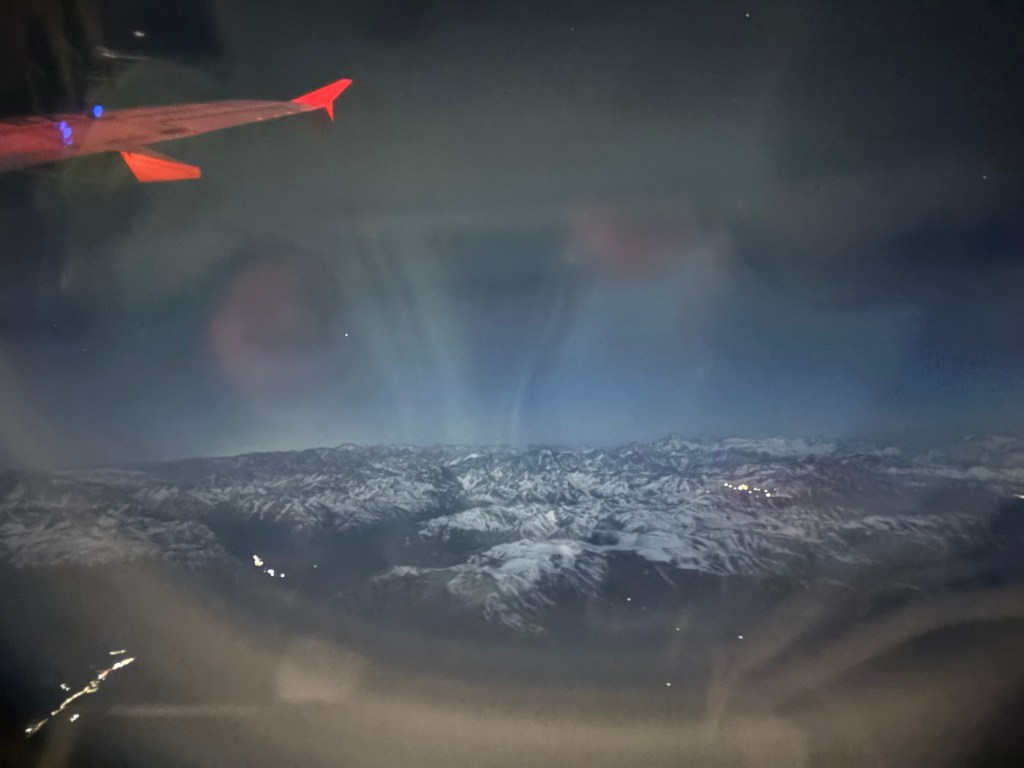
    The Andes make for one of the more definitive country borders I’ve ever seen. I hope I haven’t said that in an earlier post already.

    At some point I did drift off into sleep, but Mette woke me up just before we touched down in Calama. She pointed out the window, where I was treated to a very different view: the first light over the desert. We could have been landing on Mars.
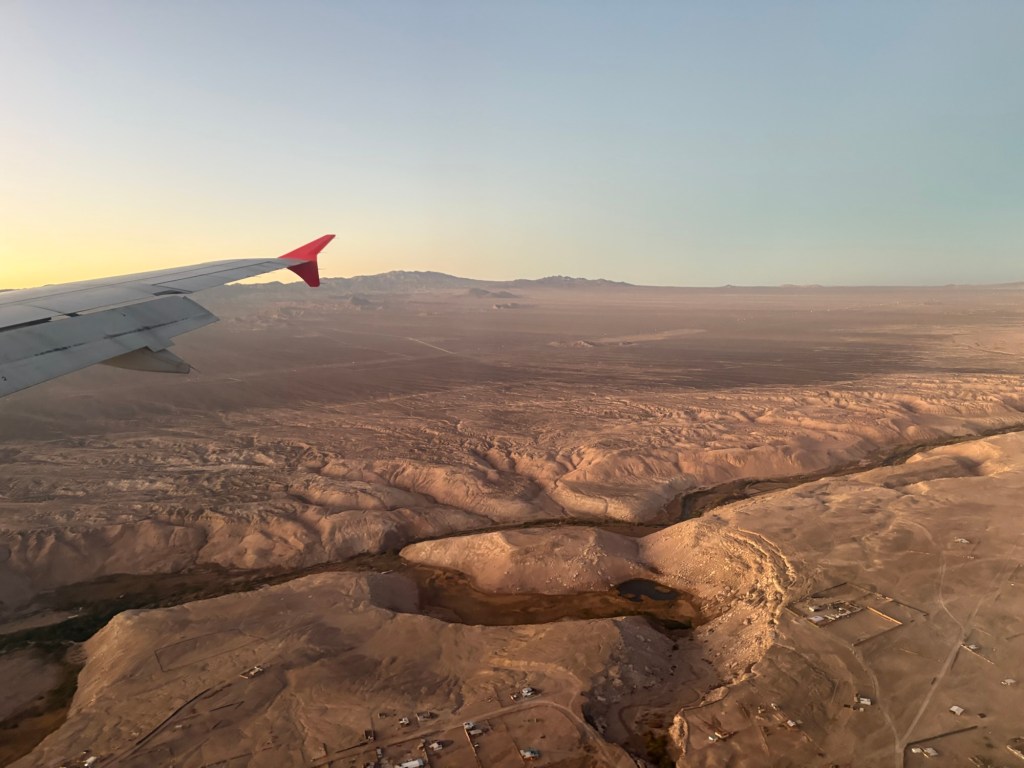
    Or on Tatooine, for that matter.

    Once again, we had tried to book the rental car the day before, but this time we had run into some trouble. Nothing seemed to line up with what we needed: September 11 to 15, cardholder under 25, automatic, and cheap. Not even Fer’s connection in Calama (it seemed he had an amigo or a primo in every hamlet of Chile and half of the ones outside of it) bore fruit. Finally, we had gotten something, but despite our early arrival, we couldn’t pick it up until 11am.

    So again, we waited in a hotel, although it couldn’t have been more different from the one in Pucón; it felt like a casino, maybe because we were in the desert and I implicitly associated it with Vegas. We arrived a good two hours before the pickup, and there was plenty of time to sleep on the couches and hope that the staff wouldn’t kick us out for being vagrants. This time around, I had made the reservation, so I handled the interaction at the front desk and was largely competent, nodding, smiling, and occasionally asking questions about the policy (and not telling her that my friend Suditi would be arriving that night, putting us up to six people in the car).

    We stopped at Jumbo, which is like the Chilean Walmart (except maybe the ratio of food to not-food is switched, and the actual Walmart-owned brand in Chile is Lider, so what am I even talking about really) and loaded up on food, as there were no supermercados in San Pedro. From everything we had heard, it was an expensive town. In the pursuit of cost-effectiveness, I got bamboozled by the classic 64 pack of Kirkland granola bars in the Internacional section, telling my friends about how clutch and how good of a deal they were. As there was no price tag, we only found out at checkout that they ended up being over $20—which ended up being the cost of three to four lunches in San Pedro.

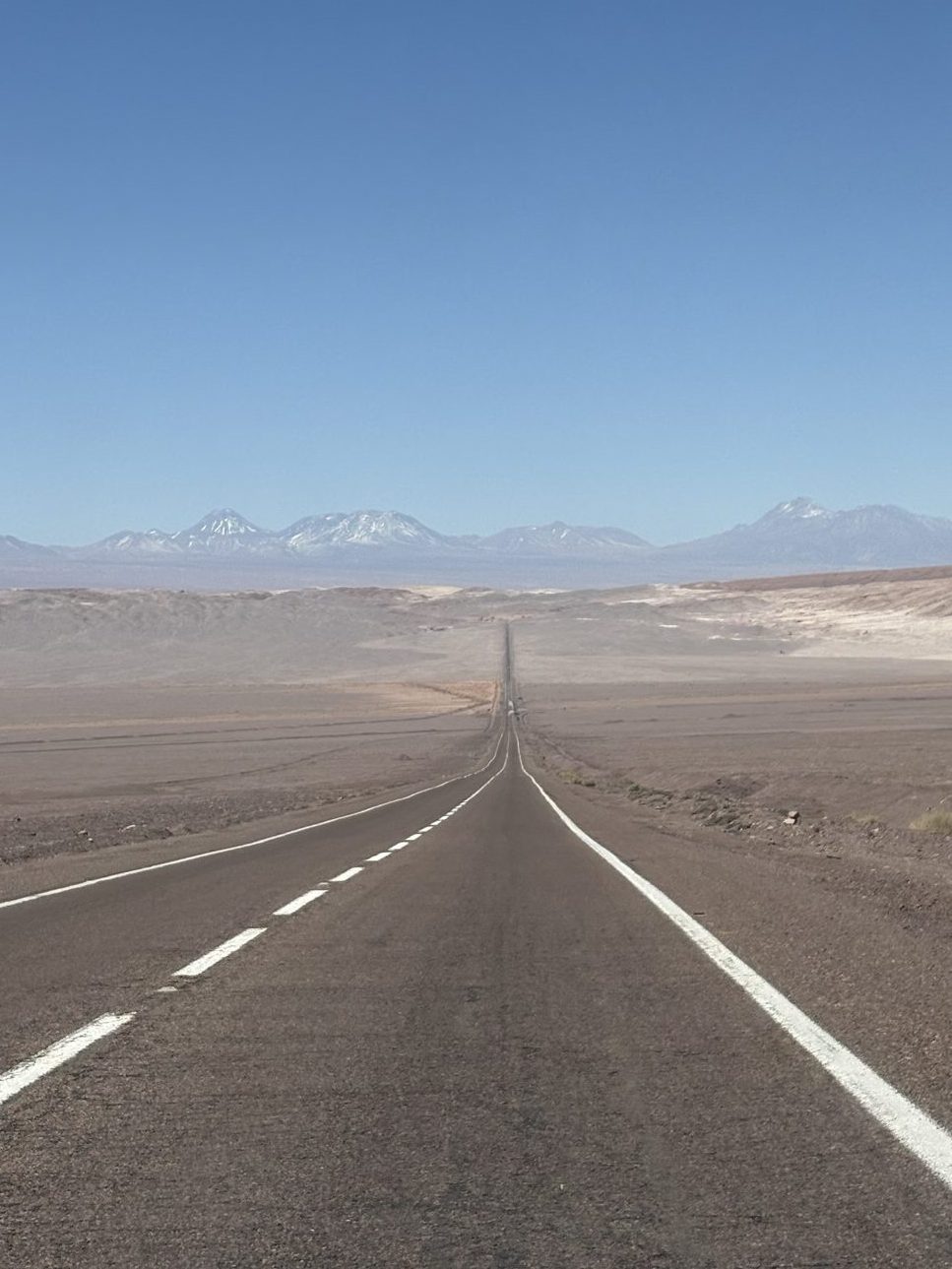
    Elena drove for the first leg, and I sat in shotgun, while I think everybody else passed out in the backseat. It was just under two more hours to get to San Pedro de Atacama, and we didn’t pass a single settlement the entire time, just the occasional roadside shrine with crosses and flowers. In the distance, 6,000-meter (20,000 feet!) volcanos loomed like fallen gods.
    I mean, like, holy shit.

    The Atacama is the driest desert in the world, because of the combination of the rain shadow of the Andes and the anti-cyclone off the coast of Northern Chile (which I had learned in my geography class two days prior). In some places it hasn’t rained in over 500 years, or at all. Looking out of the car window, it was impossible to even imagine rain here. I don’t think we had a single day with clouds, without the sun beating down on us—though because we were up at 2,500 meters of altitude it was never sweltering. In fact, it was quite cold at night. During the day, it would depend on how high up you were; it could be hot or cold, but always incredibly dry. Your clothes would dry out on the line in under two hours.

    At one point, as the road snaked left and right and winded up and down, we whizzed our way through a sort of chute, with walls of rock surrounding us—and as we emerged on the other side there was a llama waiting for us, standing tall on a little butte. It was crazy luck —but as it turned out, wildlife was common here; we would go on to see alpacas, vicuñas, and flamingos.  
    It’s a screenshot of a video (damn you WordPress Premium) so the quality isn’t great.

    The closer we got to San Pedro, the better the drive got; the road sloped further up and the volcanoes on the horizon were close enough that we could start to imagine they were real. By the time we were about ten minutes away, the rock formations had become simply outrageous (we were close to the Valle de la Luna, a famous part of the desert that we later explored, sort of), and there was no choice in the matter: we pulled over to a turnoff, stepped out of the car, and took a photoshoot like the tourists we were. That is, everybody but Hodei, who stayed asleep in the car.
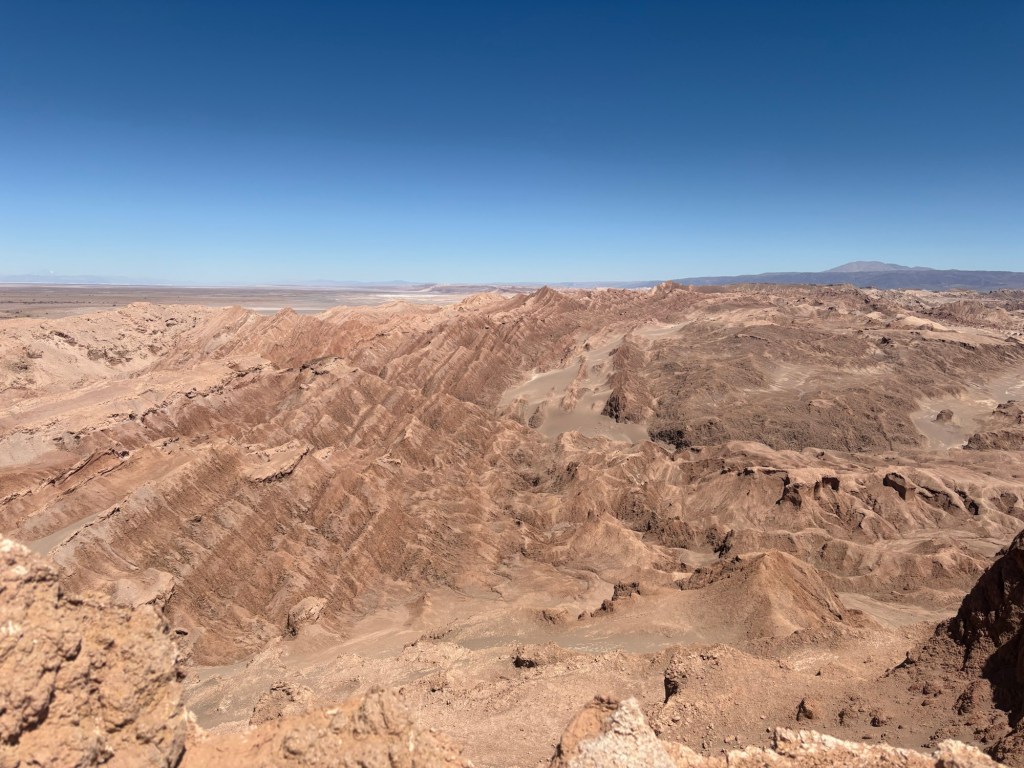
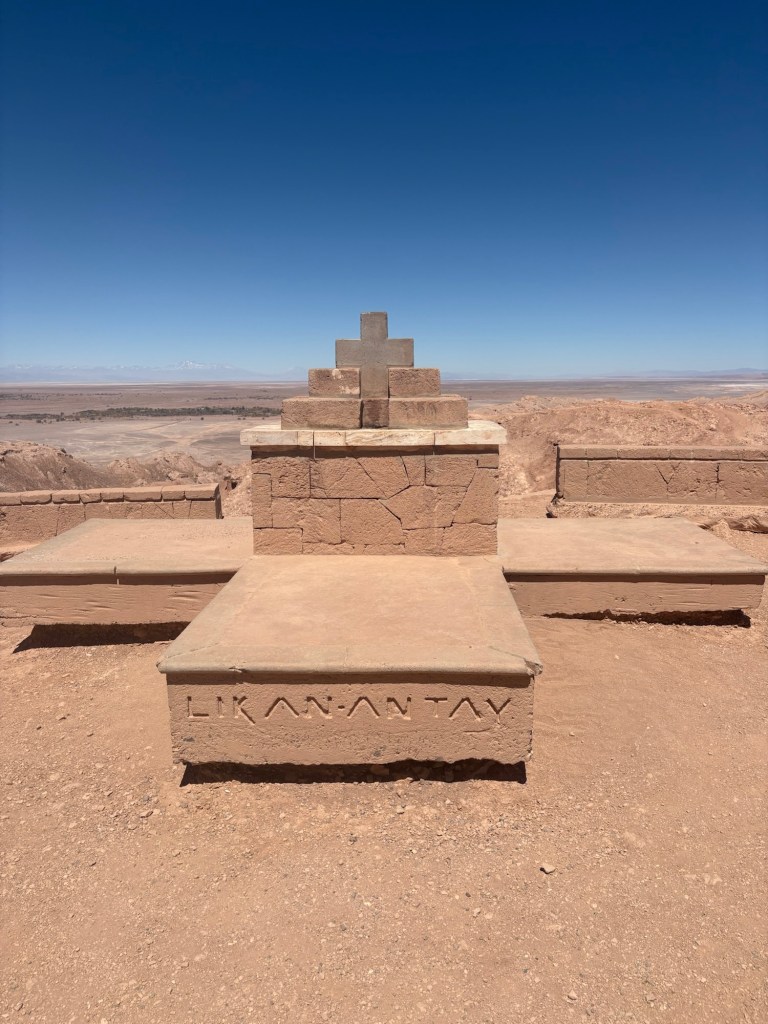
    “Otherworldly” is so cliché when talking about the desert, but what else do you call this???
    I wish I knew the lore about this monument, but I don’t.

    At a certain point, two guys came up to us, asking to take a picture with Mette, Anna, and Elena. We weren’t entirely sure why, though it could have been because two of them were blonde, uncommon in Chile and doubly so in the north, which was phenotypically darker than the rest of the country. At any rate, we were obviously not from Chile, which probably drew interest. They were locals, from Calama, yet like us, it was their first time going to San Pedro de Atacama, despite the towns being two hours apart. Such were the economic realities for the area— Calama is a mining town, while San Pedro is a hub for tourists, more expensive than the rest of the region.
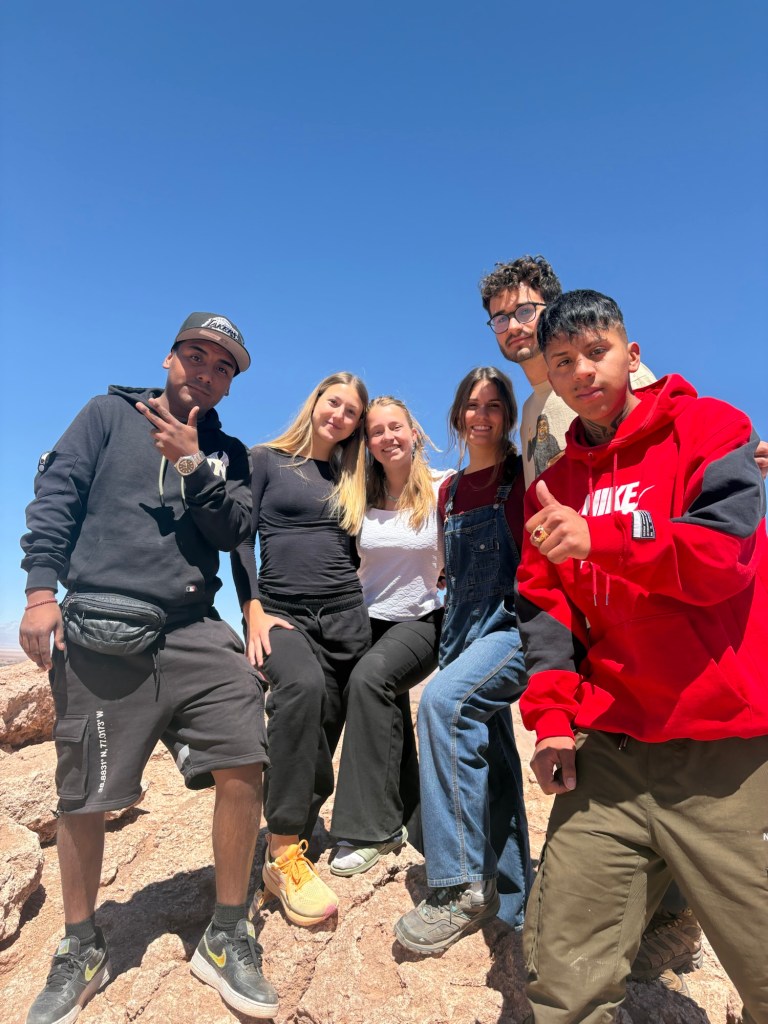
    I got in the photo too, which I don’t think they wanted, to be honest.

    Menu del Día:

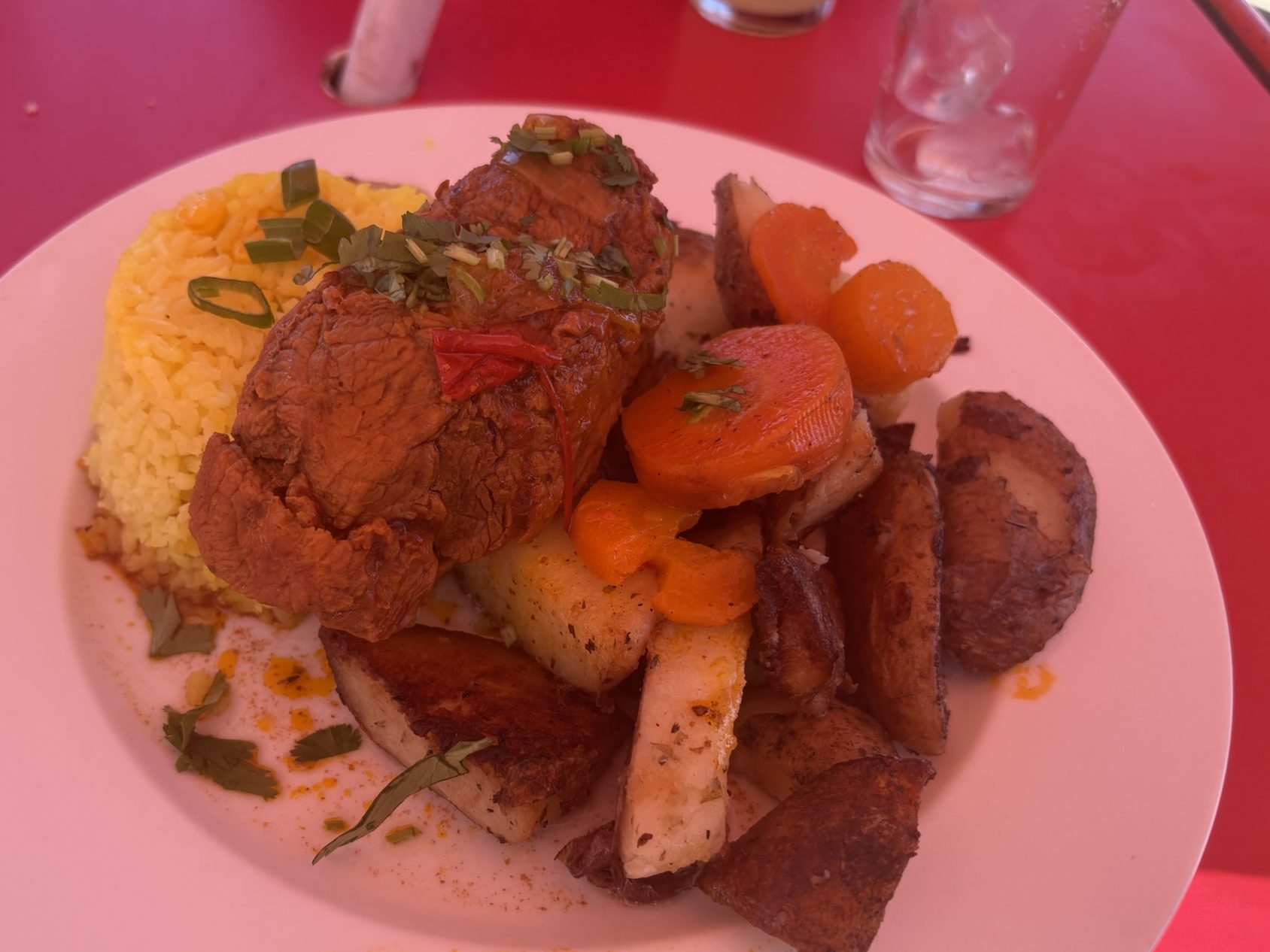
    Though when we arrived in San Pedro, tired, hungry out of our minds, we stumbled onto possibly the best culinary deal across all my time in Chile (outside of going to a feria and getting a kilo of produce for $1). As we drove in on one of the town’s dirt roads, the directions to the Airbnb wound up taking us right past a soccer field, and next to the soccer field were a bunch of little restaurants with signs for “Menu del Dia.” We didn’t hesitate. The Menu del Dia turned out to be a large starter, an entrée, and two sides for $7. And the portions were large; the starters would be like a large bowl of cazuela (a flavorful soup) or ceviche. Yes, ceviche is still good in the desert somehow—the principle I grew to adopt in Chile was if there is ceviche on the menu, you must order it.
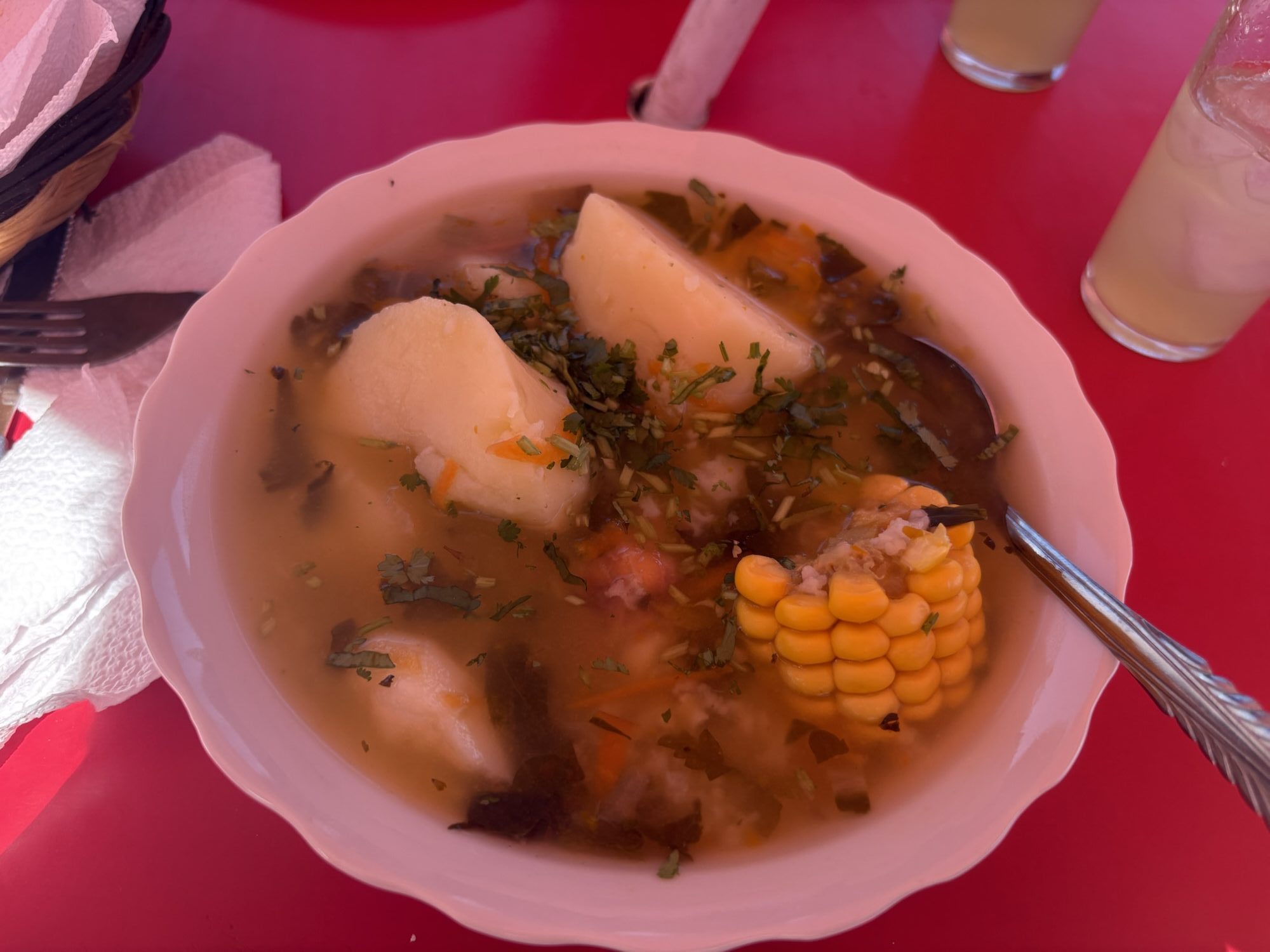
    Cazuela: so good, although the one my friend Montse’s mom made was better.
    Carne jugoso. This with the cazuela was $7, not a bad deal at all.

    We ended up going to the Menu del Dia three times for lunch on the trip, experimenting with different entrees and combos and occasionally throwing in a beverage, like the delicious honeydew juice. It was always a phenomenal experience: we would sink into the plastic chairs, exhausted from a day of exploring; make conversation until the food arrived (for some reason, usually something foul and raunchy that garnered us looks); and then the talking would be replaced by the noises of us inhaling our lunch. Dogs would come by to be pet—or really, for food, which was why the restaurant owners would shoo them away. One time, a man stopped by with a guitar, playing a song (badly, alas) that he said was typical to the region; it sounded a lot like “El Carretero”by Buena Vista Social Club.
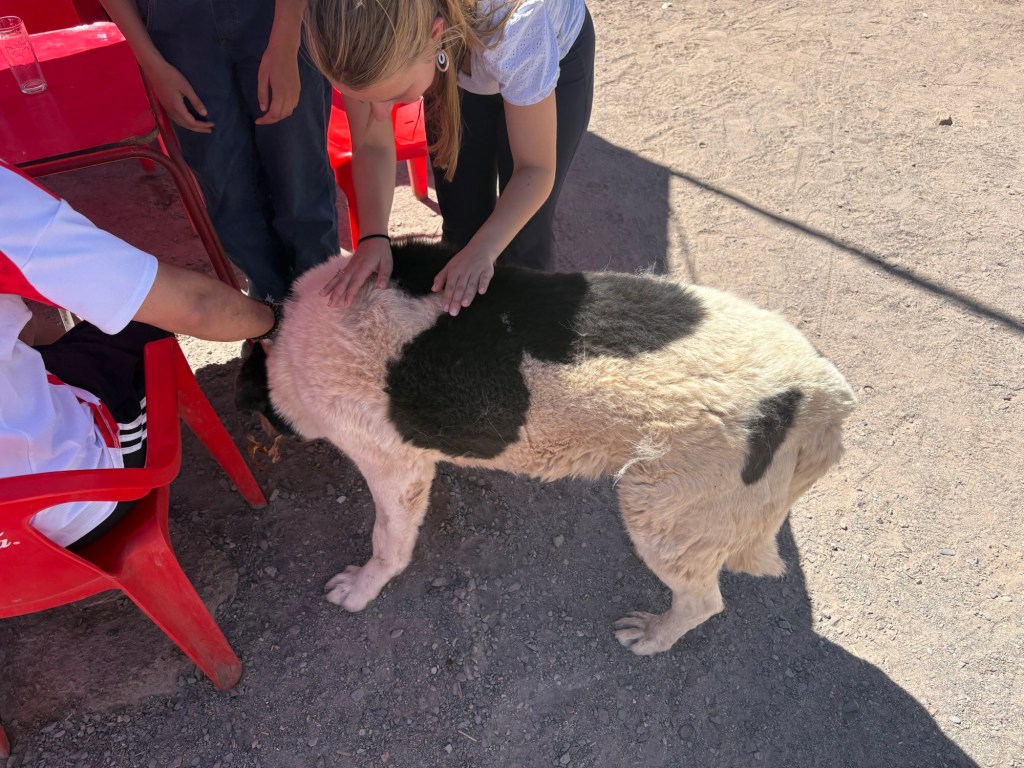
    Dog, or cow?

    Airbnb:

    Our Airbnb was just three minutes away, a small, shared unit with the owners next door. To fit both our car and their car into the narrow driveway, we had to do some maneuvering. Usually when we came back, there would be a dog or a cat roaming, and sometimes their kids would be kicking a soccer ball.
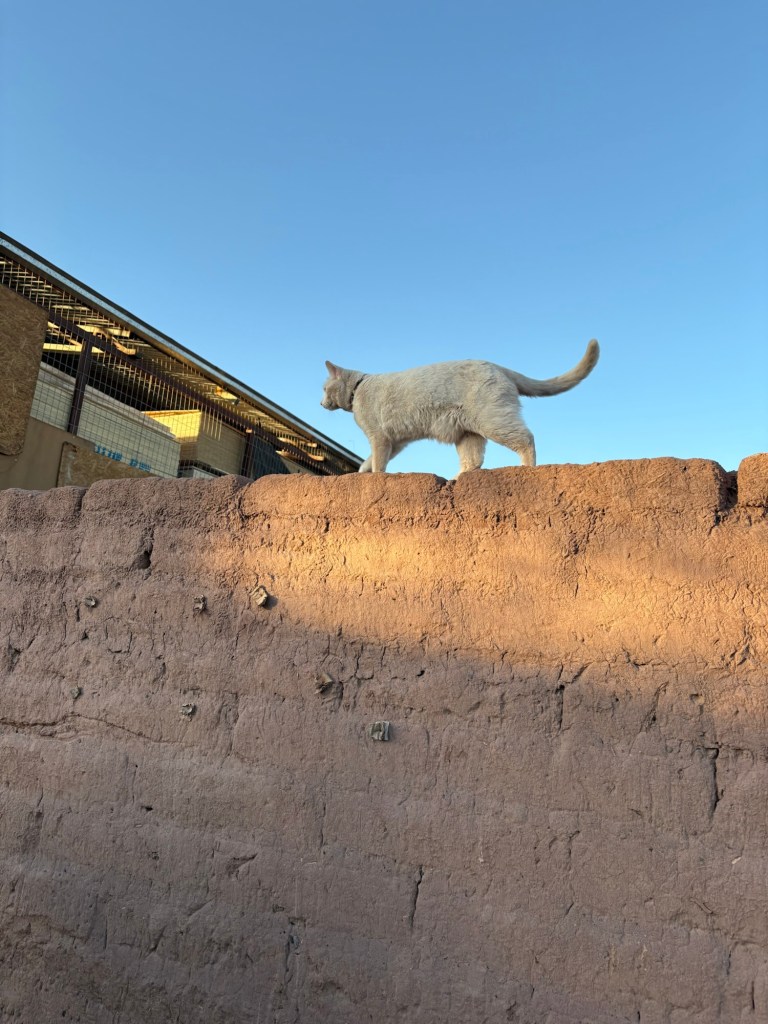
    ¡Mishi!

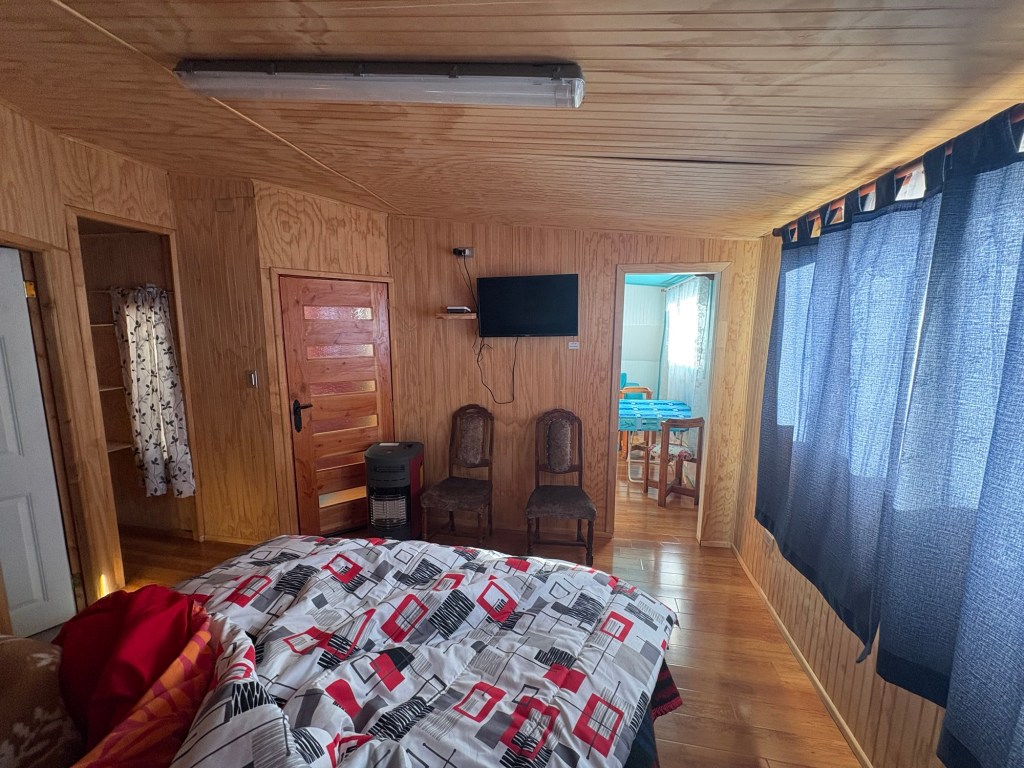
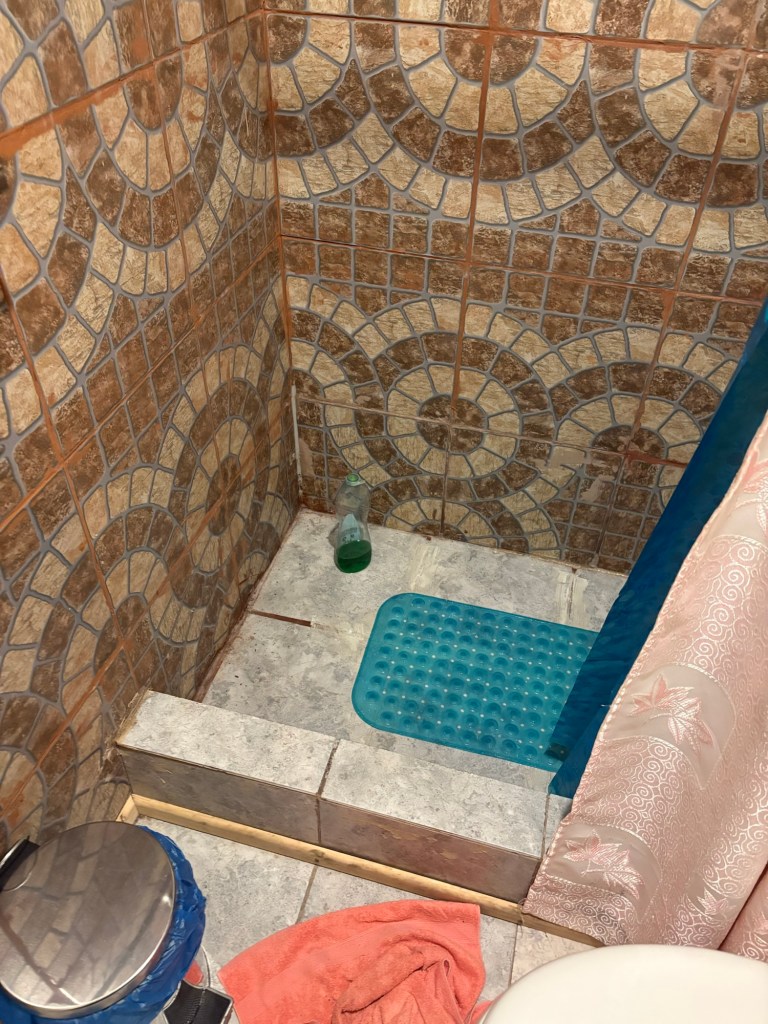
    Inside, there was just enough space for six people to exist. A bunk room for Anna, Mette, and Elena; another room for me and Hodei to share a bed (he kept waking me up in the middle of the night with strange and hilarious noises that I wanted to record but that also perturbed me enough to remain still), and space on the couch for Suditi. The shower had excellent pressure and was perfect for enjoying a post-hike beer.
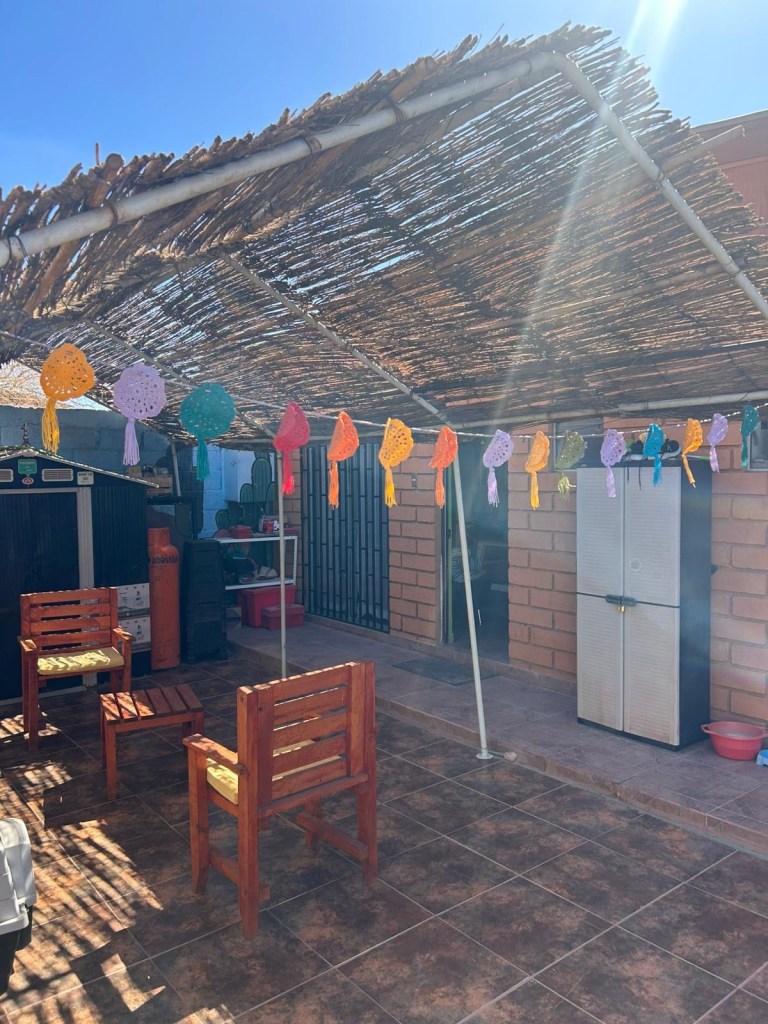
    We also got to enjoy this lovely patio.

    Over our stay, out of sheer bad luck, we broke three dishes. Every time it happened, we sent Hodei next door to talk to them because, as a literal Spaniard, he was the most fluent in Spanish. But the first time he did, our host gave him a blank look. We all thought this was hilarious; the meme in our house that he was impossible to understand because of his quick and low way of speaking, so this only added to the legacy.

    Fortunately, they were super chill about it, but we still felt bad, so one time when the kitchen sink got so clogged it just wouldn’t go down, instead of bothering them, we took the potentially disastrous course of action of trying to fix it ourselves. It was nearly overflowing; we called it a “tremendo poot caldo,” which was a combination of a few inside jokes. The main one was that poot was how Hodei pronounced “pool” for the first time in English—his English comprehension was C1 on the fluency scale, but his pronunciation couldn’t have been more than A2.

    Brief tangent here: we had a lot of inside jokes, as any friend group does, but perhaps more so because Spanish was a second or third language for most of us, and we were constantly making fun of each other’s speaking capabilities. For my first month, I couldn’t open my mouth without them making fun of my gringo accent(in Chile, gringo is specifically somebody from the U.S; it’s not race-based nor does it apply to any other nationality). Furthermore, because it wasn’t our primary language, I think that inside jokes were an easy way to achieve connection despite communication barriers.

    Poot, caldo, whatever you want to call it, we decided we would unclog it by unscrewing the bottom piping from the sink. The sludge that had built up below was truly unfathomable. I think I was the only one who even dared to touch it, collecting all the goop in a bucket while Mette took pots full of the upper water and dumped it into the road. It was mildly stressful but mainly hilarious doing it.

    Probably because we were drunk. After every single day of exploring, we would try a new artisanal beer, just one tallboy split among five wine glasses (Elena couldn’t, as she was celiac, a tough one in Chile) but since we were at 8,000 feet of altitude that would be enough for some tipsiness. Two would have you pretty lit, all things considered. I think that helped us, honestly, with the plumbing job, because we nailed it. Afterwards, I had to wash my hands a bunch of times over, but thankfully I had a functional sink to do it in.
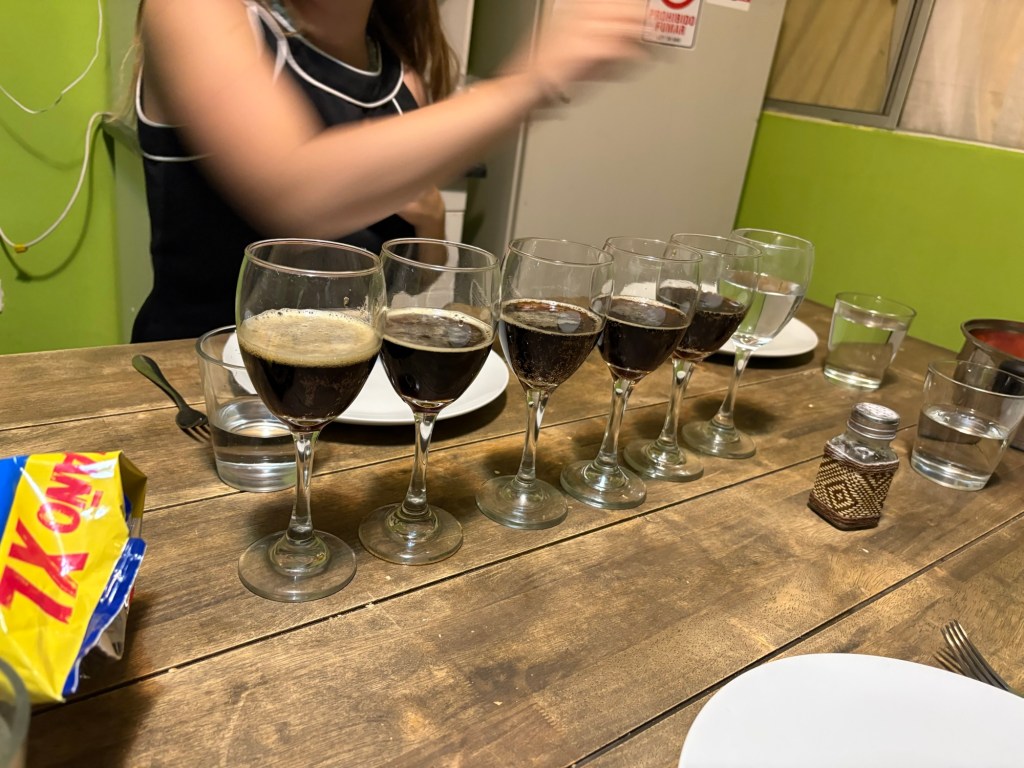
    Beer (and Mette).

    I think that about tells the story of the Airbnb. We stayed five days; all in all, it was a lovely spot, it was mainly a home base. Most of the stories occurred outside of it, which I’ll get to in the next posts.

    Is there anything else to mention?

    Permit me two more moments. One time when everybody else was gone, Mette and I had a conversation about romance and study abroad. It seemed to us that every other exchange student we had met was either: A. In a serious relationship of several years, or B. Was leaving behind a new fling that had only just begun to crystallize. Somehow the former category seemed more active in pursuing romance than the latter. We reflected on the silliness of it all.

    The other thing wasn’t a moment, but rather something of note. Well, not even that, but I want to subject you to these details if you’ve made it this far. My hiking boots smelled so bad that I had to keep them far outside every day. Only later did I learn that I could take the insoles out to let them dry, which would have at least minimized the degree to which taking them off was an act of chemical warfare against the Geneva Convention.

    Departure:

    Of course, when we left San Pedro on the final day, we were behind schedule. Not me this time, though; I wouldn’t be flying back to Santiago with everybody else. From Calama, I would split off from my friends and go to the similarly named Caldera, a mere ten hours south of Calama by bus. I was going to visit my friends Raul and Montse to take part in some fiestas patrias activities, before taking another twelve-hour bus down to Santiago for dieciocho.

    My bus was at seven, so I wasn’t moving with too much haste in the hours before we had to go, exploring the markets one last time as I tried to find a small gift for Fer (his birthday was coming up soon). I also bought myself a nice hat and re-bought the bracelet that I had lost. As I was doing this, my friends found out that their plane was an hour (or perhaps a half-hour) earlier than they had realized, and suddenly we were in quite the rush.

    We had to drive two hours back to Calama and get gas and return the car and then get to the airport. Anna, of course, was our driver, as she had been for most of the trip. She’s Italian and drives like it, speeding by everything, ignoring the occasional stop sign or speed bump, and yelling cazzo, merda or va fan culo (I think I’m spelling those right) at the other drivers. She was undoubtedly a skilled driver, but I wasn’t always relaxed when she was behind the wheel.

    But she was born for today’s assignment. I’ve never seen any driver so locked in. I swear we didn’t go any less than one hundred seventy kilometers per hour the entirety of the stretch, which might be only a slight exaggeration. She was passing trucks and cars like nothing. While she pulled off a lot of maneuvers that were cutting it close, I knew she had faith in her abilities, so I wasn’t too terrified—except for one when she passed into a blind turn. Luck was on our side, but if it wasn’t, I wouldn’t be alive to write this right now.

    We also had six in the car, but that almost didn’t matter, because we were speeding anyway, so if there were carabineros, we were screwed regardless. We prayed they weren’t on the road and prayed we would make it and listened to Adele all the while as we hurtled back to Calama.
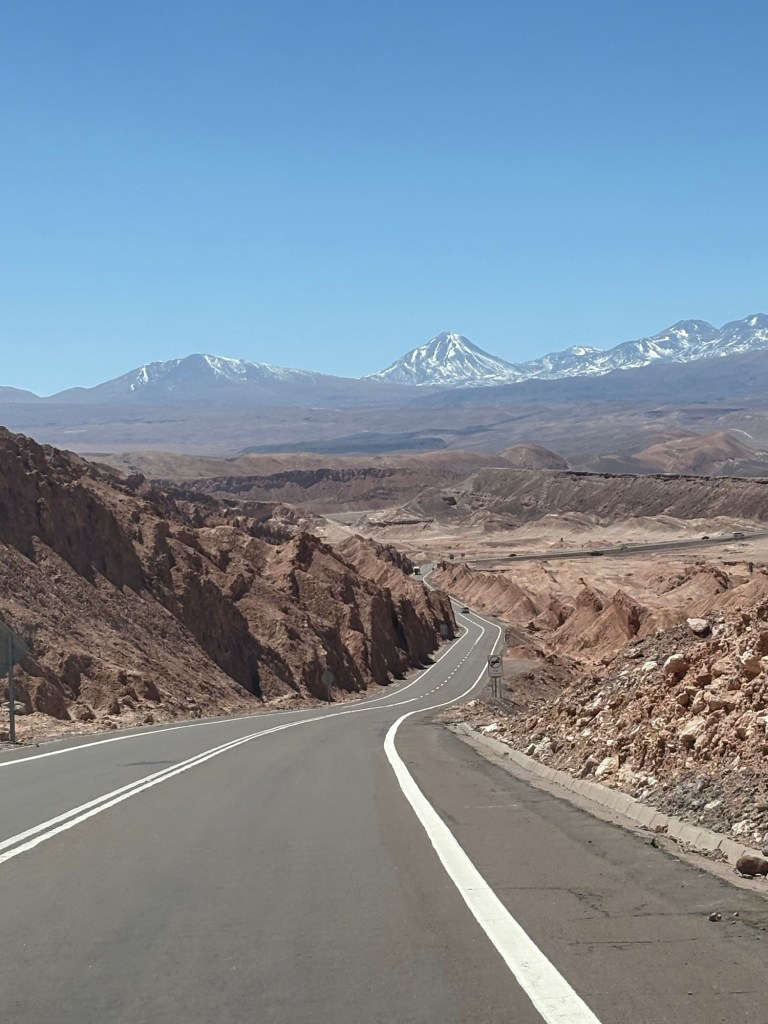
    Therapy, or driving this road at one hundred miles per hour?

    Thanks to Anna’s F1 abilities, we made it. They dropped me off at the hotel where it had all started. It was like Villarica all over again, with me hanging back to have my own little adventure—this time intentionally. I was excited. I love travelling with this group—we travel similarly, and nicely, together—but it’s so nice to also have your own moments to explore.

    First, though, I had to make my bus, which with my prior experience, was not a given. Especially in Calama, which was the least walkable town in Chile I visited. And while I felt completely safe, as I made it to the bus station, I felt eyes on me. People were watching; I stuck out as a gringo with two bags struggling to find the bus stop—I had to double-track myself on the sidewalk like four times.

    To be fair, it turned out to be a confusing situation: it was just an office, with a parking lot in the back and literally nowhere to sit. Everybody was sitting in the tiny room or on the sidewalk, so I decided I would wait somewhere better, as I had an hour and a half to kill. So I continued walking, passing a discoteca that was bumping even at six in the evening, and a rather suspect bar—no windows, with men at the outdoor tables being served by women in bikinis. Just further, though, was an ornately decorated Peruvian restaurant. I didn’t think twice.

    I was the only one there, and I decided to treat myself to some expensive ceviche—like the cost of three Menu del Días. It was divine. Peruvian ceviche is different, with a more spicy and complex flavor profile than Chilean ceviche. I wasn’t sure what else to do as I waited, so I called my friend Sofia from back home. She’s fluent in Spanish, and for the first time I was able to have a proper conversation with her in the language. Here it was: tangible proof that my skills had really increased.
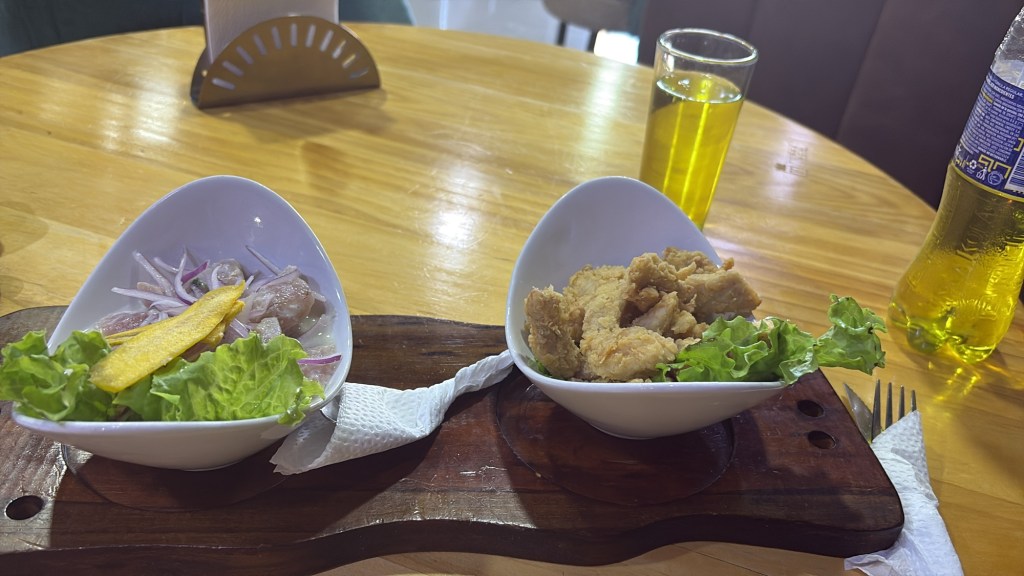
    Notice the Inca Kola in the background.

    Though I think the servers at the restaurant thought it was funny—a gringo talking in choppy Spanish to someone back home.

    Finally, I went to go to my bus. Of course, it came late, and I had the sinking feeling that I was about to be stranded once again. But just after I had double-checked with another passenger that I was in the right place, it arrived. My seat was a comfy semi-cama in the front row of the top of the bus, the best seat in the house. We drove off—literally into the sunset. It was the perfect way to say goodbye to San Pedro.
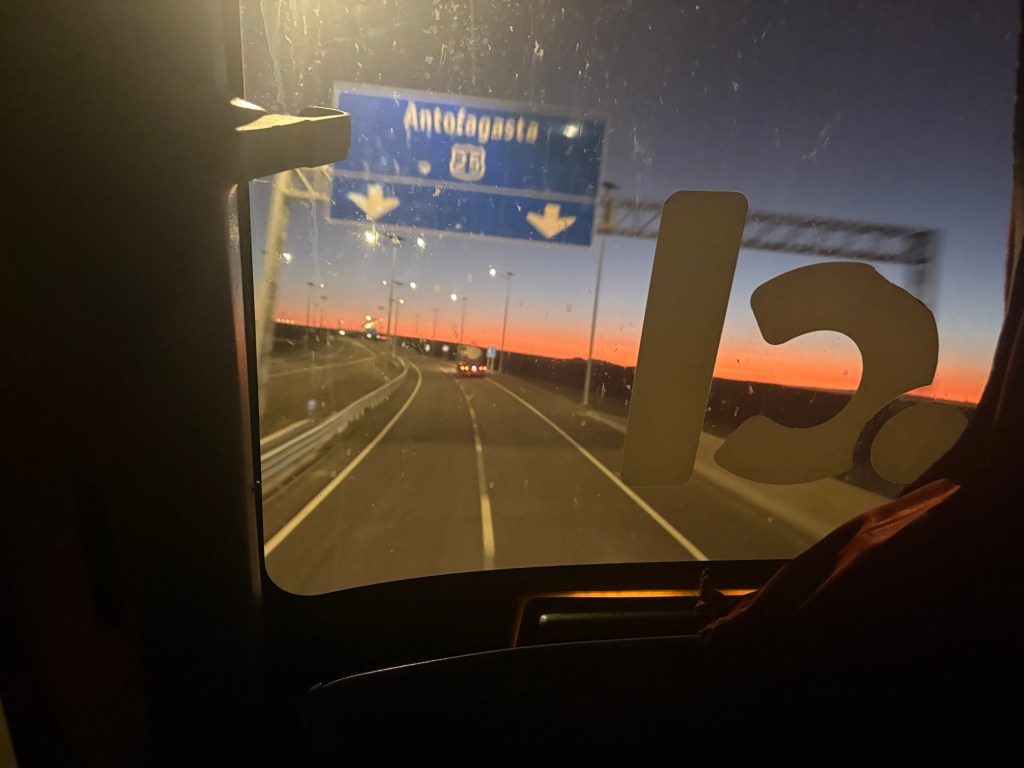
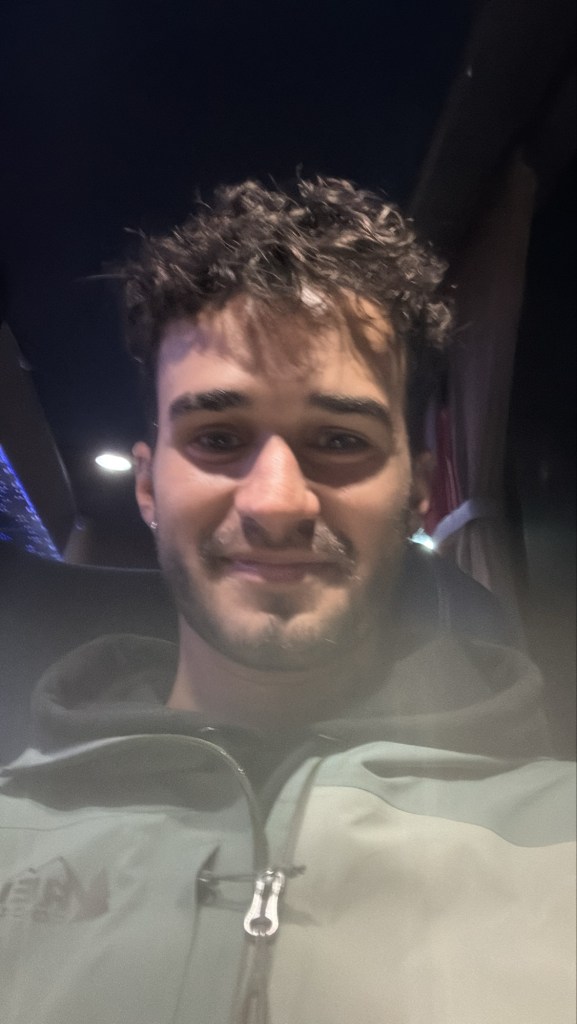
    I was too tired to hold the camera still for more than a millisecond.

    Next up was Caldera—although you, dear reader, will have to first make it through three more posts about San Pedro.
  • Chile #6: Pucón, Part 3: Stranded

    Chile #6: Pucón, Part 3: Stranded

    After a photography post, you know I’ve got to follow it up with a long piece of writing. This is the story of how I was stranded in a small town ten hours south of Santiago—and also the story of how I almost got into trouble with the law.

    Our buses back to Santiago were at 9 and 9:30, and it was already dark as we were leaving Parque Nacional Huerquehue. We knew that it was going to be a bit of a scramble, though I was on the second bus, so I had less worries. Thankfully, we were able to clean the rental cars, fill them up with gas, and return them without a hitch. We even had some extra time to goof around with the car wash vaccuum.

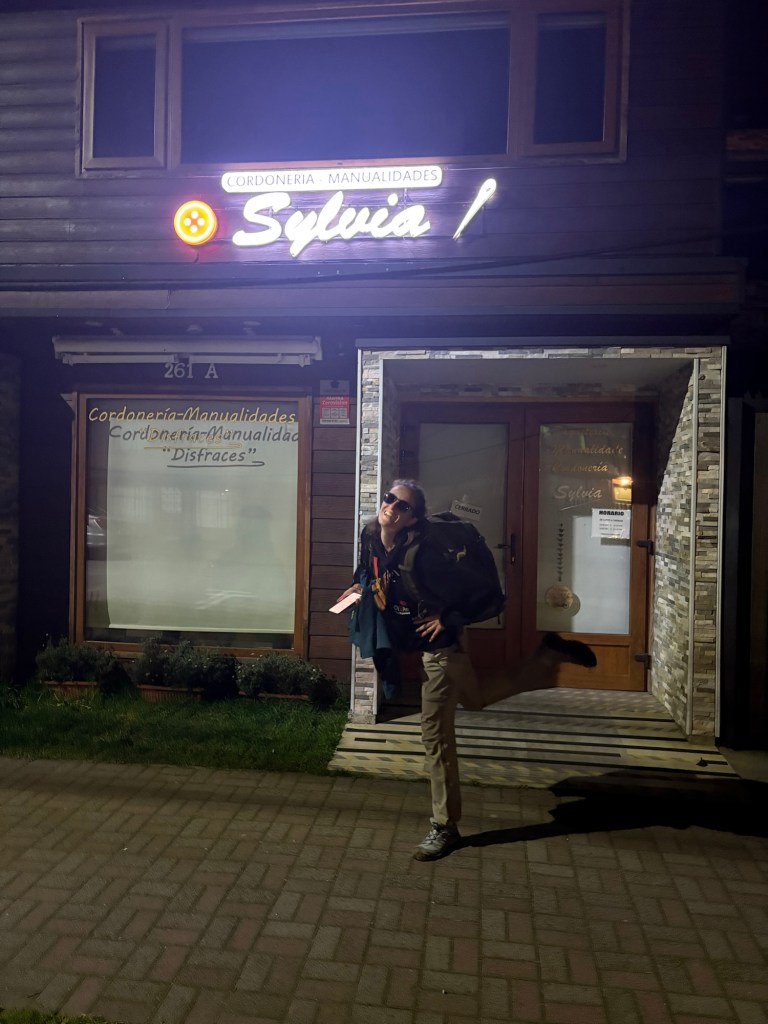
    Time to spare to flick Silvia up in front of her store (spelling difference notwithstanding).

    As for getting back across the lake to Villarica, where our buses awaited, we were largely fine too. Elena, Carla, and Anna needed to take an Uber to the station, as they were running late for their 9pm bus; the rest of us—Hodei, Mette, Silvia, and I—were able to hop on a local bus from Pucón to make our 9:30. Our drive swerved like a man possessed, speeding past sedans and other buses on the highway to get us to Villarica.

    We were the first ones on the 9:30 bus. At last, we could collapse in our bus seats and theoretically, sleep the ten hours back to Santiago. I had even paid a little extra for a salon-cama, the one that reclines further. Luxury was on the menu.

    Or, maybe it wasn’t. My seat, next to Hodei, was a semi-cama—the first sign that something was up. I double-checked my ticket, saw that it was right, and accepted the minor L. I began to take out what I would want from my backpack for the journey.

    I was in the middle of changing into my pajamas (my things were sprawled all over the place, which I remember because I knew I had to be annoying Hodei) when somebody tapped me on my shoulder.

    “You’re in my seat.” It was a guy in probably his mid-forties, who did not look pleased.

    “Um… sorry, but this is my seat.”

    “No, look,” he said, showing his ticket, which read seat number 36, my seat.

    “That’s really weird, because mine is 36 too,” I said.

    He turned to get the conductor—at this point there was a line behind him of people who couldn’t pass—and then my heart sank as I noticed. My ticket was for seat number 36—but for the 9 pm bus. The one with Carla, Anna, and Elena. The one that had already left.

    I profusely apologized and scrambled to gather my strewn-about things, telling my friends that I would go down and talk to the conductor. Maybe there was a free seat for me to take. Silvia came with me; at this point in the semester her Spanish was way better than mine. To clarify, every one of my interactions in Chile, including those among my friends and I, took place in Spanish; throughout this first month, I was operating at a considerable deficit when it came to communication skills.

    I had hardly outlined the situation to the conductor when he shook his head. Todo lleno. The bus was completely full.

    It all happened in a blur. I think I said something to Silvia like, I’ll be fine, you guys get home, I’ll figure something out, see you back in Santiago. The only concrete detail I can place was the door closing; we looked at each other with the glass separating us before the bus drove off.

    I wandered into the station and explained my situation to the woman working behind the counter. It took a few tries to get every detail correct, but when I was done, she winced and told me that every ticket had been sold. The only hope was to ask conductors of any later buses if anybody had no-showed.

    There must have been six or seven buses that night, and every single one of them was filled. Turns out, nobody else made these kinds of mistakes. In fact, the only vacancy on any bus in Chile that night was probably the one that I had left on the 9pm bus.

    I had no clue what to do next, so I sat down and ate a bag of Takis from my backpack. Then I asked the woman if she knew of any hostel in the area where I could spend the night. She told me that she would call her friend, who might have a room available.

    Ten minutes later, the friend arrived, a man who did not look pleased to be there at 10:30 pm on a Sunday night. He beckoned me to follow him out of the terminal, so I did, stopping to thank the woman on my way out. I gave her a hug, which I remember she thought was funny.

    My new savior was named Leo and had just left from a lively asado (a barbecue), which explained his annoyance. I had thought that I would be sleeping in his family home or something, but it turned out that he owned a hostal, a guesthouse with a bunch of rooms, a slightly upgraded version of a hostel. It would be $30 for the night, which was a little steep for this level of accommodation in Chile, but I was in no position to negotiate considering he had just done me a massive solid.

    I also, of course, didn’t have any cash, which was decidedly not music to his ears. But after swearing a bit (weon) Leo let me know that he would come by in the morning and take me to the bank. With that, he left to return to the asado.

    The room turned out to be quite comfortable, with a kitchen, a TV, a bathroom, and a queen bed. I couldn’t fall asleep until 3AM; I drifted in and out of consciousness as a bizarre Chilean reality show played on the TV like a fever dream.

    That damned TV. The show was like a low-budget Beast Games or something. Comfy digs, though.

    I wish I could say that the next day, I got up early and explored a ton of Villarica, or that I was super productive and wrote a new blog post. The reality is that I was a little bit burnt out, and outside of the morning errand where Leo took me to the bank, I didn’t leave the room until the afternoon and largely just scrolled on my phone. Though I did get to drink a few cups of tea and eat empanadas, so it wasn’t all bad.

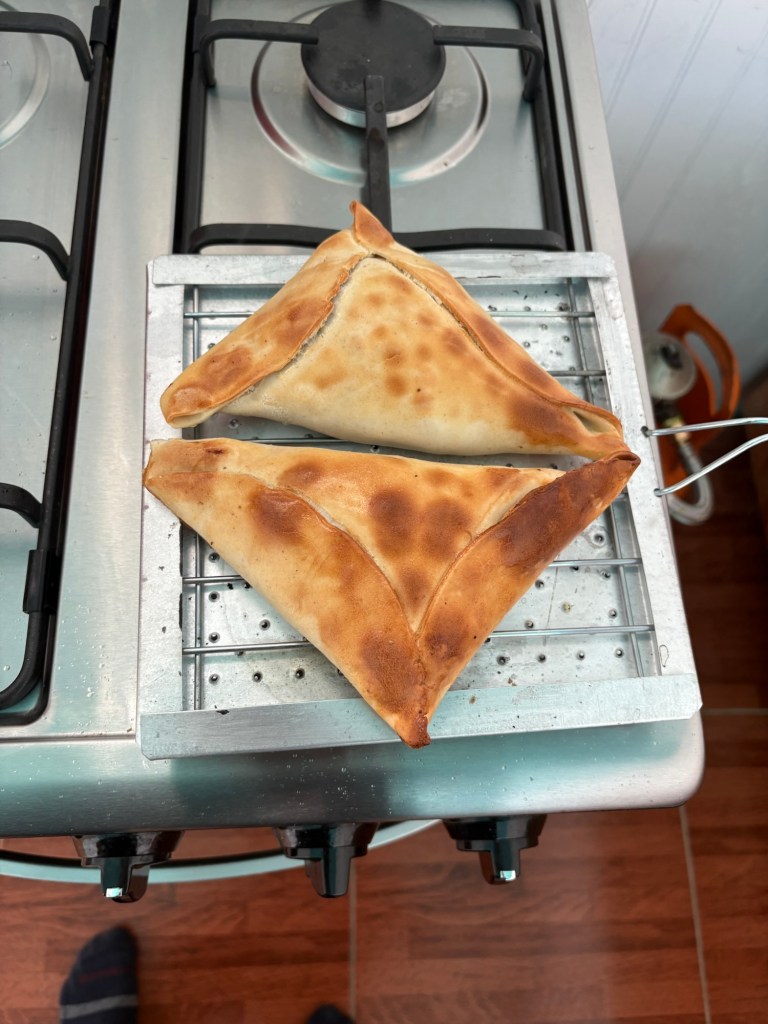
    Empanadas de pino (the classic Chilean empanada with ground beef, onion, egg, and usually a singular olive) on the tostador.

    What was bad, though, was that I had to email my professor that I would miss yet another section of his Monday class. For various reasons (various reasons will be my PR spin on my truancy) I had yet to attend his class, so now with my Villarica escapade, I was three weeks into the semester without even meeting my professor.

    What was worse, but fun in a Type 2 way, was the shower, which didn’t have soap or hot water.

    Shampooing with dish soap is rarely the vibe.

    At around 3, the realization that I’d never be here again overtook the laziness that had set in, so I decided to go out and look around. Villarica turned out to be a lovely town, lively with panaderías and people clutching bags of fruit and a street guitarist absolutely rocking a cover of “Come As You Are” by Nirvana.

    I tried my first Chilean burger, which was an utter disappointment, though probably my own fault for ordering one in the first place. However, I got to eat it lakeside, which was not terrible at all, and I soaked in yet another vista, this one more tranquil than glorious. I sat on a wall by the water, with only the geese and a couple lightsaber dueling with sticks on the grass to keep me company.

    I felt weird. It was my first time ever solo traveling, and it only had happened by accident, but after seeing so many Reels of solo travelers having a magical time and meeting tons of people, I wasn’t expecting the reality of exploring on your own: it’s great, but sometimes it can be lonely. You’re not magically going to strike up conversations with everybody you see unless you initiate them yourself.

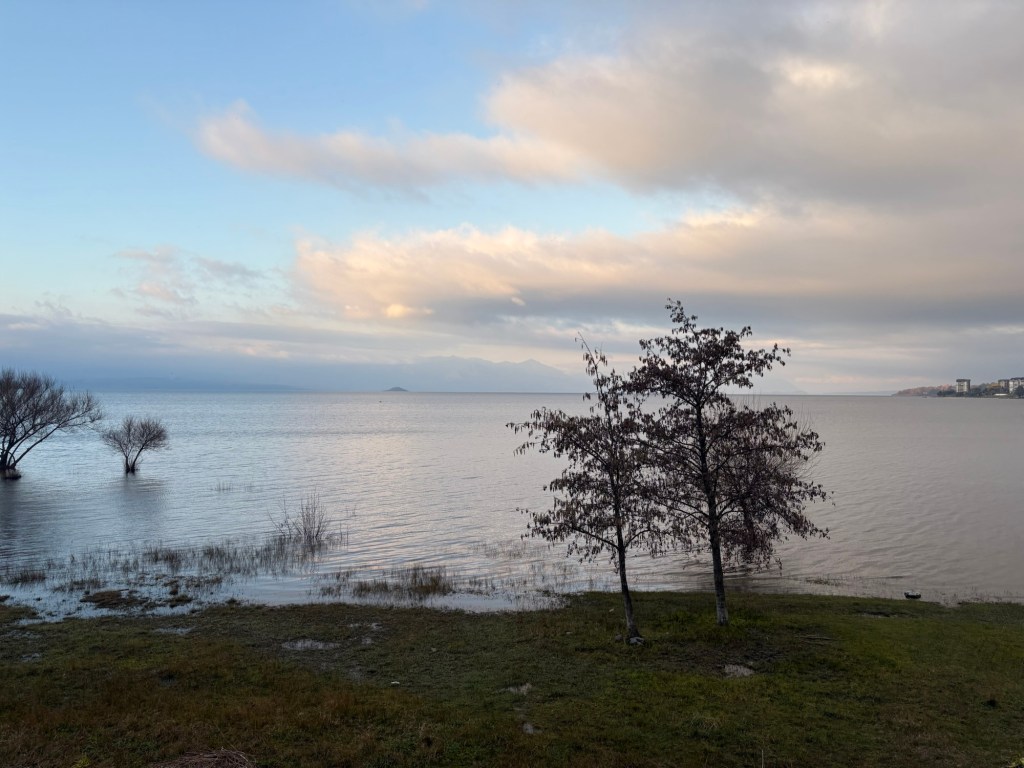
    This lake was a combination of pretty and mildly desolate, perfect for contemplating the void.

    I figured I should try just that, but my first attempt, at a roadside stand with a mom and her son selling chocolate-filled churros that tragically appeared better than they tasted, was unsuccessful. After asking how their days had gone, the conversation sputtered and died, them not interested enough to continue, and me not confident enough in my Spanish to know what to say next.

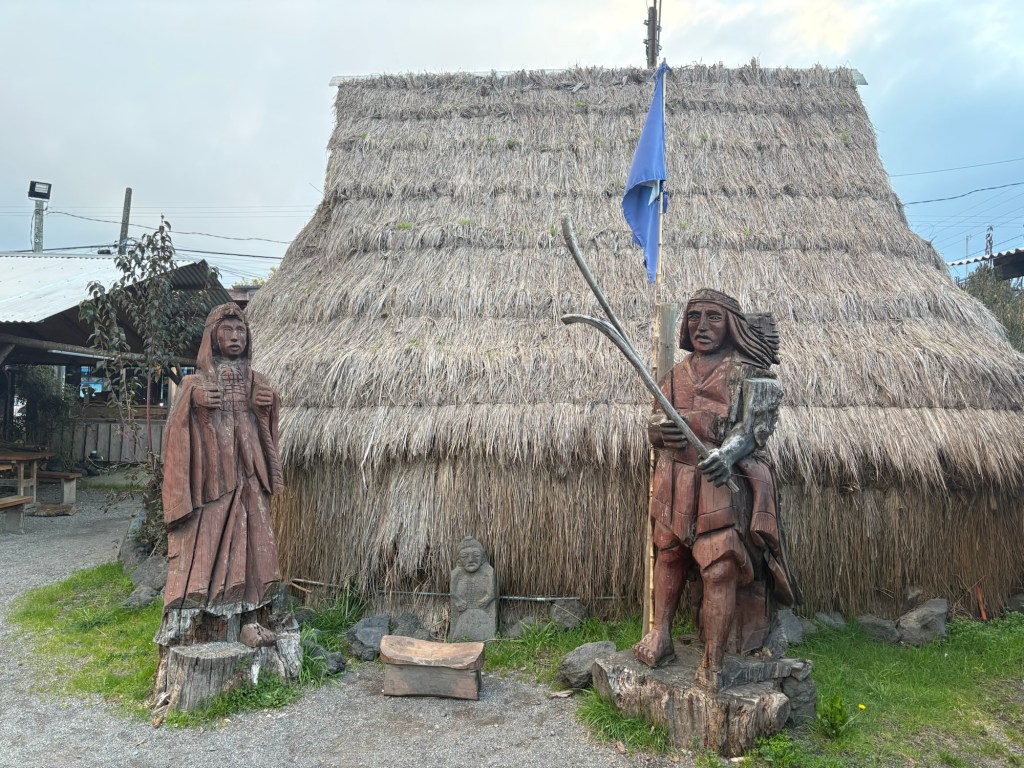
    Leaving with a disappointment part gastronomical and part social, I wandered back up the street to the Centro Cultural Mapuche, which I had expected to be a big museum but turned out to be a preserved ruka, a traditional Mapuche dwelling. There was nobody there at all, so I strayed in but didn’t stay long, feeling vaguely like a trespasser. It was a small exhibit but beautiful, with wooden sculptures and a Mapuche flag hanging from a bamboo pole.

    Another block back, the guitar guy was now shredding “Beat It,” and I stopped in at the Unimarc to buy snacks, more out of feeling like I needed to do something than out of hunger. It was here in these aisles, as I selected an Inca Kola, a yellow Peruvian bubble-gum flavored soda, that a mission for the day found me in the form of a call from my friend Hodei.

    Here was the situation: Hodei had left his estuche, a personal bag with his toiletries, in the rental car. The office was in the hotel back on the other side of the lake in Pucón, thirty minutes away. Would I have time to get it? It was currently around 6; my bus was at 9:30, for real this time, and I had no intentions of missing it. I crunched the numbers and ordered an Uber.

    My driver was a friendly, overweight guy in his fifties named Hernán, a pastor who claimed to not speak English but could translate any word I needed when my Spanish was lacking. Naturally, we got to talking about God. I told him that I didn’t believe, not out of any anti-religion sentiment but because I had never felt the need to, and he told me that even if you don’t believe you can’t deny that there’s something out there, something that makes the world as beautiful as it is. He explained to me that he saw God in his son, who played some sort of musical instrument for the church, and in his daughter, who was just starting high school and had no idea what she wanted to do afterward, and that he was worried for her but was excited for the woman she was starting to become.

    I told him that I shared his love of family, and I told him about my parents and my siblings and that I wanted to be a writer.

    He asked me which state I was from—he knew I was a gringo from the moment I was in the car—and so I told him about Rhode Island. He replied that he had family in the U.S, and that he was supposed to visit them last February and go to Disneyland but that his tourist visa had gotten revoked last-minute.

    Not for the first time in Chile, I apologized for the new administration and for Trump.

    “Ah, no te preocupes,” he told me, laughing. “I actually think what Trump is doing with all the deportations is great.”

    A truly unexpected response. Yet it made sense. The dominant theme of the domestic election cycle that year was the presence of Venezuelan immigrants in Chile. It’s a complex issue, but suffice it to say for this post that they were unpopular. Sure enough, Hernán launched into a rant about delinquency and how nowhere in Santiago was safe anymore. Blissfully, we arrived at the hotel soon thereafter. I started to say goodbye, but he told me he would wait for me and take me back if I paid him cash. Somehow, I still didn’t have any efectivo on me, even after getting some that morning, but he said we could make a stop on the way back, so it was settled.

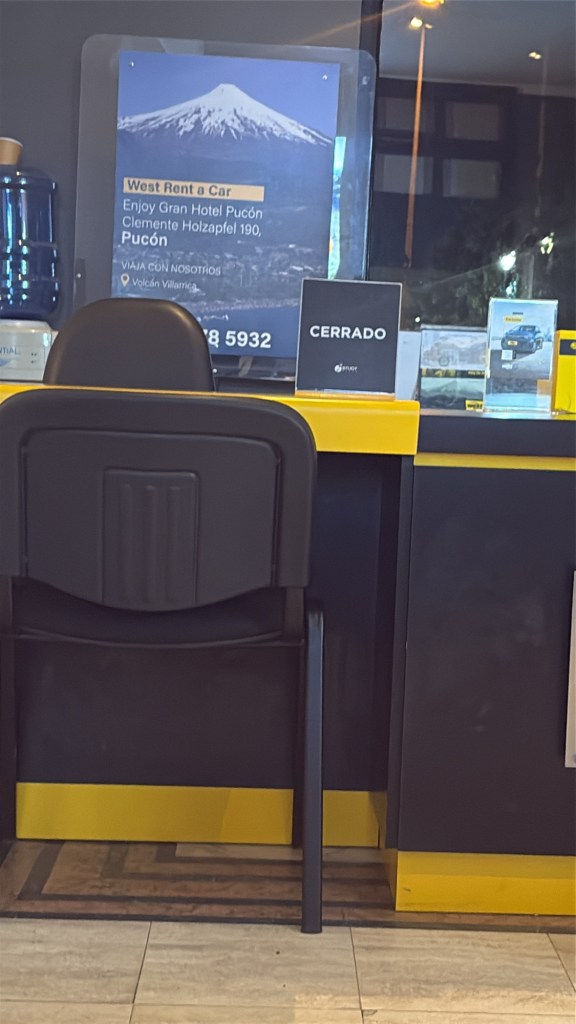
    I entered the familiar hotel lobby at 6:45. The rental car office was supposed to close at 7pm, so it was perfect timing. According to Google, anyway, but in la vida real the rental car desk greeted me only with a “Closed” sign.

    Well, a cerrado sign.

    Across the lobby, the hotel receptionist told me there was nothing that could be done. The rental car workers had left for the night, and I would have to come back tomorrow.

    I didn’t have tomorrow. The events of the last twenty-something hours replayed in my mind: I had missed my bus, I had laid around in bed all morning, and I had eaten a bad cheeseburger. Now I had come all the way across the lake for nothing, and suddenly, I resolved that there was no way I was leaving empty-handed.

    I called Hodei to let him know that I was about to try and find the estuche myself.

    Glancing over my shoulder to see if anybody was watching, I jumped over the desk and began to rifle through the drawers. Laughably, I found it in the very first drawer. It had been too easy, and as I sauntered out of the hotel I told Hodei over the phone that I had done it.

    And then behind me, I heard: “Qué estaí haciendo?” What are you doing.

    Oh shit. I turned and saw a security guard approaching me, mouth to his walkie-talkie.

    “Uhh.” I put down my phone. “I wanted to get my bag.

    He wasn’t buying it. “You need to wait here for the police,” he told me.

    My heart sank. I had made a huge mistake.

    Within thirty seconds, there were more security guards surrounding me, and they began to question me on who I was, and why I was robbing the hotel.

    The pressure of the situation flipped a switch in me, and pure adrenaline took over. For the first time in Chile, I was completely fluent in Spanish. In a flow state, I outlined the story: how we had rented a car the days before, that I had missed my bus, that my friend had left a bag behind, that I was retrieving it for him. That nobody was here, and I had made the probably foolish decision of trying to take it anyway. That I was really sorry but just frustrated that I couldn’t help Hodei out.

    Over the course of ten minutes, I continued being cross-examined, feeling terrible for Hernán out there waiting. The security guards were skeptical—they needed confirmation of the fact that it belonged to Hodei, and of course when I tried to get him back on the phone my WhatsApp wasn’t working. Finally, we reached a conclusion: I wouldn’t get to keep the estuche, but they would send it in the mail to Hodei when he confirmed it was his; more importantly, they wouldn’t call the police. Despite the end result being literally the same as if I had done nothing at all, I considered it a massive win.

    Back in the Uber, I told Hernán the story, and he thought it was hilarious and decided to buy me an empanada. We stopped at a grocery store on the way back, and I went to go get cash from the nearby ATM. For one heart-stopping moment (everything had a flair for the dramatic that evening) my debit card got swallowed up by the machine, and I very nearly rage-quit. Only after a minute’s delay did I get it back.

    Hernán was nowhere to found, and I had to wait another five minutes before he reappeared with an empanada. It turned out he had made a lengthy detour to the bathroom.

    We talked the whole half-hour back, and while I can’t remember the specifics of this conversation, the tantalizing feeling of joy at connecting with a stranger on a non-superficial level in Spanish remains.

    We arrived at the hostal at 8pm, where we bid each other farewell. I was greeted by Leo, and to my surprise, he too struck up a conversation with me, asking about my day. When I told him that I had seen a Mapuche ruka, he smiled. “I’m Mapuche,” he told me. “I have the flag in my kitchen, I want to show you it.”

    I waited as he went to retrieve it, but he returned empty-handed. “It’s too big,” he said. “I can show it to you before you leave. Stop by before you go.”

    I had no idea why this mattered, but with my current level of Spanish, I decided it was easier to accept it as fact than to question the specifics. But some twenty minutes later, when I knocked on his door on the way out, Leo was gone. It was a disappointment, but it seemed to fit with the vibe of my first official day of solo travel.

    I made my bus that night, though not without yet another near miss when I transferred in Temuco some hours later. Finally, I could relax in my semi-cama—that is, until my 8AM class the next morning.

    Finally.
  • Chile #3: Pucón, Part 1: Lakes and Sleep Deprivation

    Chile #3: Pucón, Part 1: Lakes and Sleep Deprivation

    Around a month and a half ago (as you can see, I am very behind in my writing, and yet I’m surprised it was only a month and a half ago), I went on a trip with my friends to Pucón, a town in the south of Chile. It was a lovely trip with some twists and turns, although first I figure I should explain that description “in the south of Chile” because with a country so endowed in latitude, that can mean just about anything.

    Pucón is in the southern half of Chile, though by no means in the southern third. Yet it’s quite far south for the part of Chile that is reasonably populated, not including the city of Punta Arenas thousands of kilometers further. Nor including the few people in between from the Aysén region, whom I know exist because my housemate Kevin is one of them.

    I suppose I’ve complicated this matter more than it needed. What’s important is that it’s south of Santiago, which you can think of as the origin, or point (0,0) of Chile, if Chile were a coordinate plane with a compressed x-axis and a heavily elongated y-axis. Santiago is basically the center of everything, in geographical and especially in political and economic terms.

    And again, I’ve complicated things.

    What matters for the story is that it’s ten hours south by bus. We left Thursday night to arrive bright and early on the morning of August 15th, which was a feriado, or holiday, here in Chile: El Día de la Asunción de la Virgen.

    The overnight buses here are quite accommodating and have become a mainstay in my adventures—as well as a source of them, as you might read in a future post. The basic seat offered is a semi cama, which is usually spacious enough, depending on the company, and reclines to 150 degrees. The salon cama, a slightly more expensive option, reclines a further ten degrees. I have yet to try the elusive full cama.

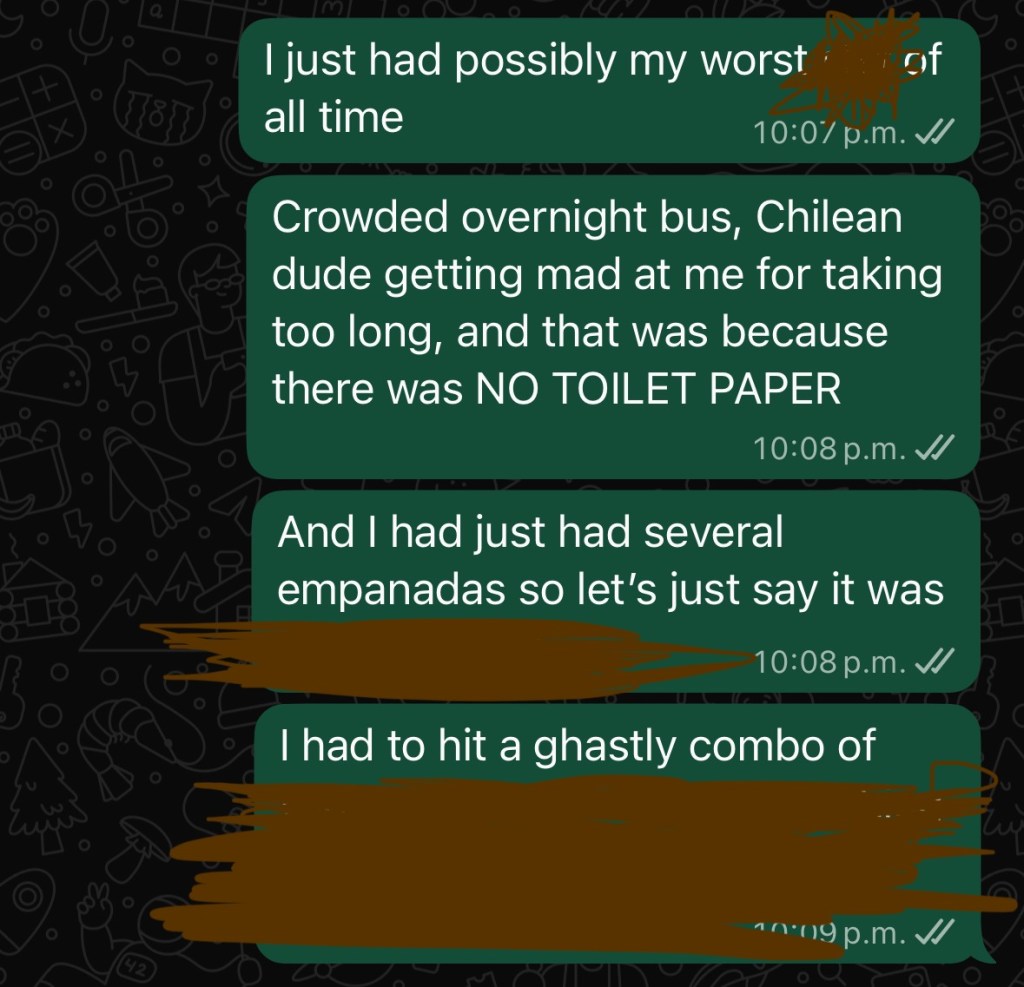
    There are also bathrooms, but the toilets are strictly for urination, and they don’t stock toilet paper. If, hypothetically, you find yourself in a situation where you have learned these details too late, and a man is yelling at you to hurry up, know that there are solutions, though unseemly, available to you. Hypothetically, they would not be pleasant, especially if you had to deploy them at the very start of your trip.

    Censorship is bad, but this method needs to be discovered organically. I also probably shouldn’t TMI everybody even more than I already have.

    Like a plane ride, or certain types of fungi, the overnight bus (the bus by day is a different matter) is teleportative in nature, although its nature is not particularly fast. You enter from the nocturnal chaos of a scrum of bodies at a busy Santiago terminal, pass ten hours in the dark—whether your curtains are drawn or not, you won’t see beyond your window—and emerge in a small town starkly different in climate, culture, and pace.

    The machine of teleportation, also known as the bus.

    As you traverse this liminal space, you have several options to entertain yourself: reading, music, contemplating the void. The one I opted for on this particular night was sleep.

    Unfortunately, sleep didn’t opt for me, and upon arrival, I was operating somewhere in between the world of the living and the world of the dead. Putting one foot in front of the other required all of what little cognition remained.

    Our bus had taken us to Villarica, a bigger city (although “bigger” is quite relative) on the other side of Lago Villarica. From here, we could catch our first glimpses of the similarly named Volcán Villarica, one of 2,000 volcanoes in Chile, but among the most active. For me, the opportunity to scale this monster was the main attraction of the trip.

    Volcán Villarica peeking out in the background. It’s 2,847 meters tall (9,341 feet).

    Pucón awaited us 30 minutes away, on the volcano side of the lake. Apparently, we could have gone straight from Santiago to Pucón without the need for the transfer, but our planning could be characterized only by its lack of anything resembling the word. Plus, when confronted with a million different bus options that all seem somewhat similar, sometimes it’s easiest to just pick the cheapest one and see what happens.

    This philosophy extended to our rental car and housing selection, which we hadn’t arranged before leaving Santiago. The idea was that these things would just sort of work out.

    When we did arrive in Pucón, we had to wait until 9 AM to be able to get the rental cars (at some point between last night and this morning Elena had evidently booked them), which left us with an hour and a half to kill walking around, a good portion of which we spent helping a man in a wheelchair get across town to the grocery store. With him in tow, our overfull backpacks screaming “tourist,” and numerous stray dogs trailing us, we must have made for an interesting sight for the locals on their way to work, though just as likely we could have been entirely unremarkable.

    As it was, the only other locals we saw were on a construction site—where we found the man in the wheelchair—and in my hazy state every sight was interesting, and unremarkable.

    The car rental office was in a luxurious, old-fashioned lakefront hotel that felt Wes Andersonesque. It’s always an interesting feeling stepping into one of these establishments when you didn’t, and will never, book a room.

    I ended up returning, rather spontaneously, to this lobby twice more throughout the trip. This is foreshadowing for Parts 2 and 3.

    While it’s obvious we didn’t belong, they didn’t stop us from exploring, so I wandered my way past the lobby, walked out the double glass doors into a courtyard that reminded me of the Breakers (that Vanderbilt mansion in Rhode Island of middle-school-field-trip fame), and jumped down the stone wall that led to the beach. I must have passed a half-hour or two sitting on the lifeguard tower with Mette, admiring the view.

    Lago Villarica is really big. I mean, not as big as one of the Great Lakes, but I’m not swimming across this thing.

    There were seven of us, so we got two rental cars: a sedan and a sedan-sized pickup truck. I say “we,” but it was really Elena, Silvia, and Anna that ironed out the details; in my state I was little more than glorified ballast. But after a café trip and a double shot of espresso, I committed to the fact that I would just sleep that night, and that conversationally, today wasn’t going to be my best performance.

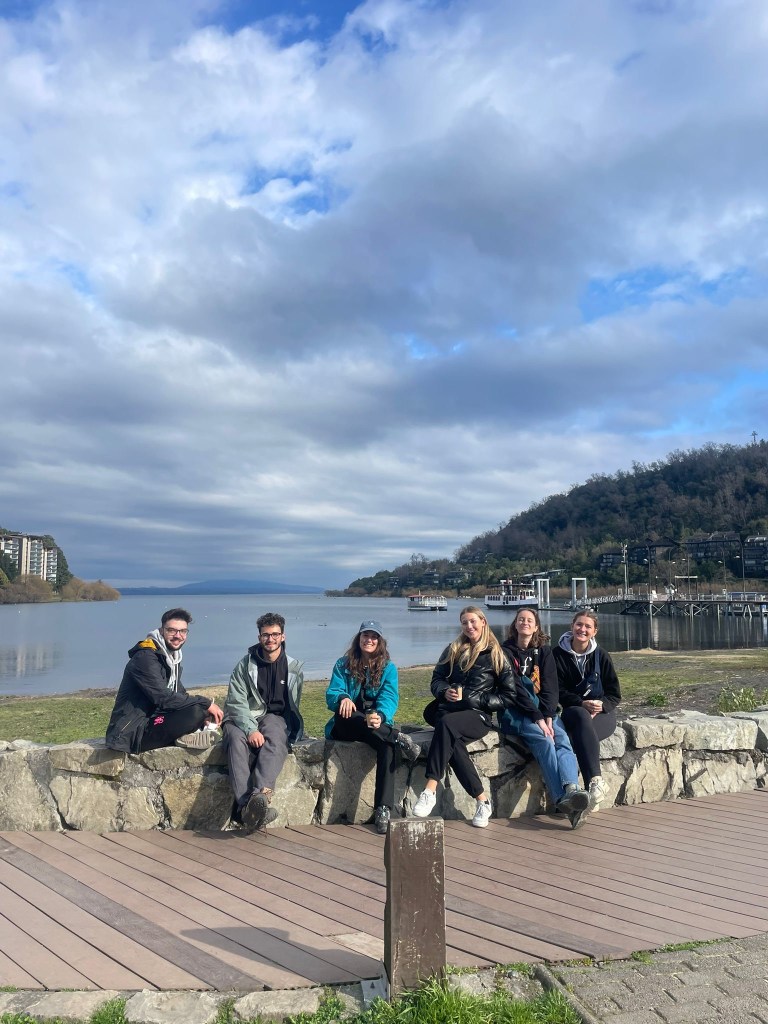
    Post-coffee group photo. Left to right: Hodei, me, Anna, Elena, Silvia, Carla. Mette behind the camera.

    The Airbnb was, once again, the cheapest option possible, some turnoff along the main way out of town, deep in a forested labyrinth of dirt backroads where there were more animals than people. Mette had booked it some hours before. There was no WiFi or heat, and the wood stove lacked kindling, so we had to get creative both nights because both days we forgot to buy any. The owner’s dog was possibly the largest I’ve ever seen; he could play fetch with large rocks. Thankfully, he was quite friendly.

    The only photo I took of the Airbnb is of this fellow.

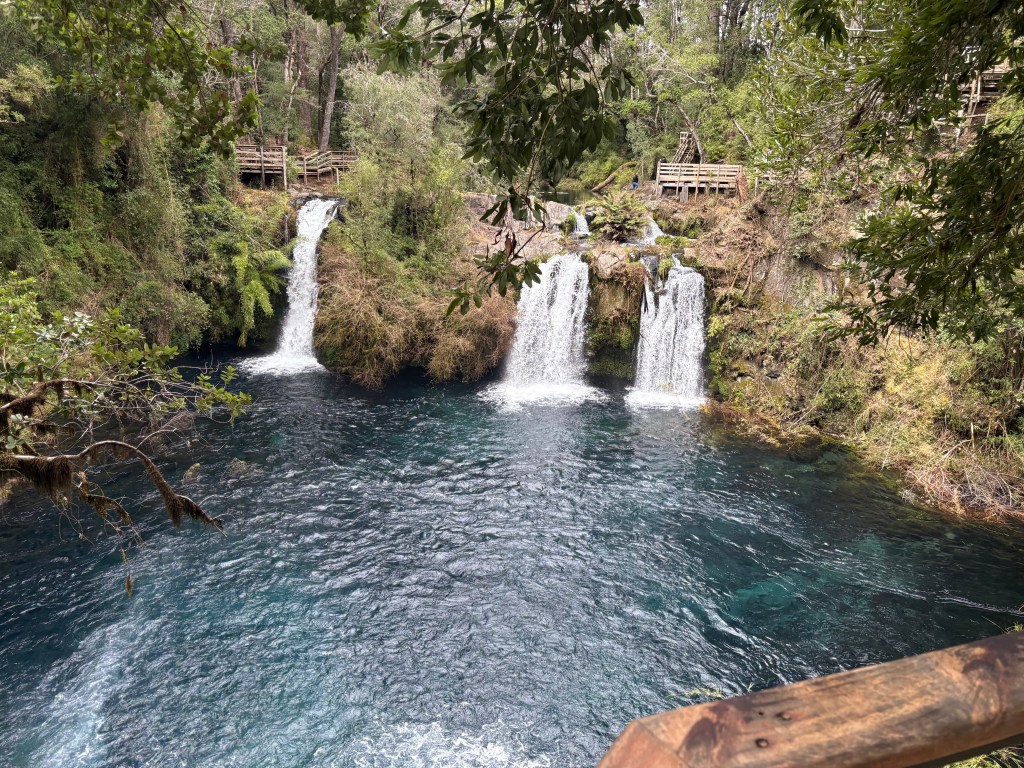
    The first stop of the day was Ojos de Carbugua, a multi-tiered waterfall park like what I had seen in Costa Rica, except the rainforest was temperate rather than tropical. The network of paths allowed us to circumnavigate the falls and see them from at least ten different viewpoints, which probably would have been glorious to a one-year-old without object permanence. With my lack of sleep, that’s essentially what I was, so it was perfect.

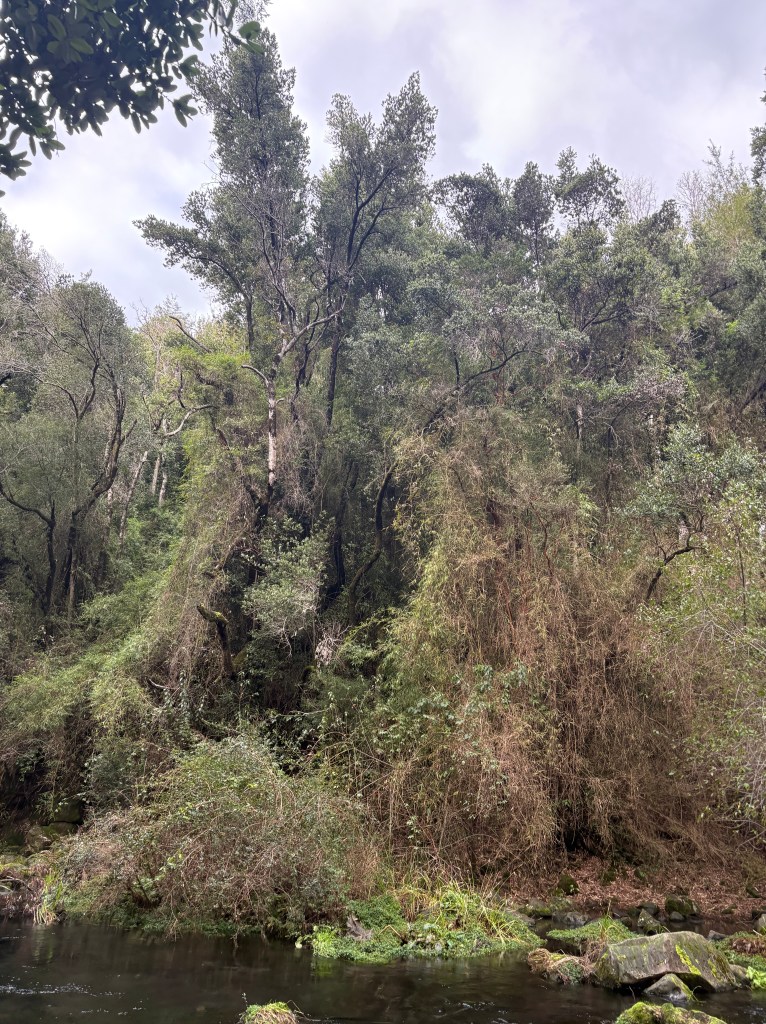
    The only photo of Ojos de Carbugua I took that doesn’t include one of us doing something stupid for the camera.

    The entry was only two thousand pesos (approximately two dollars) per person, which is quite good in a country that seems to put a gate in front of every natural attraction. That’s a pessimistic, and not entirely accurate viewpoint, as there are more free things than you could see in a lifetime in Chile, but it’s true that if you want to see a lineup of heavy hitters, you’ll have to pay up at some point.

    For only ten hours south, the climate had changed a lot from the dry Mediterranean scrub in the valley of Santiago. The skies were cloudy, constantly threatening rain. It was considerably colder and considerably greener, forested everywhere—a difference I noticed especially on the roads between attractions. On the drive to, say, Valle Nevado, a ski resort just east of Santiago, you’ll have an open view the entire way up. Here in Pucón, the wide-open expanses were much less frequent, making them all the more magnificent.

    In general, way more stuff grows here than in the areas near Santiago.

    Next on the day’s menu (figuratively, of course; the literal menu, for me, was the near-twenty slices of ham that I had bought at the Lider on the outskirts of town) was Lago Carbugua.

    Pucón is in what some unofficially call the Los Lagos region of Chile, hence all of the lakes. Officially, it is in the Araucanía region, which is a Mapuche word that reflects their continued presence and importance in this part of the country.

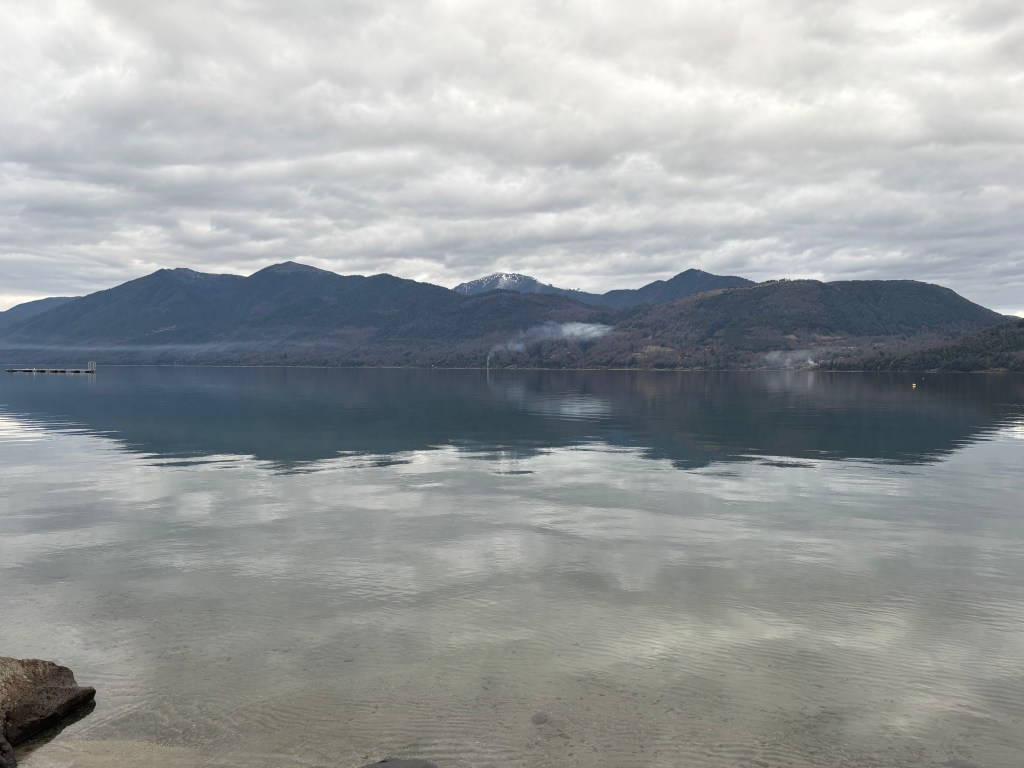
    The gloom in the air lended Lago Carbugua a melancholy sort of beauty. The beach was wide and at such a gradual angle that if you wanted to submerge yourself you had to run a good twenty meters out.

    Smoke in the distance: logging? A home furnace? A guy from Santa Cruz, California?

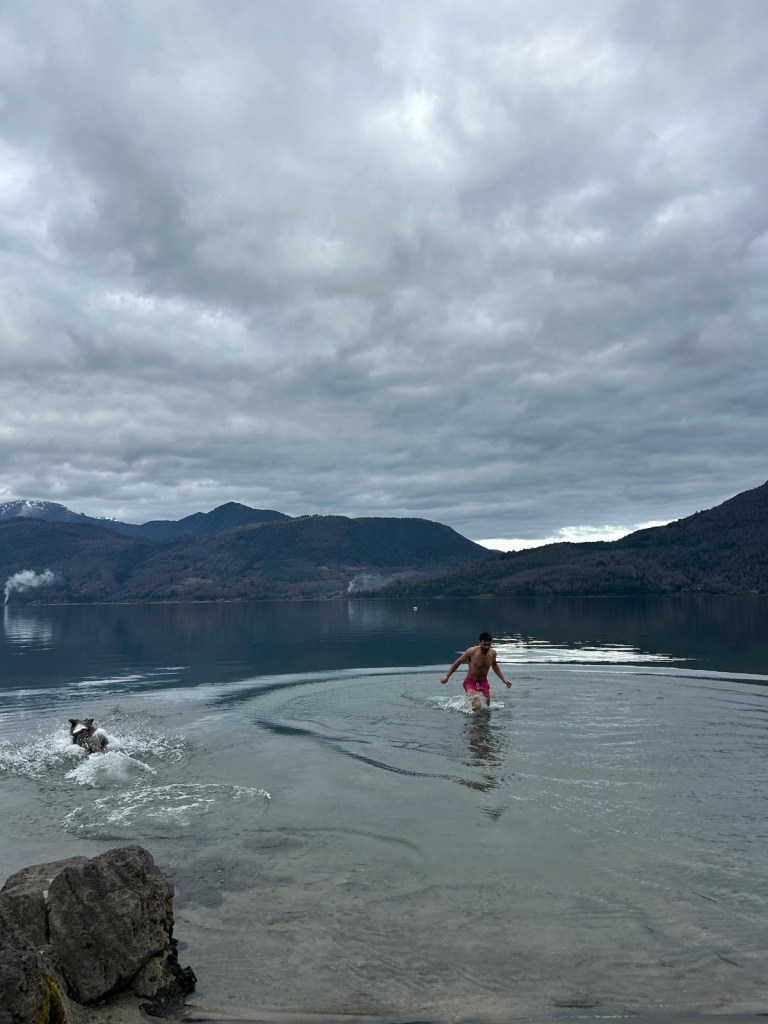
    Which, of course, I did. I have a principle that if I see a lake, and if it’s not teeming with seaweed or chemicals or crocodiles, I will jump in. Despite the cold, I had to follow through for the sake of my own ethos. Although maybe I was just doing it to get the final jolt to keep me awake until we headed back to the Airbnb.

    Thankfully, another principle that I have is that I never regret jumping in said lake, and today was no different. Not to get all pretentious, of course, but you do feel more alive after an icy plunge, and more connected to the nature around you besides. This principle also applies to swimming in the ocean, to going on hikes, and to buying somewhat fancy cheese.

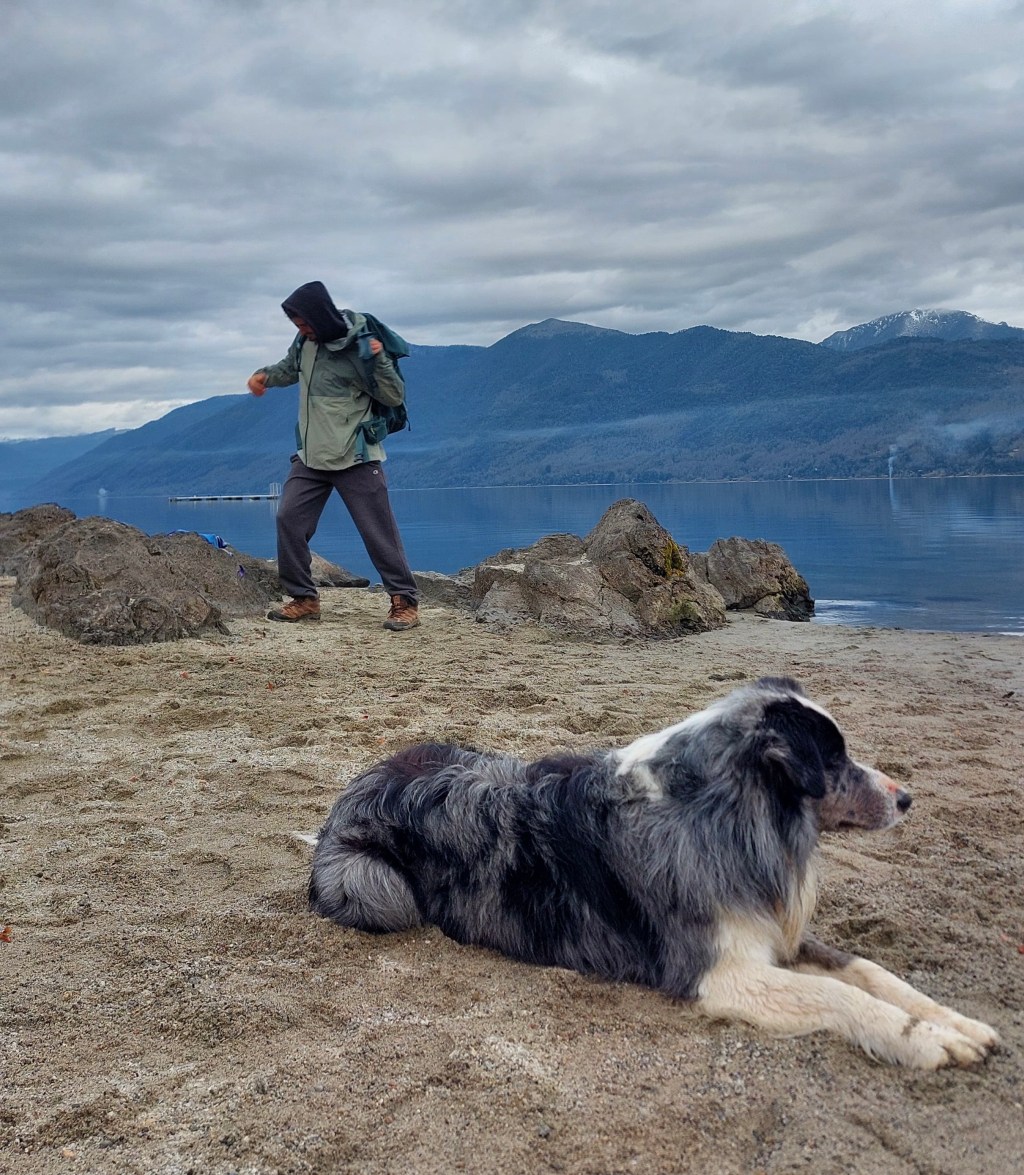
    We stayed until dark. I jumped in again. We passed the time making ridiculous conversation, I’m sure. The only thing I can concretely remember is meeting perhaps my favorite stray dog that I’ve encountered in all my travels in Chile, and I have encountered a lot. His special talent was that if you tossed a stick high into the sky, he would catch it every single time. Here are some photos of us both being animals.

    Yes, he could actually catch this large-ass branch.
    I was far less resistant to the bitter cold of the lake than our new friend.

    We returned to the Airbnb in varying degrees of exhaustion. At this point—some continuous 30-odd hours of being awake—my Spanish had entirely left me, and my English was not far behind. But I had one task ahead of me: a friend from my history class was in town, and his group had booked with an agency to summit the volcano tomorrow morning. In an Airbnb with no Wifi, on a phone without cellular service (we were in an area so rural it laughed at the idea of an E-Sim), signing up for the tour was quite the hassle. But in true buzzer-beating fashion, I succeeded, thanks to Hodei’s hotspot, just before the window closed.

    A few minutes after dinner, a delicious soup that Elena had chef-ed up, I went to bed. I had to be up at 5 AM; seven precious hours, then, to try and make a dent in my sleep debt before the volcano.


    Note: I think I’ve made peace with the fact that my experiences are going to vastly outpace my time, ability, and motivation to write about them. I’ve finally found a good routine that lets me write on most weekday mornings, but I’ve got a good ten or fifteen more posts in the works just to catch up to this point in the semester, and if each one is as detailed as this one, I’ll be finishing them in 2026. Maybe I’ll change things up and be less thorough—but probably not. We’ll see. Regardless, enjoy the sporadic content. Leave a comment or question below, and be sure to subscribe.

  • Chile #2: A Stroll Up Cerro Santa Lucia

    Chile #2: A Stroll Up Cerro Santa Lucia

    I’ve hiked, climbed, ski-lifted, and crampon-ed, if that’s a word, up a lot of hills recently, big and small. What I’ve found is that sometimes a small hill is just as worthwhile as a true mountaineering expedition at altitude, and a lot less expensive and time-consuming, too.

    Last Saturday, I went with some friends to Cerro Santa Lucia, a hill in the middle of Santiago. It’s the baby sibling of the massive Cerro San Cristobal, which dominates the skyline. But even that larger hill is the runt of the geological litter of the Andes towering over the eastern outskirts of the city.

    All of these comparisons are a roundabout way to say that Cerro Santa Lucia measures in at a “lowly” 68 meters, or 223 feet for the free (an adjective that seems to land awry these days, if it didn’t ever before). It’s small enough to be entirely surrounded by downtown Santiago, but rises drastically enough above the otherwise flat valley floor that it remains unsettled, an island of nature hemmed in between the urban hubbub of Barrio Lastarria, Bellas Artes, and Avenida Alameda.

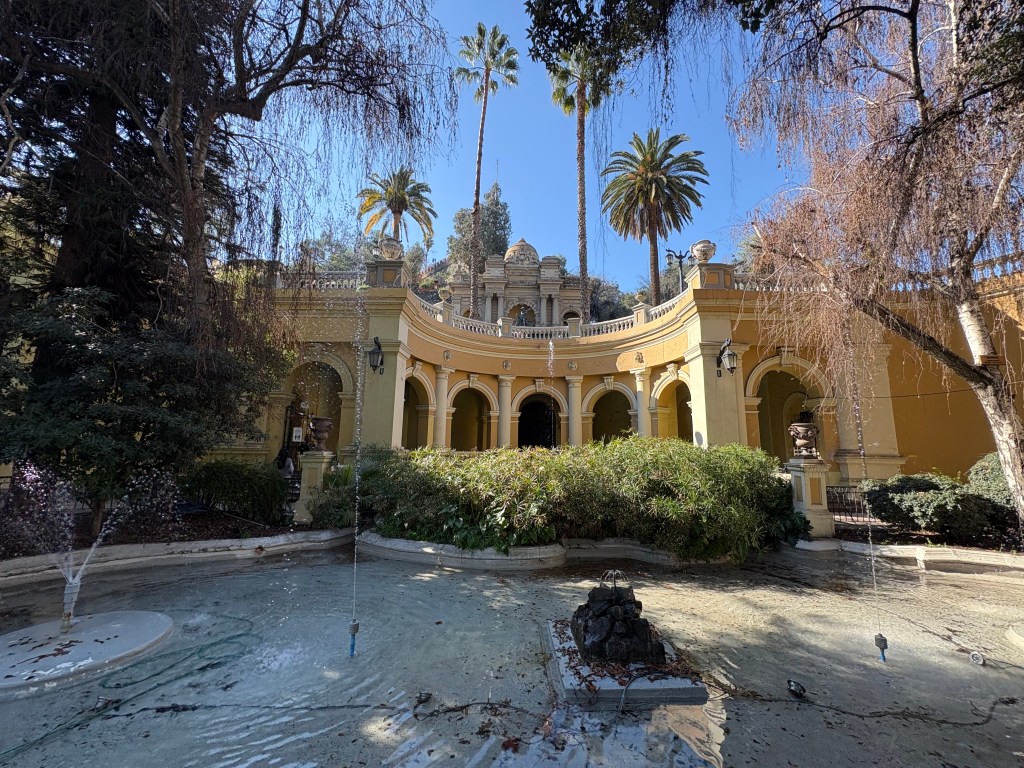
    It’s a steep way up. None of it is straightforward, either. For a seemingly petite outcropping, Cerro Santa Lucia still manages to be labyrinthine. Around its base, the park can’t seem to decide whether it’s open for roaming or fenced-in, and for this reason there seem to be countless entrances, though maybe only a few that go anywhere. At any rate, if you want to ascend, you’ll eventually be corralled onto a cobblestone road and pass by a lively fountain in front of a gorgeous building.

    From here, you have two options: keep following the road, which inclines at a barely-perceptible angle and spirals around the hill—perfect for horses wheeling a carriage fifty-plus years ago, maybe—or you can take a series of jagged switchbacks, which slice their way up with sharp intention.

    For my impatient self, there was only one option. Besides, I had sandwiched this quick outing right in between my midday climbing session and a homemade ceviche night that awaited back at the house. I was able to do so because I’m lucky enough to live close enough to downtown that Cerro Santa Lucia is only forty minutes by walking, thirty minutes by metro, or, best for me, twenty minutes by micro, the term for the hundreds of bus lines that crisscross Santiago.

    While somewhat exerting, the hike to the top wasn’t too bad. It had rained the day before, so in places mud squelched underneath our shoes (a piece of cake, though, compared to the mud in Parque Nacional Huerquehue a week prior). As we climbed, the path occasionally opened up to a beautiful viewpoint here, a charming garden there. Close to the top, a lovely terrace beckoned us with its inviting benches.

    To reach the summit, a platform atop a tower perched at the highest point of the hill, we had to file up a crowded set of stairs. From what I had seen on my way up, I had a feeling the view was going to be something special.

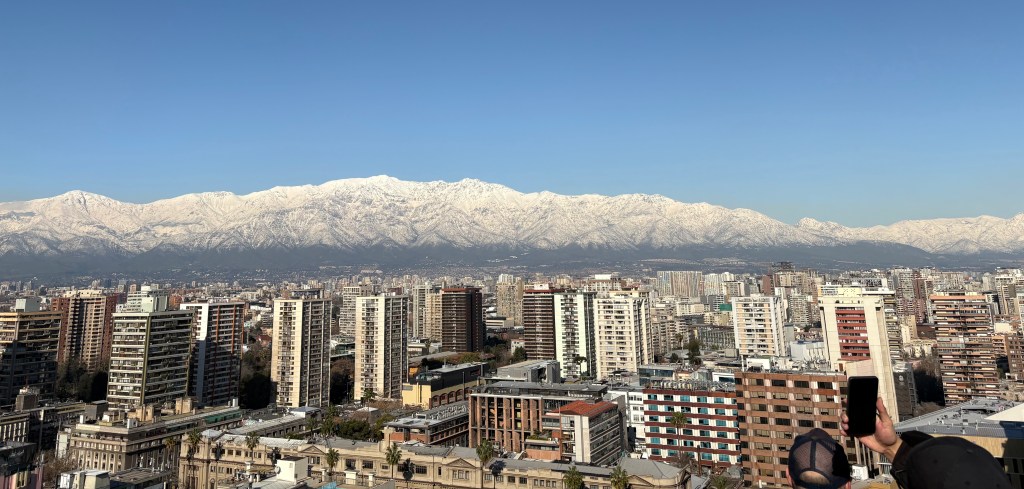
    Special it was. Yesterday’s rains had cleansed the smog and dumped snow on the cordillera, and the result was truly breathtaking. I had seen the city from above from several vantage points, but never like this, with such clarity in the air, with the mountains looming so large, with the ability to turn in any direction you please and see for dozens of kilometers.

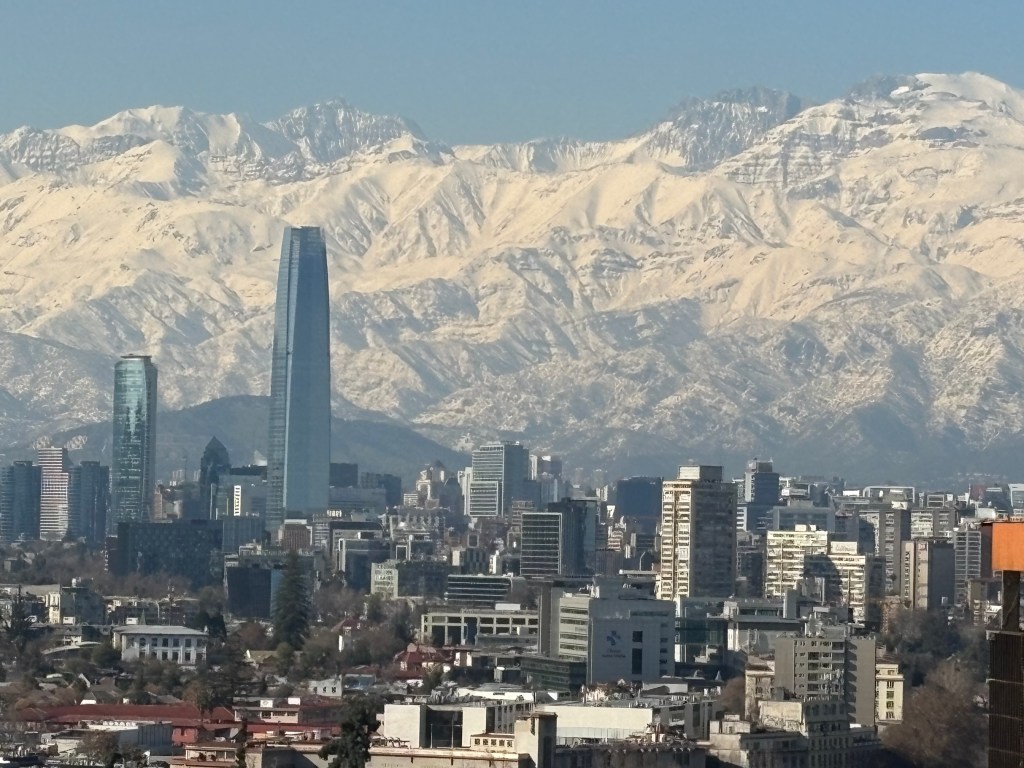
    From this lookout, you realize just how large of a city Santiago is. There are nearly eight million people here, the same size as New York City, but usually, while it feels and breathes and lives like a metropolis, it never feels so aggressively, in-your-face massive as the Big Apple. Atop Cerro Santa Lucia, though, on a raft in a sea of endless high-rises, it’s hard not to be overwhelmed by the sheer number of settlements. Some of the buildings are older, just below the level from where you stand; some of them are modern, stretching above you. In the distance, the Costanera proves that it is indeed the tallest building in Latin America.

    Once again, WordPress won’t let me add videos. Instead of my 360-degree panorama, this picture will have to do, because I don’t want to pay extra.

    I can’t think of anything quite like this view. In its sprawl, it’s kind of similar to looking out over Los Angeles from Mulholland Drive, except that you’re in the heart of downtown, and you didn’t need a car to get there. It’s not like Christ the Redeemer, or for that matter, Cerro San Cristobal, because you’re not so high above it all as to be removed from it. You can still hear construction and music and buses and cars honking at each other. You can still taste the life of the city; you can still place your finger on its pulse.

    And, of course, there are the Andes.

    These are mountains with a capital M. These are mountains that you have to see to believe. These are mountains that once you see, you’ll never really believe, so big they make the skyscrapers next to you feel like an ornate carpet on the valley floor. I’ll put it this way: the smartphone camera is commonly accepted as the great humbler of all mountains, rendering proud peaks smaller than they’ll ever be in your eyes or in your memory, but see for yourself. The Andes refuse to be humbled.

    The big building in the back is the Costanera.

    Descending back into the commotion, strangely, you feel less insignificant. You may be one person among 8 million; the city may be a mere speck next to one of the defining features of our planet, positioned on one of its most active fault lines, but you have people to meet, goals to chase, a life to get back to. As you weave your way back into the quilt that, for one hour, you had detached yourself from, you feel that you are an important thread. You are undaunted by all of those tall buildings. In fact, you hardly notice them.

    One of the great and peculiar qualities of my experience in Santiago has been that, unlike in some other cities, I’ve never felt like an ant, like one tiny unimportant being scurrying among a swarm of countless others, readily crushed at any moment. Or rather, I’ve never felt that way except for when I was at the top of Cerro Santa Lucia.

    I suppose, then, it would be rather apt—and proportionally accurate—to call it the anthill of the cordillera.

    Note: I know it’s been a few weeks since the last post. I haven’t forgotten about the blog; I’ve actually been working on a bunch of different posts. With so much happening every day, it’s hard to find the time, much less keep up with everything. I think my new strategy will be to keep things very focused to a specific theme, moment, or place.

    Feel free to leave a comment or subscribe!

    6 responses to “Chile #2: A Stroll Up Cerro Santa Lucia”

    1.  Avatar
      Anonymous

      Me gusta Serro Santa Lusiaaa!!!🤓

      Like

    2.  Avatar
      Anonymous

      Can’t wait to hike it with you again…?!

      Like

    3. leahhetteberg Avatar
      leahhetteberg

      The pic of the Andes goes crazy, one can only dream of what a good DSLR could do out there. Glad to see you’ve well adapted the Sam Healey schedule into your new environment. Exciting stuff! Can’t wait for the next one ❤

      Like

    4.  Avatar
      Anonymous

      Hola Sammy,

      Ese es el hormiguero más hermoso que jamás he visto. Y gracias por recordarme que debo apreciar los momentos más pequeños, no siempre tiene que ser la montaña más grande que tienes que escalar para tener una buena experiencia… aunque Serro Santa Lucia es gigante!!! Que vista maravillosa!!! GUAUUUU

      Te extraño muchísimo!

      Like

      1.  Avatar
        Anonymous

        Y me alegra que ya estás escalando en el gimnasio también!

        Like

    5.  Avatar
      Anonymous

      hi sam! I am reading your blog as I take my flight from Atlanta to Santiago. Traveling from San Diego to Atlanta was one thing, but leaving the country during this flight is a cumbersome feeling. It is one that my heart is not ready to processs quite yet. I take your words with me as comfort and can’t wait to catch up over a pisco or two. See you soon 🫶🏻

      Emily h

        Like

      Leave a comment

    6. Chile #1: The Introduction, Sort Of

      Chile #1: The Introduction, Sort Of

      It’s Friday evening, and I’m moving into my house in approximately one hour, and I have a feeling that things are about to, somehow, pick up even more. I haven’t had much time to write, and I’m sure there will be even less of it in the coming days. But I made a promise to myself (and quite a good deal of other people) that I was going to keep up with this blog, so I’m going to try and publish this real quick, before my life in Santiago really begins.

      Not that my life in Santiago hasn’t begun or anything. I’ve been here less than a week, yet so much has happened already. I wrote a little bit last Sunday, just to capture the whirlwind of my first weekend, and that will have to suffice for this first blog post. Attempting to capture the days that came after is a project for another day, when I have more time. Will I ever have more time? Who’s to say. However, I will add some updates to what I have written, just to inject some flavor—some ají, if you will.

      From Sunday:

      I don’t even know where to begin.

      The thing is that I’ve only seen Santiago during the daytime for all of three hours. Update: Santiago during the day is rad, especially after it rains and you can see the cordillera in all of its glory. 

      I wasn’t able to catch even a wink on the plane, so I’ve been putting up heroic sleep numbers this weekend. On Saturday, I got a full workday, a 10AM to 6PM shift; on Sunday, an ever so slightly less nocturnal 3AM to 3PM. Admittedly, the sleep has been in a heated bed, quite easily the greatest innovation in the thermal department since fire itself. You can understand why the bed has ensnared me so. 

      But that hasn’t even harshed my vibe, as one could say. I’ve had a grand old time. 

      I’m going to try, and fail, to not sound like a little kid, enamored with every little thing from petroleum stores where they sell honey by the kilo to the roving bands of fifty-odd guys on motos flagrantly disregarding stoplights in comuna Santiago. Or the cleanliness—and the station art—of the metro. The fact that everybody here dresses way cooler than back home. The guys bombing Cerro San Cristobal on skateboards. Having tea with every single meal. Having bread with every single meal. A kid biking around with, inexplicably, a cheap plastic prosthetic leg in his hand. The magicos, colorful (and massive) weed brownies that you can buy on street corners outside of bars or record stores that look like they could take you higher than the cordillera itself.

      Or chacareros. Freaking chacareros. Whether homemade or at Bar Alameda, I can get down with a chacarero. 

      It’s not an exaggeration to say that being here is positively electrifying. 

      Granted, it’s only been two days. But on the other hand, it’s only been two days. I haven’t even been to a single orientation at my university yet, or laid eyes on the house that I’m going to live in.

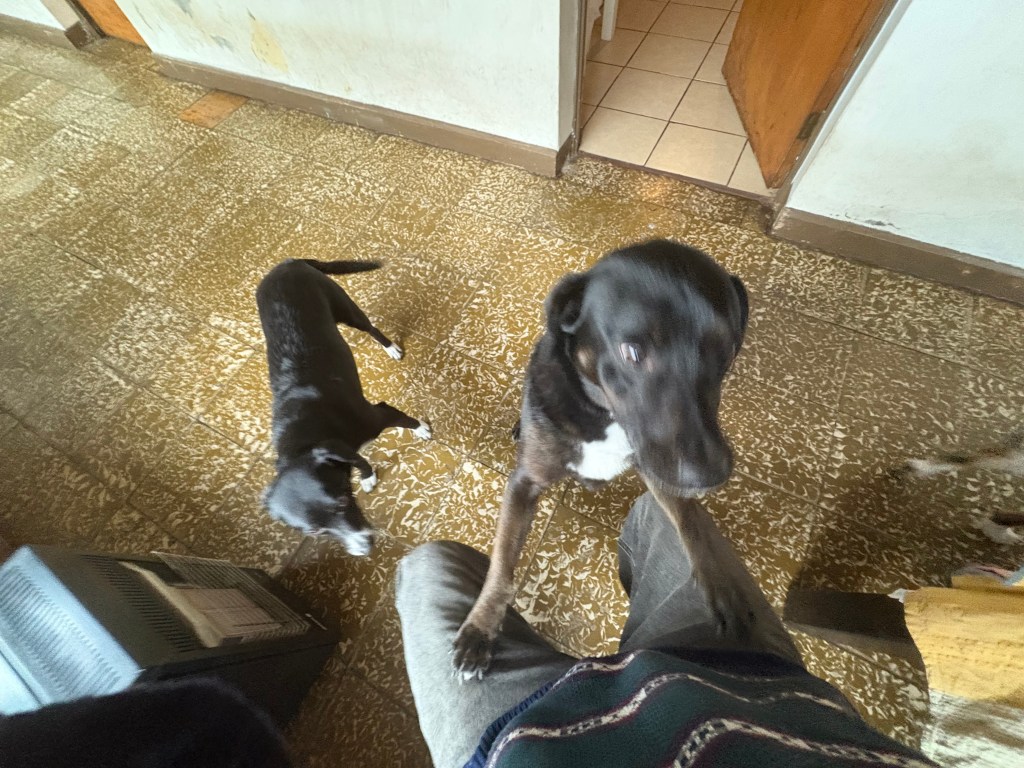
      So where have I been? Right now, I’m in comuna Huechuraba, in the aforementioned heated bed, at Barbara’s house. Barbara has three ridiculously cute dogs, Cala, Guita, and Mamba (I have probably spelt these names wrong) who are super friendly and jump really high. I want to add a video of their hops, but apparently you need WordPress premium for that. Lame. Here’s a not-lame (but blurry as hell) photo of Guita and Mamba:

      Barbara’s house is super cool. It’s really, really long and narrow, kind of like Chile. It used to be a horse stable. 

      I know Barbara because she is the sister of Lorena, who is the wife of Laura, who is the good friend of my older sister, as these things often go. Yet despite being halfway to the theoretical maximum of degrees of separation, I have been treated like family the entire time. Barbara has shown me what feels like the entirety of Santiago in two days—but let me take it from the beginning.

      The first restaurant that I saw in Santiago was a Dunkin at the airport, a slice of home 5,000 miles away. After making it through the customs line at around 6:30 AM, I got a ride from Pancho, a family friend of Barbara who told me a bit about Santiago and about his jobs as a professor and a prison psychologist. 

      Then I arrived at the house of Nina and Pepe—Barbara’s parents—for breakfast, bread with meat and cheese. The bread here is really good, especially marraqueta, which I already know I’m going to miss when I leave Chile. Update: I’ve had multiple marraquetas every day. Their house is in comuna Recoleta, and they have the prettiest garden I have ever seen. So far I have been so lucky as to try three of its yields: oranges (and orange juice), almonds, and ají, which is a tangy kind of hot sauce, although the homemade one is more like a really fresh salsa.. All three have been divine. Update: When I told them how much I love ají, Pepe brought me my own container so that I can season food to my heart’s content.

      Then I slept, which I told you about already. That night Barbara and I went to comuna Santiago and we had completos, of course completos (I forewent the mayo on the italiano), and afterward we walked around the Rio Mapocho and endless museums and government buildings and the Plaza de Armas and the Costanera and a whole lot of universities. On the sidewalks you can buy secondhand clothes, and I realize now that I should have come to Chile nude with an empty suitcase because literally everywhere you look you can find grail pieces for cheap. 

      A few times I took photos, but Barbara told me to ask before I did so to make sure it was safe. The rule she gave me for walking at night is that if there are dogs, families, or bikers on a street, you’re definitely in the clear, but if it’s empty, take caution, especially later. Of course it depends on the area, as these things often go. In comuna Providencia, where my house will be located, it is, allegedly, safe all the time. But you can’t go out in Bellavista these days without putting yourself in a bit of danger. Update: I went out in Bellavista.

      That was the extent of what I wrote on Sunday. As I look back on it now, it seems like I’m not even really going to be able to cover much of my second day in Santiago, because I have to go soon and I want to get this on the website. I’ll try to throw a few random thoughts out there real quick, though.

      Every single house in Santiago is fenced-in, yet I’ve met more next-door neighbors here in a few days than I have in two years in Isla Vista. It’s funny how that works. In the U.S, our houses are, physically speaking, far more open, yet compared to here, our communities are far more closed off. 

      Barbara, Nina, and Pepe are absolutely awesome. Here was Sunday night dinner:

      I’m truly so grateful to them for showing me around, feeding me, and housing me this last week—and being patient with my shitty Spanish on top of that.

      In terms of Spanish, I had a realization after my first weekend:

      1. My Spanish is really bad.
      2. It doesn’t even matter. I can make myself known, understand enough, and even have a personality from time to time.

      Revisiting that prediction, I’m not so sure it’s aged well. My Spanish is really not up to par. However, being thrown into the fire has been a cool and fun challenge. The only scary thing is that an entire can of gasoline is about to be poured on that fire: all my classes start next week, and I’m about to meet a whole lot more people. Ojalá tenga éxito.

      I’m not worried, but I am going to have to probably actively study a little bit each day, in addition to my steady daily overdose of immersion. 

      Okay, this first blog post has been all over the place. In the future, I would like very much for that not to be the case. After next week, I’ll know a lot more about my rhythm, I think. I’ll be more prepared to write these, will know when to do so, and will have a whole lot more to update you all about. I’m excited to get on a consistent schedule, with this and everything else.

      But until then, more craziness. I wouldn’t want it any other way.

      Feel free to drop a comment below, and definitely make sure to subscribe (god, what have I become?).

      12 responses to “Chile #1: The Introduction, Sort Of”

      1. leahhetteberg Avatar
        leahhetteberg

        The way I physically dropped everything the second I received this link. What a great start to this project Sammy!!! Don’t harsh yourself too much for not writing as much as you wanted, the fact that you have created and published a formalized piece of personal and creative expression is more than an accomplishment in itself, nevertheless considering how much you’ve had going on this week!!! I am so excited for this 🙂

        P.S. it made me log in to WordPress to comment this which I have not done in actively years and am discovering some old projects of mine. scary.

        Like

      2. leahhetteberg Avatar
        leahhetteberg

        The way I physically dropped everything the second I received this link. What a great start to this project Sammy!!! Don’t harsh yourself too much for not writing as much as you wanted, the fact that you have created and published a formalized piece of personal and creative expression is more than an accomplishment in itself, nevertheless considering how much you’ve had going on this week!!! I am so excited for this 🙂

        P.S. it made me log in to WordPress to comment this which I have not done in actively years and am discovering some old projects of mine. scary.

        Like

      3.  Avatar
        Anonymous

        Love your first post!

        Love, Mom (ha!)

        Like

      4.  Avatar
        Anonymous

        ¿Cómo me suscribo a tu blog, amiga?

        Like

      5.  Avatar
        Anonymous

        Que blog tan maravilloso! Y que bueno saber de ti. Al principio las palabras te duelen la lengua como el ají, pero pronto mejorarás tú español y ya dejarán de lastimarte. Ten paciencia y aprovecha tus guías chilenas. Aprender a relajarse en español puede ser más valioso que estudiarlo por toda la noche.

        Un abrazo, Julian

        Like

      6.  Avatar
        Anonymous

        ooh lala, mamacita 🥰

        Like

      7.  Avatar
        Anonymous

        Sam I love this! I can’t wait to read more of your writing 🙂 – Julia

        Like

      8.  Avatar
        Anonymous

        Sending most passionate love from Bakersfield

        Like

      9.  Avatar
        Anonymous

        empanada de pino review soon please

        hw

        Like

      10.  Avatar
        Anonymous

        Sam,

        Tu escritura es tan animada, me encanta! Me hace feliz de saber que lo pases bien – solo es el comienzo de tus aventuras! Por favor ecuentre algun lugar para beber unos pisco sours!!

        Te veo pronto,

        Emily H.

        Like

      11.  Avatar
        Anonymous

        Sammy,

        Leyendo tu blog me llena el corazón. Ahora sé, inclusivamente más que antes, que este es exactamente el lugar que debes estar 🙂 Me alegro que encontraste una familia tan maravillosa y cariñosa y que estás disfrutando de todas partes de la ciudad! Pronto te vas a sentir más y más cómodo en el español, yo lo sé!

        Te extraño mucho, pero con mucho alegría,

        Sofía

        Like

      12.  Avatar
        Anonymous

        Estoy muy contenta de haberme tropezado con este blog. Que maravilloso otoño te espera!! Ya puedo decir que to español será más mejor que la mia cuando regresas.
        – Josie

          Like

        Leave a comment