Tag: san-pedro-de-atacama

  • Chile #9: San Pedro, Part 2: Searching for Blue Takis

    Chile #9: San Pedro, Part 2: Searching for Blue Takis

    September 12 (?), 2025

    I can’t explain why, because since coming back to the States, I’ve only had them once, and they truly just were not the same. They lacked a hint of lime, I think, or maybe their strange, almost magical pull only worked when I was on foreign soil. Whatever the reason, during my time in Chile, I was a fiend for Blue Takis.

    I must have eaten at least twenty-five bags of them. Worse, I became known for doing so, both by my housemates (for whom my very ethos, at times, boiled down to Blue Takis) and by the broader market reactions of the Chilean economy. That latter part is mainly a joke, but I do swear that Tottus, the supermarket two blocks away from my house, started stocking them for me: as the semester went on, they went from scarce to scarily abundant on the shelves.

    But before they were a disturbingly large part of my abroad identity, they began as just an idea, and an elusive one at that. It was a concept that intrigued me and frightened me in equal parts.
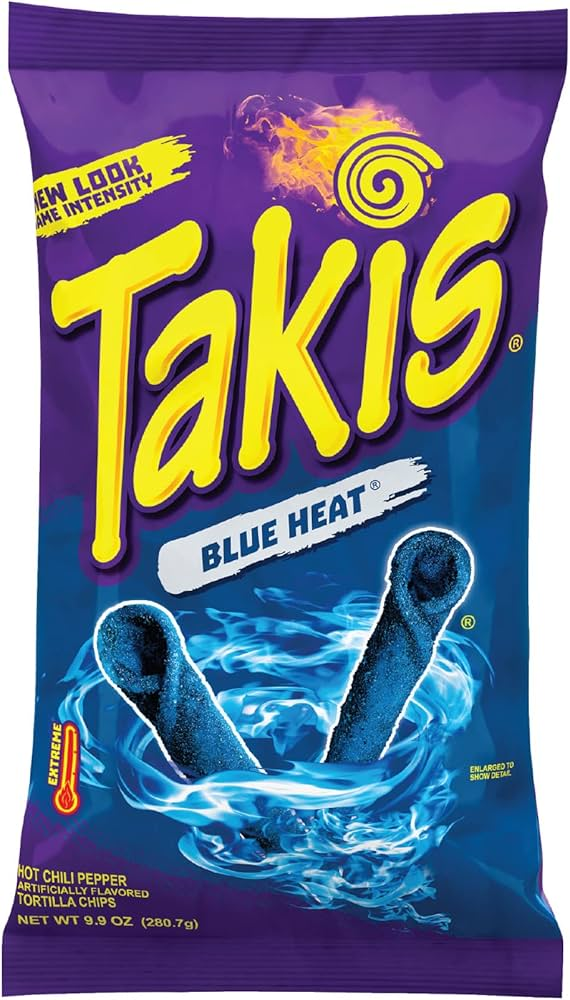
    For reference. Why are they blue???

    For no reason at all, the obsession began in San Pedro de Atacama. At some point on the trip, Anna and I had discussed how takis azules existed and how they must be horrible—and as soon as it was it acknowledged, it had to be proven. It was like finally verbalizing the unthinkable tension at the core of a doomed relationship; anything short of a breakup would be impossible.

    Maybe that’s a bit much. Really, it was a matter of curiosity, descended from our house’s tradition of trying the most artificial snacks that Chile had to offer. Throughout the semester, Anna had insisted on the supremacy of the sabor quimico of cheese Ramitas, a Chilean stick-shaped chip (the bags were dense, too: you could never call them guilty of selling air like Lay’s). In the same vein, Dylan and I were constructing a tier list of every ice cream bar that could be bought in the frozen aisle of Tottus—the “Danky Nogatonga,” of course, being the eventual winner.

    Blue Takis, while not Chilean in origin, scratched the same itch. Thus, on our second day at San Pedro, after returning a day exploring the desert beyond, I felt like it was the perfect time to start searching. We had arrived back in town in the middle of the afternoon, and after thoroughly enjoying a Menu Del Día, the only other big activity we wanted to do was a stargazing tour. Most of the group was ready to relax, but I was still possessed of that traveler’s desire to explore, so I told everybody that I would go out and book us with a guide.

    With this task to take care of, not to mention some audio messages to send to friends back home, it seemed logical to fold one more loose quest—locating Blue Takis—into the mix.

    As my friends rested, I set off on my solo mission. Our Airbnb was one turn off the highway, sequestered away from the tourist sections of the town. Nestled (to use the saccharine language of vacation home realtors, or Airbnb hosts) right next to a little playground. From here, it was a few windy turns to reach the town center.

    As I walked, I passed another, more deluxe playground (Chile has top-notch playground game, let me tell you). Next was the bus stop where I had tried to meet Suditi when she had arrived the night before. There had been two dogs fighting for control of a street corner here, but I never saw which had prevailed, as just then Suditi had called to let me know that she was at the front door of the Airbnb instead of at the bus stop. Because she was meeting my other friends for the first time, I had to run back home.

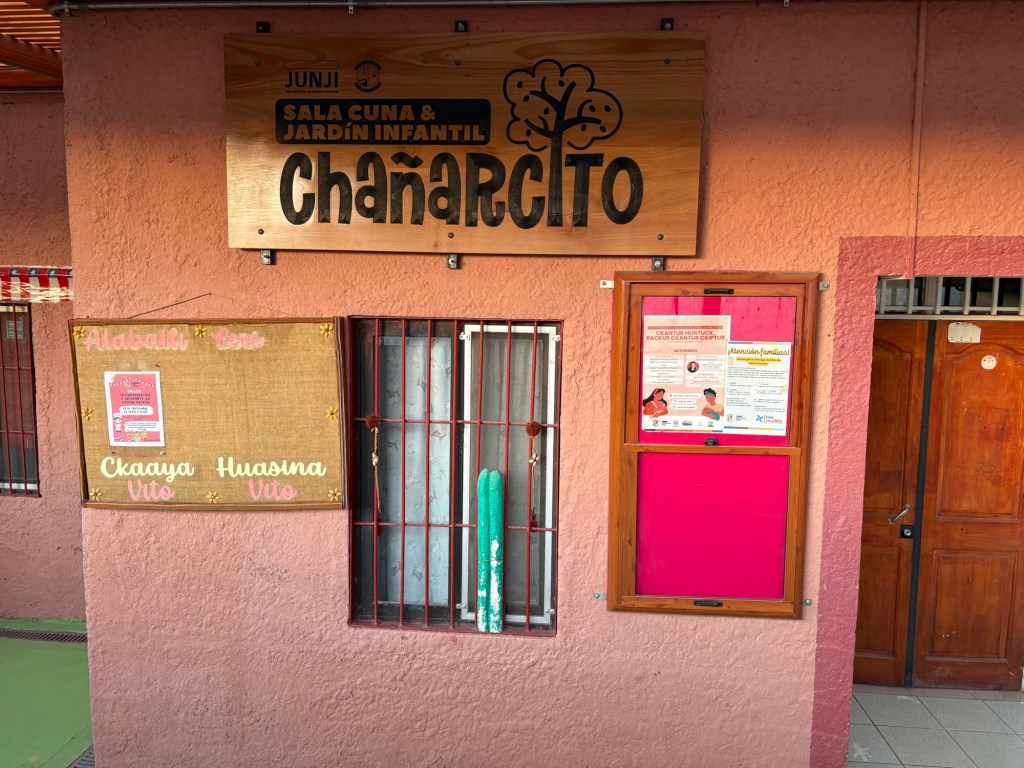
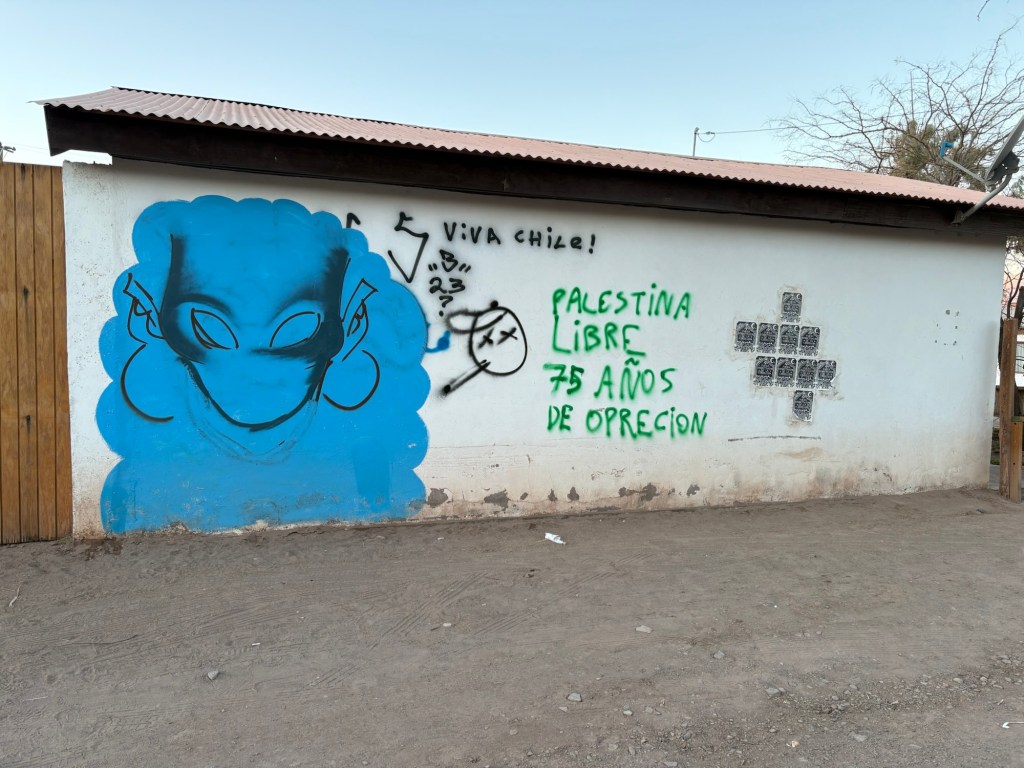
    Even as I drew nearer to the town center and the more-trafficked areas, there were plenty of signs of a thriving local community distinct from the tourist economy. The graffiti and murals, which abound in Chile, were tinged with a distinct Altiplano flair. The tiny elementary school had flyers on its adobe walls written, at least partially, in an indigenous language. Just past this was some sort of cultural center/amphitheater hybrid, empty but decorated with the national colors of red, white, and blue—ready for fiestas patrias.
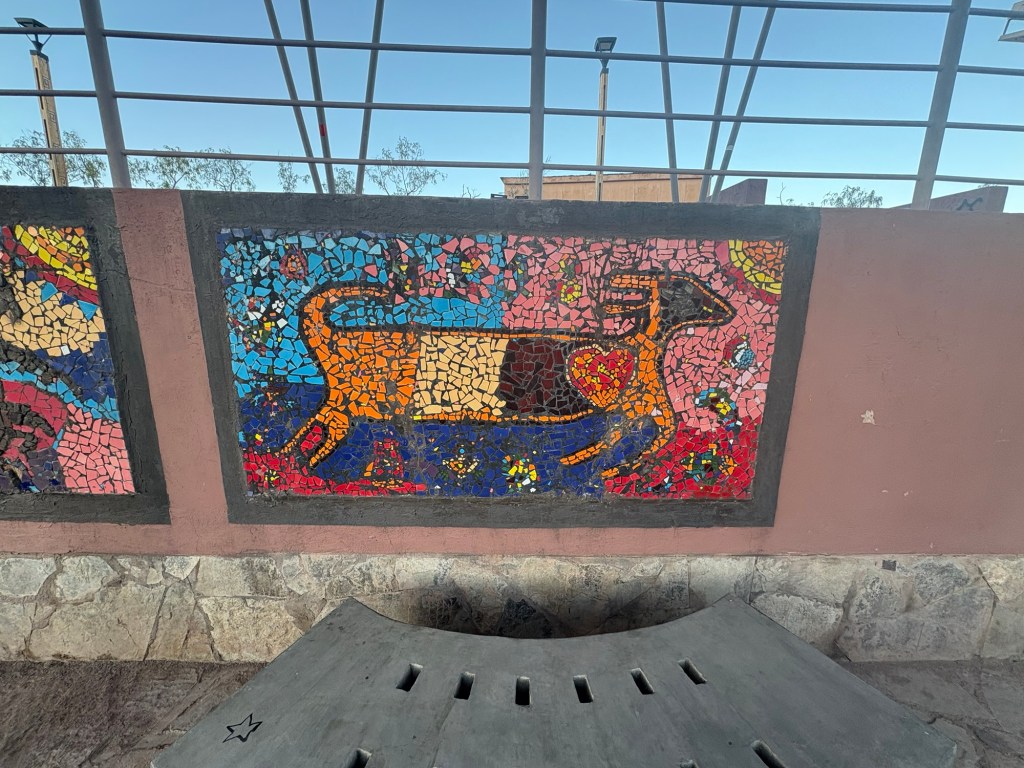
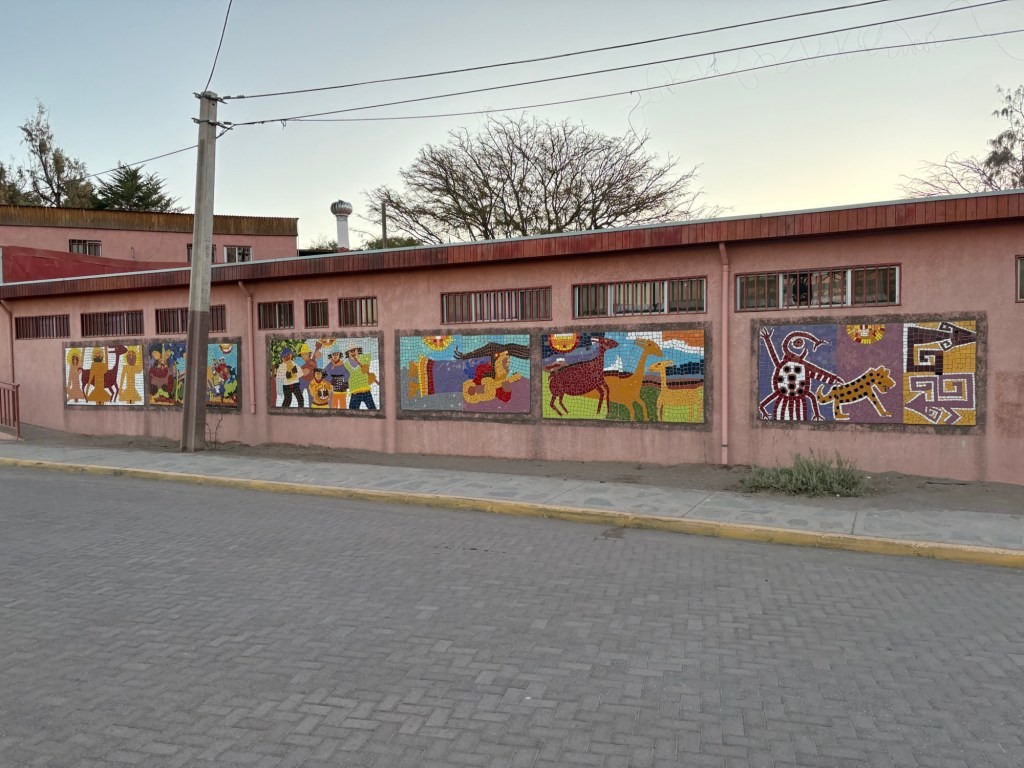
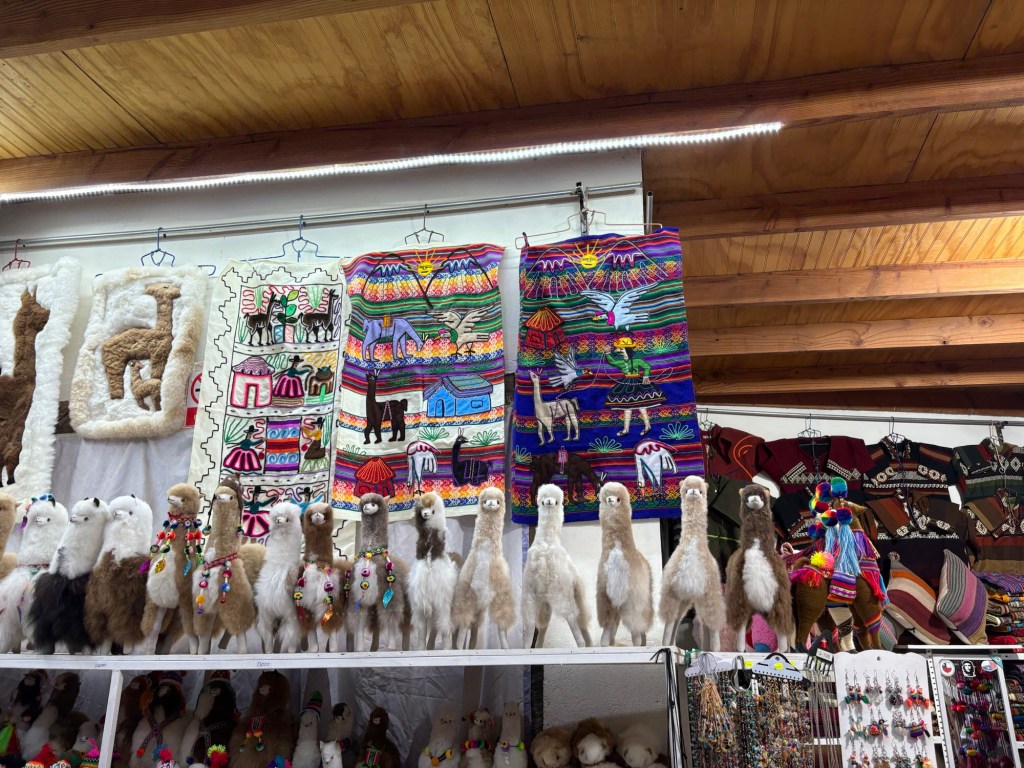
    Further in, the main drag of San Pedro hummed with tourists returning from the days’ excursions, a dirt road lined with tour agencies, hostels, and bars. Especially numerous were the vendors selling their wares; every other door offered blankets of striking blue and orange hues, coats fashioned from alpaca and vicuña fur, or countless bracelets and hats and necklaces. Not to mention the plethora of fridge magnets and “San Pedro de Atacama” T-shirts.
    We had come the night prior, too, to explore. The Spanish word “recorrer” comes to mind, which doesn’t have a great English translation. “Travel around,” maybe; we had been taking a stroll. At some point, we had gotten completely lost, routed away from this main street. It was late, our data wasn’t working, and there wasn’t really any street lighting. With the desert architecture, it felt like we were in the back alleys of Mos Eisley, minus the scum and villainy. Instead of being scary, though, it had been fun. San Pedro wasn’t large enough to be lost in for too long, so there was no urgency, and eventually we had found the Airbnb.
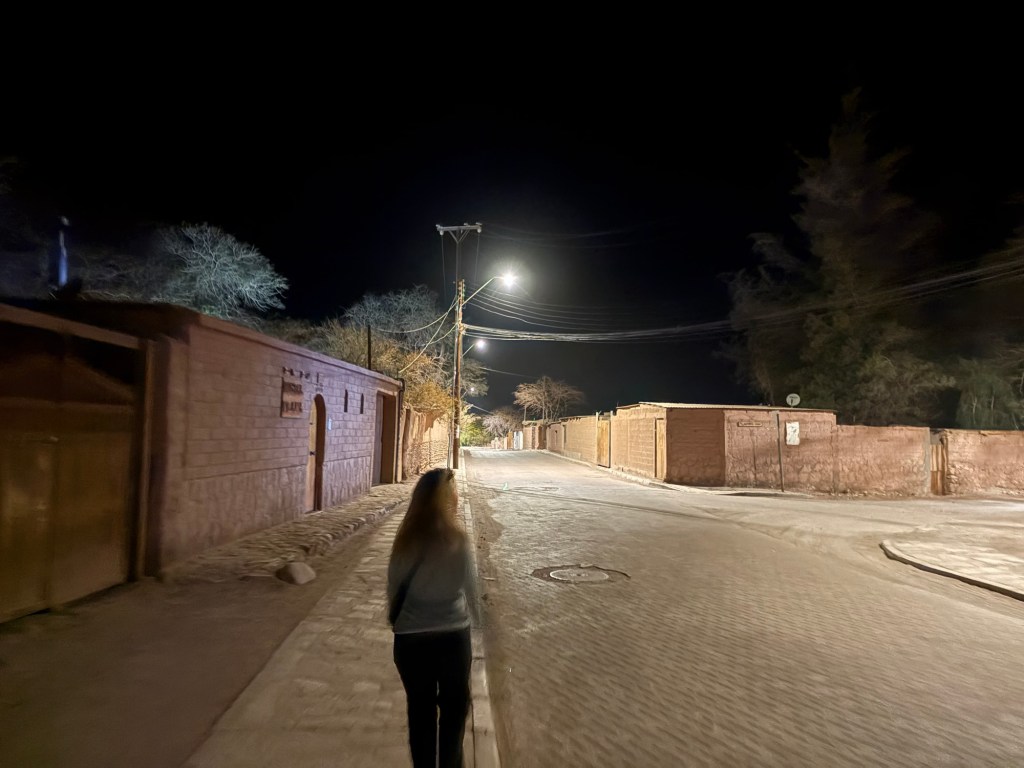
    Night wanderings.

    I guess I’m mentioning this because on that previous night’s walk, I had listened to every single stargazing tour guide’s official pitch and acquired every single one of their flyers. Since then, I had crunched the numbers and identified the one that was the most optimal—that is, the cheapest. Their tour office was my first destination.

    I can’t remember a single thing about booking the tour or about the interaction, which means that my Spanish was probably not too bad. I signed us up, got their WhatsApp for coordination purposes, and, checking the time, texted everybody that we had about two hours before they picked us up at 8pm.

    It was time to transition to Phase Two of the mission: Operation Blue Takis. But before I could peel away from the thoroughfare and begin searching the minimarkets of the less-traversed streets, I was distracted by an ice cream store with a line jutting into the street, causing other pedestrians to adjust their course around it. Ice cream sounded great; was it worth waiting for?

    The math got a whole lot easier when I noticed that right next to this ice cream place was another one with no line. In no time, I was savoring a double scoop of mint and lime. It made all the difference, I must say. If I ever publish a Youtube video of my “Top 5 Robert Frost Inspirational Moments,” this experience will make the cut.

    Ice cream in hand but still craving the mystery spice of the nebulous Blue Takis, I began to wander the side streets of San Pedro. As I stopped in minimarket after minimarket (Chile has top-notch “minimarkets per capita” game, let me tell you), I realized that I had stumbled upon a pretty solid formula for solo exploration. I would enter a minimarket, look for the Blue Takis, fail to find them, make conversation with the shop owner (a two-in-one of learning about the town and practicing my Spanish), pet the dogs sitting by the front door, and set off for the next one.
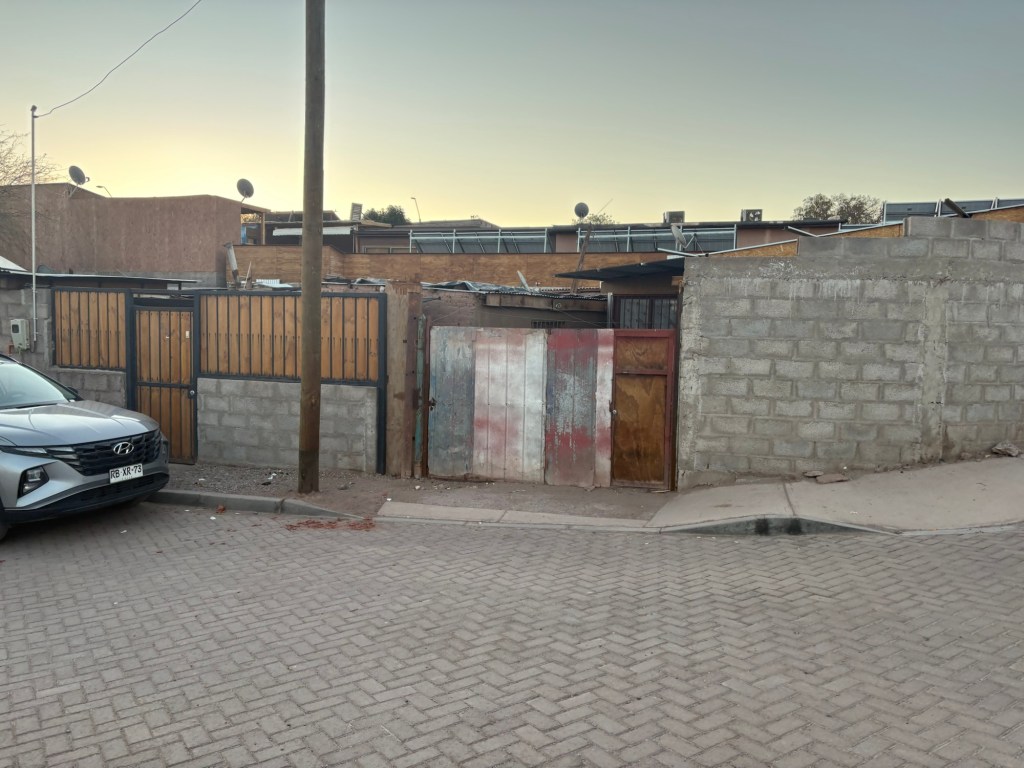
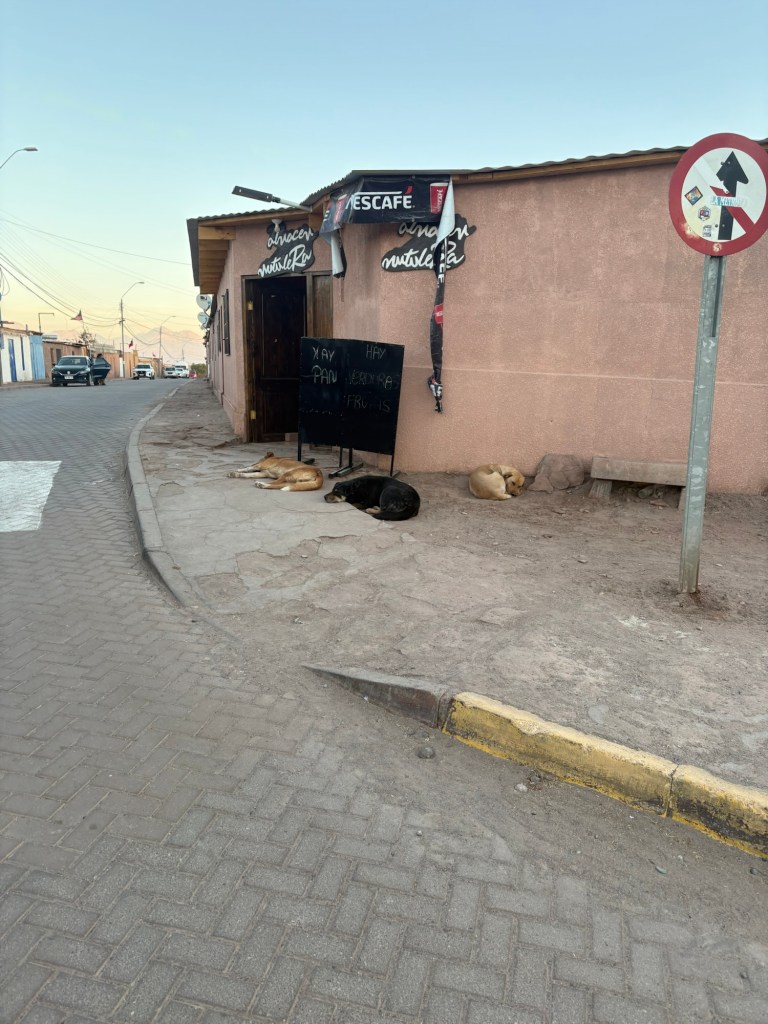
    Wandering San Pedro again. Throughout my semester, Chilean support for Palestine was everywhere.

    I think the key for this system was having a goal, even a relatively unimportant one. Aimless wandering, it turns out, is better with just a bit of aim.

    Just a bit, though. The fate of your day can’t hinge on the success of the mission. If this had happened later in the semester, when my chemical dependency had built up, it might have been different. Thankfully, it wasn’t all that crucial today, which was good, because I just wasn’t having any success. I found normal Takis, Nitro Takis, Xplosive Nacho Takis, and even Guacamole Takis, but no luck with their blue cousins—which of course only increased their allure. With every failure, I began to build up anticipation for a potential breakthrough.

    And then, as I rounded a corner, I heard music.

    If there’s one thing I’ve learned from traveling, not necessarily in the “survival skills” sense but in the “maximizing experiences” one: when you hear music in the small town of a foreign country, you must follow it until you find the source. Although maybe I didn’t learn this, exactly, because it wasn’t a conscious decision so much as an instinct. I was a salmon being guided to a spawning point. I streamed along, passing not one but two dirt soccer fields in the process, until I ended up back at the amphitheater that I had seen earlier.
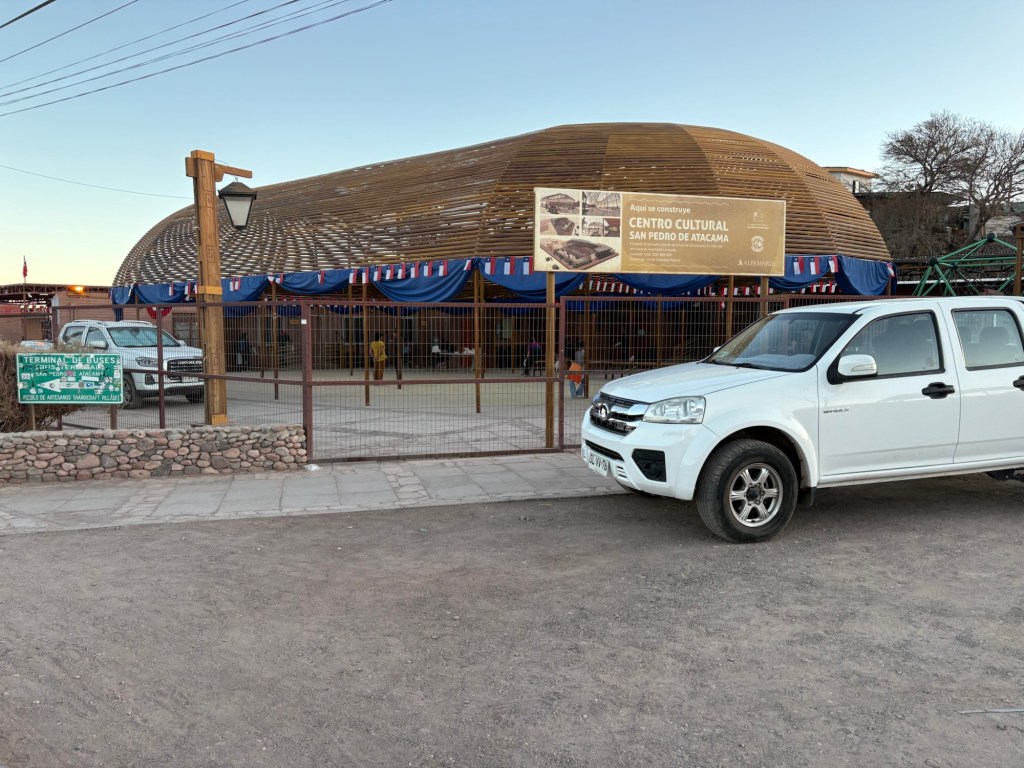
    It had been previously empty, but now there were people streaming into the entrance. I made my way into a courtyard with sections of folding chairs, of which probably half were occupied. To the right, there were some oversized steps that a group of people were sitting on. There were probably fifty people in total there; I seemed to be the only extranjero. I’m sure a fair amount were domestic tourists, certainly some santiaguinos, but the majority seemed to be local families ready to support relatives who might be on stage.

    I took a seat about five rows back from the front. Up on stage, there was a band playing. Specifically, a band of old people. And they were positively rocking out, playing folk music, with multiple guitars, tambourines, and an accordion. They were dressed in clothes which I assumed belonged to an indigenous tradition (Aymara, Diaguita, Atacameño being the ones most prominent in the region). “Es una pruebita, no más,” said one of the men playing guitar—they were warming up, just showing us a little vibe, nothing more.
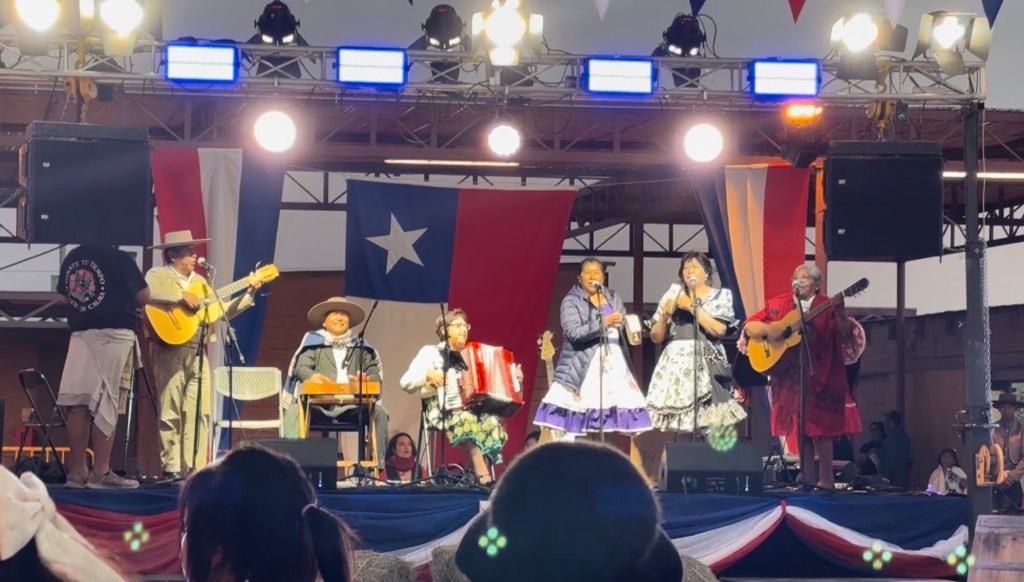
    Soon they jumped into the next song, which seemed to be more structured than the previous jam. Multiple singers blended their voices into one harmony, with somebody occasionally punctuating the melody with a “tiki tiki ti” or a holler or a downright ululation. The vibe was phenomenal, and I let the music wash over me. I was (and still am, to be honest) at the point where it’s not always the easiest to passively translate songs in Spanish—I must actively tune into the lyrics—and right now, feeling the moment, instead of understanding it, just seemed more important.

    I thought about texting my friends to let them know but decided I would be mildly insufferable, gatekeeping the moment that I had discovered for myself. Besides, they were busy making dinner. As a tradeoff for booking the astronomy tour, which was soon thereafter anyway, I didn’t have to help. So, while I needed to head home soon, I could just enjoy the right now.

    Behind the stage was a large Chilean flag. In front of it draped semicircles of red, white and blue; spanning the courtyard were lines showcasing those same colors. The place was fully fiestas patrias-ed out. To be fair, so was just about every business, home, and public center these days. Even my climbing gym had a set of translucent holds with Chilean flags and pinwheels inside.
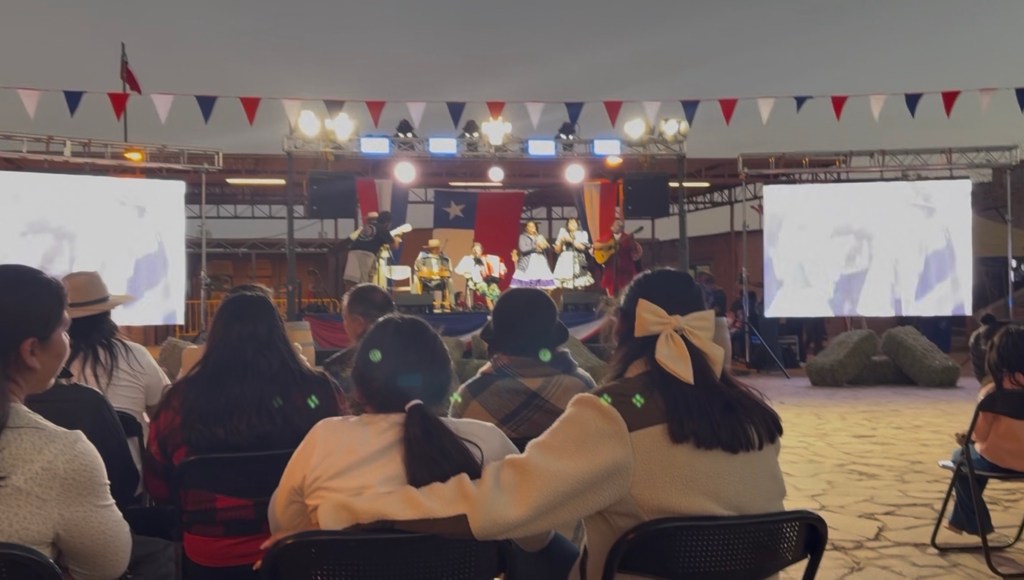
    Zoomed-out screenshot from the same video to show the decor.

    That was one thing I loved about fiestas patrias, and something that I was trying to reconcile about the Fourth of July: the flags everywhere, the rampant patriotism. As I watched the band perform amidst a sea of national imagery, my mind drifted to how something like this might look in the United States.

    It was hard to get past the thought that if there were an American-themed music show in 2026, besides that fact that it would probably be intentionally divisive, it would also just be, well, cringe. Hello, the TurningPoint USA Super Bowl halftime show.

    But why?

    Well, Chile seemed to be quite good—better than us, anyway—at separating the celebration of the country from the celebration of all that baggage that comes with it. This is something that I think we on the left in the United States tend to be more hesitant about (and something that those on the right tend to care less about).

    Granted, we occupy a completely different geopolitical position. We’ve committed imperialist atrocities around the globe, and domestically, the flag has been co-opted at times to stand for things contrary to what it should, like fear, like the hegemony of a white settler-colonial state.

    But Chile doesn’t have the rosiest past (or present) either, which the average citizen seemed ready to acknowledge. To be honest, being critical of the state in Chile seemed to permeate the collective social consciousness with an institutionalized depth that we in the U.S. haven’t reached. There are the various exhibits commemorating the horrors of the Pinochet regime, the “¿Donde está Julia Chunil?” graffiti questioning the disappearance of a Mapuche activist that is nearly as widespread as the flag itself, and of course, right before fiestas patrias is September 11, a national day of protest.

    Furthermore, Chilean leftism is relevant and organized on a scale that would terrify us, or at least terrify the corporate forces that have influenced us to be so wary of anything left of center. The runner-up in the presidential election, Jeannette Jara, was from the Communist Party.

    But those millions of Jara voters, from what I can tell, celebrate fiestas patrias on a level that I’ve haven’t really seen at any Fourth of July function. A large part of that, of course, is celebrating family and friends being together, but the national identity is the impetus for it all. And it doesn’t change the fact that the average person on the left celebrating the Fourth might be, for any number of reasons, more reluctant to go all “rah rah USA” than the average left-leaning Chilean would be for Chile during fiestas patrias.

    Keep in mind these are the observations and generalizations of a foreigner in Chile, so consider this a “vibes-based” analysis. Analysis is a strong word, even; this is a mildly revised write-up of where my mind happened to go as I watched a woman in her sixties shred on the accordion.

    Expanding it beyond ideology, we’re simply a different nation than Chile. We’re so geographically massive and so powerful that we often don’t think beyond our borders when we conceptualize the world, except when we’re talking about a trade war, or an immigrant invasion, or the latest country we’ve bombed. American exceptionalism is so ingrained in our collective psyches that sometimes our reality starts and ends at the United States.

    Weirdly, I feel like that (and again, the imperialism might play a role) makes it harder, at times, to identify as an American on a level that you feel. Perhaps defining your country as it stands in relation to other nations is instrumental in tethering national pride to personal identity.

    Furthermore, we’re much more heterogenous and immigrant-descended. Not that Chile is entirely homogenous, with indigenous, Venezuelan, Haitian, Arab, and other identities contained within it, but in the U.S. there are a higher percentage of people who might resonate with a different national identity. In Providence, where I’m from, Dominican, Guatemalan, Italian, Cambodian, and many more would come first.

    And culturally, in some ways we’re more fractured. In Chile, fiestas patrias features the cueca, a national dance with a traditional structure and set of rules. Everybody drinks terremotos, a concoction of pipeño wine, pineapple ice cream, and grenadine, so named because they get you drunk enough to feel like the ground is shaking (terremoto means earthquake). And in cities and villages of all sizes, people gather at fondas, showcases of food and dance and games.

    We have, uh… “Party In The USA,” by Miley Cyrus.

    Okay, don’t get me wrong, fireworks and burgers and beer are pretty great. And I always liked going to the Bristol Fourth of July parade (the oldest in the country!) as a kid. But the scale of revelry is completely different.

    It also makes me think of how Chile and just about every other nation in the world sings songs at their sporting events on both the national and club level. Meanwhile, we have “U-S-A!” and “De-fense!” The only thing we do that even comes close are the marching bands at college football games.

    These thoughts continued as the band finished, and the next act came on stage. Up to perform was a large dance unit composed of schoolboys and schoolgirls of all ages. The boys were wearing white pants and button-downs, while the girls were resplendent in Chilean flag skirts. Just before their performance began, everybody stood up for the national anthem. As it played, people sang along, and it seemed to me like people felt the emotions of it in a way we just wouldn’t. Again, as a mere observer, this might not be true.

    But I couldn’t help and wonder: why did national identity seem so unifying here, and so divisive back home?

    I’d rather pose that question and let it sit than meaningfully address it—perhaps it wasn’t even fair or accurate to begin with. An answer to any part of it could be a thesis-level project, anyway, which requires a level of research that I just don’t have the patience for right now.

    Now I’m sounding like a true American. Maybe the real national identity is just the critical thinking we weren’t willing to do along the way.

    Anyway, the sun was setting, and it was time for me to head back. As the national anthem finished, I slipped out of the now-crowded amphitheater and continued walking. My mind drifted away from flags and nations and back to acquiring Blue Takis. Alas, there wasn’t enough time. The van would be picking us up for the tour in twenty minutes.
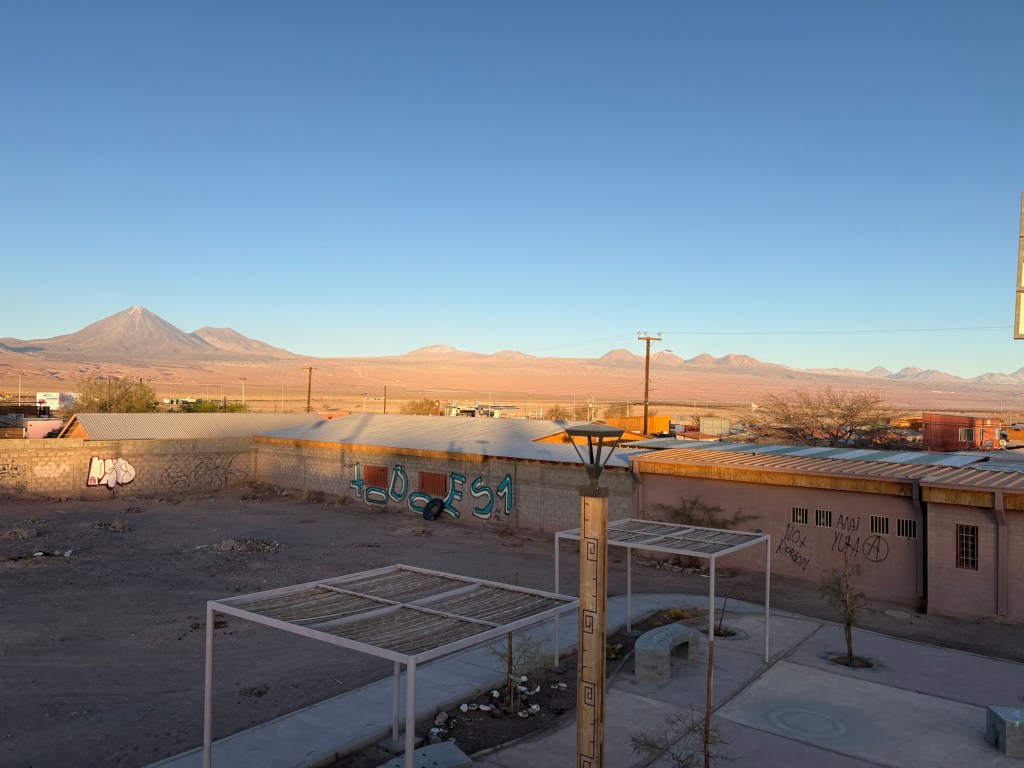
    Dusk (pre-dusk?) on the outskirts of San Pedro.

    I turned onto our street, satisfied with my solo adventure and where it had brought me, physically and mentally. Now it was time for dinner and for stargazing—the next blog post, stay tuned!

    As it turns out, the minimarket closest to our house, one that I had overlooked in my search, had Blue Takis. I found out two days later and finally bought my first bag. The first bites were cautious. But just a day later, I was crushing the remnants of the bag into crumbs and using it as seasoning on my breakfast scramble.

    From there, I’m afraid to admit, they became almost as large a part of my identity in Chile as being from the United States. Both of them were equally complex to be proud of.
  • Chile #8: San Pedro, Part 1: Arrival and Departure

    Chile #8: San Pedro, Part 1: Arrival and Departure

    I’m going to preface this post by saying that I don’t know what I intended when I began to write about our trip to San Pedro de Atacama, but that the end result was a Word document of 24 single-spaced pages across a dozen or so anecdotes. I’ve struggled with how to best group them into a few (likely four) blog posts, and I don’t know if I’ve found the optimal solution or not. Perhaps that doesn’t matter. This opening post is an introductory one, the story of how we got to San Pedro, of our lunches, of the Airbnb, and of leaving at the very end. The next one will be focused on a coherent arc that took place in San Pedro, while the final two will be focused on the desert beyond the town. Please forgive the fractured chronology. Don’t worry; I’m not trying to be Christopher Nolan.

    Arrival:

    We all had slightly different plans for how to manage the 5am flight, from don’t sleep until the plane, to getting in bed at 8pm the night before, but the result was that we were all, once again, horribly sleep deprived. I was running on two to three hours as we reached the Santiago airport, well before any light did.

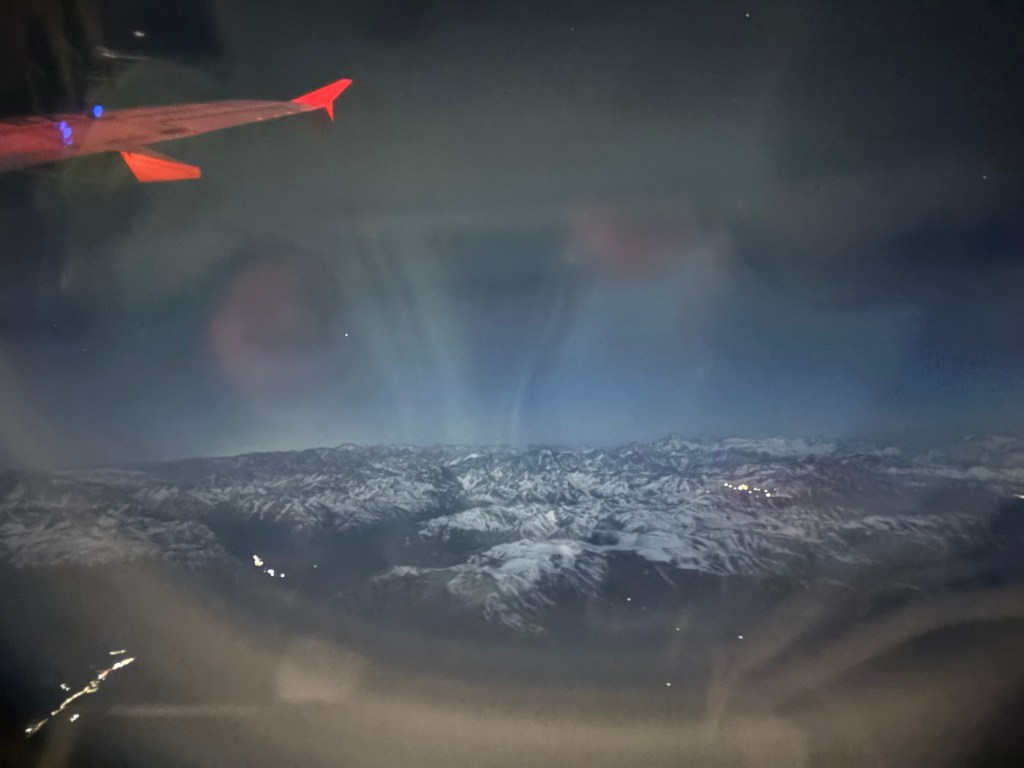
    We were flying to Calama, the closest big town to San Pedro de Atacama, a town in the north of Chile that served as the gateway to exploring the Atacama Desert. Our two-hour flight was relaxed, with nearly no other passengers, so we sprawled out and claimed our own rows. When flying north or south in Chile (the only possible directions to fly), since the country boasts the Andes as an eastern boundary, you will almost always have some utterly glorious mountain views. Though I wanted to sleep, my interest in witnessing the sun rise above the Andes, and in seeing beyond the first layer of the cordillera for the first time, superseded it. I was particularly eager for Aconcagua, the biggest mountain in the Americas. It ended up still being night as I beheld it all, making it seem even more wild and inaccessible, like the domain of some elevated species.

    The Andes make for one of the more definitive country borders I’ve ever seen. I hope I haven’t said that in an earlier post already.

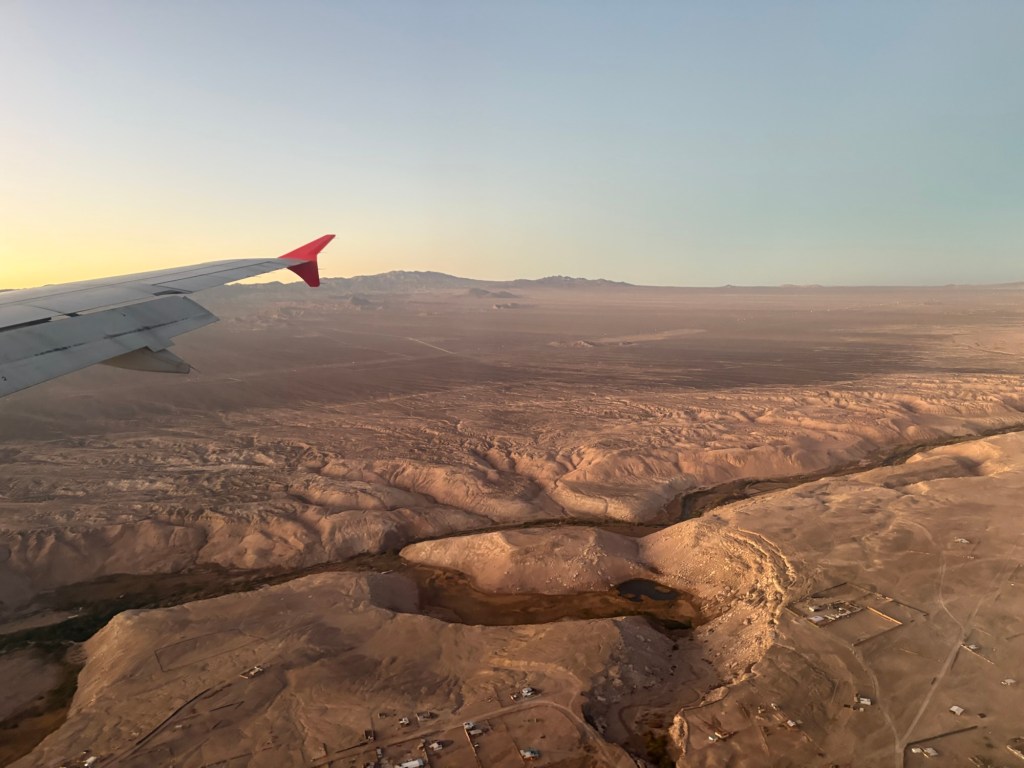
    At some point I did drift off into sleep, but Mette woke me up just before we touched down in Calama. She pointed out the window, where I was treated to a very different view: the first light over the desert. We could have been landing on Mars.

    Or on Tatooine, for that matter.

    Once again, we had tried to book the rental car the day before, but this time we had run into some trouble. Nothing seemed to line up with what we needed: September 11 to 15, cardholder under 25, automatic, and cheap. Not even Fer’s connection in Calama (it seemed he had an amigo or a primo in every hamlet of Chile and half of the ones outside of it) bore fruit. Finally, we had gotten something, but despite our early arrival, we couldn’t pick it up until 11am.

    So again, we waited in a hotel, although it couldn’t have been more different from the one in Pucón; it felt like a casino, maybe because we were in the desert and I implicitly associated it with Vegas. We arrived a good two hours before the pickup, and there was plenty of time to sleep on the couches and hope that the staff wouldn’t kick us out for being vagrants. This time around, I had made the reservation, so I handled the interaction at the front desk and was largely competent, nodding, smiling, and occasionally asking questions about the policy (and not telling her that my friend Suditi would be arriving that night, putting us up to six people in the car).

    We stopped at Jumbo, which is like the Chilean Walmart (except maybe the ratio of food to not-food is switched, and the actual Walmart-owned brand in Chile is Lider, so what am I even talking about really) and loaded up on food, as there were no supermercados in San Pedro. From everything we had heard, it was an expensive town. In the pursuit of cost-effectiveness, I got bamboozled by the classic 64 pack of Kirkland granola bars in the Internacional section, telling my friends about how clutch and how good of a deal they were. As there was no price tag, we only found out at checkout that they ended up being over $20—which ended up being the cost of three to four lunches in San Pedro.

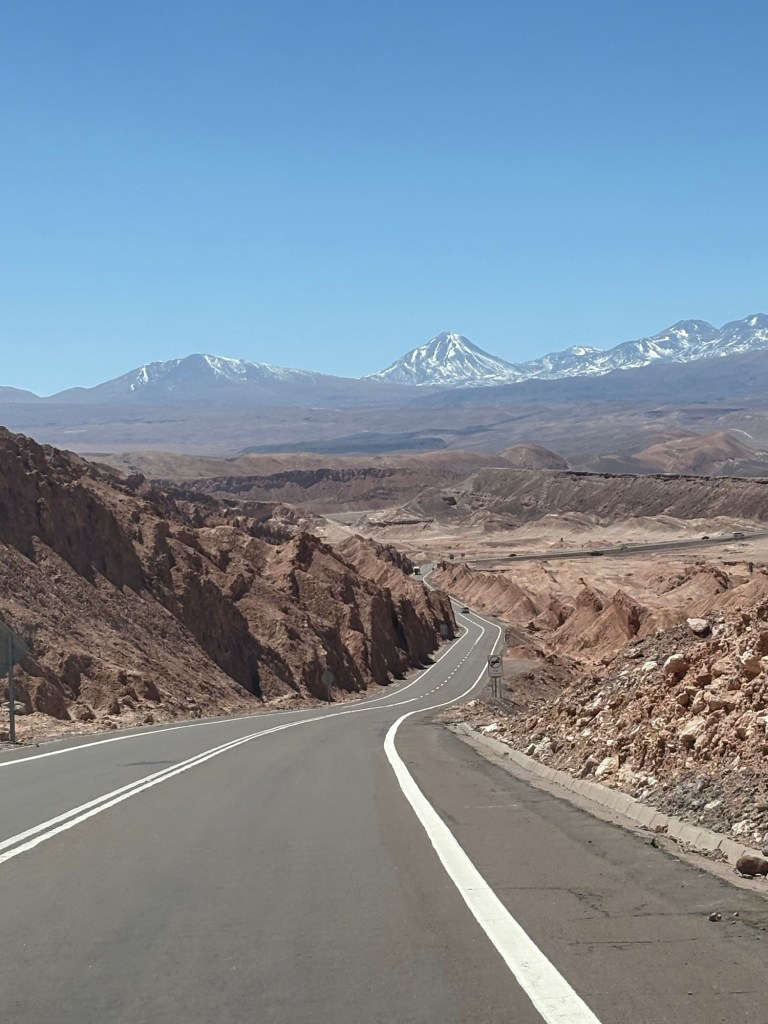
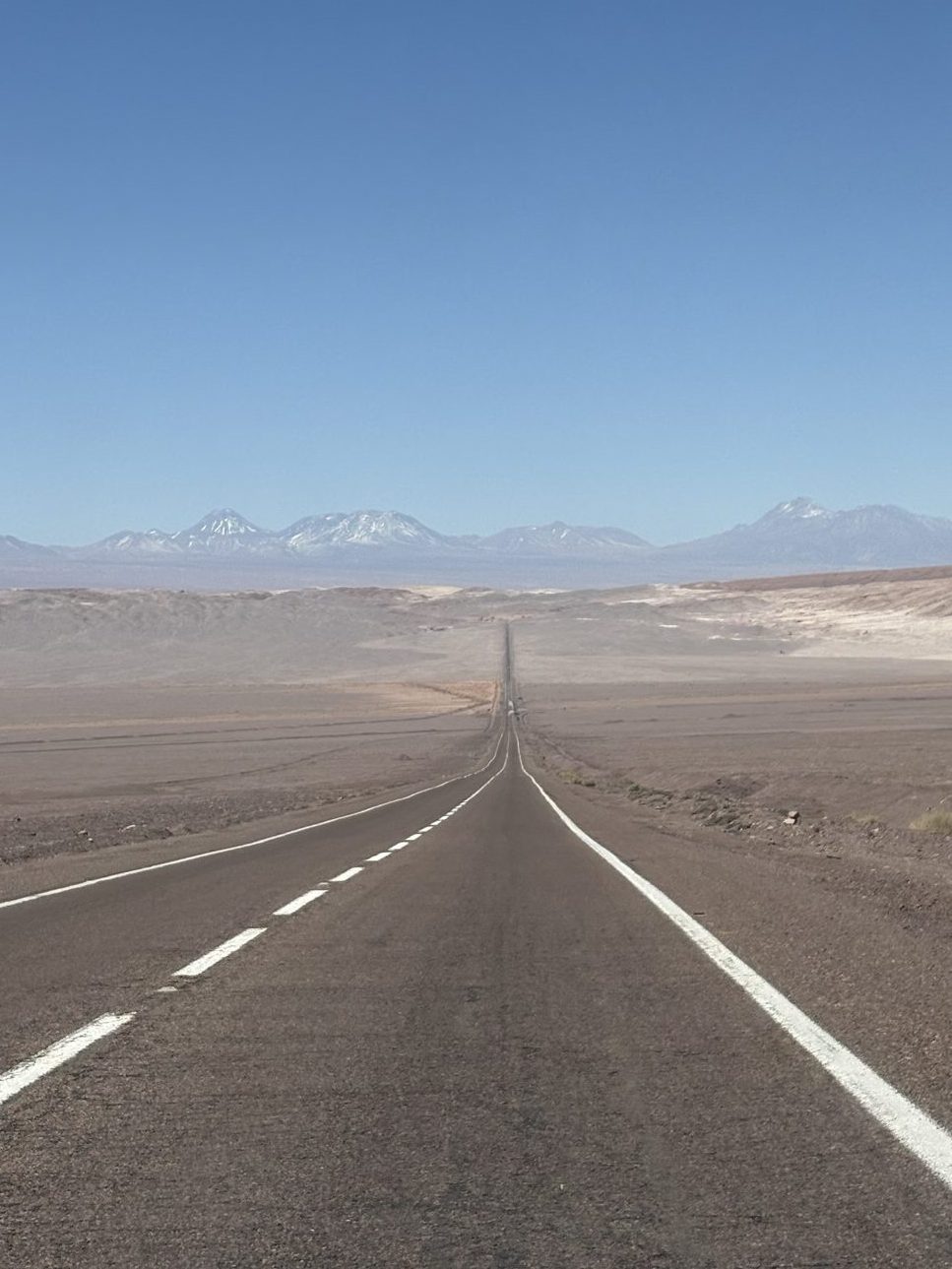
    Elena drove for the first leg, and I sat in shotgun, while I think everybody else passed out in the backseat. It was just under two more hours to get to San Pedro de Atacama, and we didn’t pass a single settlement the entire time, just the occasional roadside shrine with crosses and flowers. In the distance, 6,000-meter (20,000 feet!) volcanos loomed like fallen gods.

    I mean, like, holy shit.

    The Atacama is the driest desert in the world, because of the combination of the rain shadow of the Andes and the anti-cyclone off the coast of Northern Chile (which I had learned in my geography class two days prior). In some places it hasn’t rained in over 500 years, or at all. Looking out of the car window, it was impossible to even imagine rain here. I don’t think we had a single day with clouds, without the sun beating down on us—though because we were up at 2,500 meters of altitude it was never sweltering. In fact, it was quite cold at night. During the day, it would depend on how high up you were; it could be hot or cold, but always incredibly dry. Your clothes would dry out on the line in under two hours.

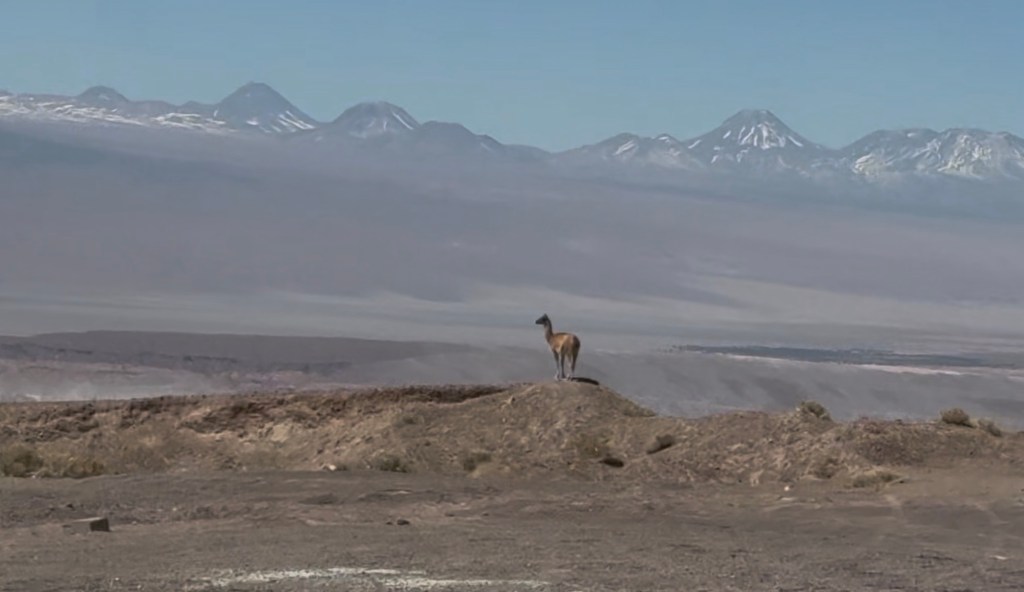
    At one point, as the road snaked left and right and winded up and down, we whizzed our way through a sort of chute, with walls of rock surrounding us—and as we emerged on the other side there was a llama waiting for us, standing tall on a little butte. It was crazy luck —but as it turned out, wildlife was common here; we would go on to see alpacas, vicuñas, and flamingos.  

    It’s a screenshot of a video (damn you WordPress Premium) so the quality isn’t great.

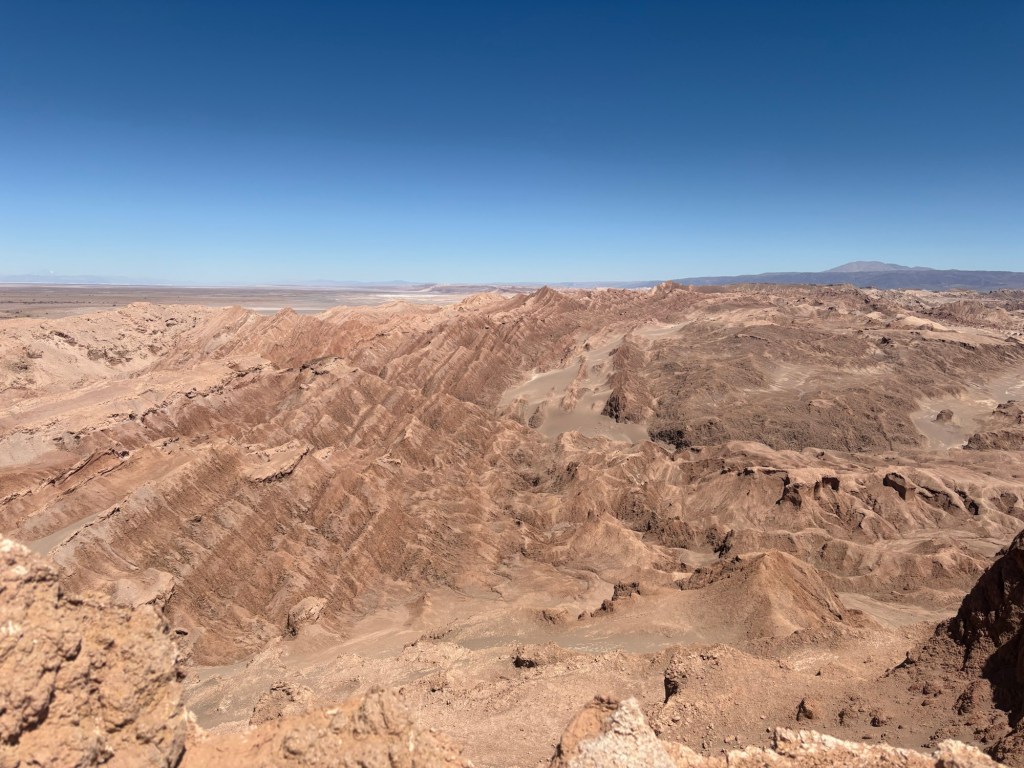
    The closer we got to San Pedro, the better the drive got; the road sloped further up and the volcanoes on the horizon were close enough that we could start to imagine they were real. By the time we were about ten minutes away, the rock formations had become simply outrageous (we were close to the Valle de la Luna, a famous part of the desert that we later explored, sort of), and there was no choice in the matter: we pulled over to a turnoff, stepped out of the car, and took a photoshoot like the tourists we were. That is, everybody but Hodei, who stayed asleep in the car.

    “Otherworldly” is so cliché when talking about the desert, but what else do you call this???
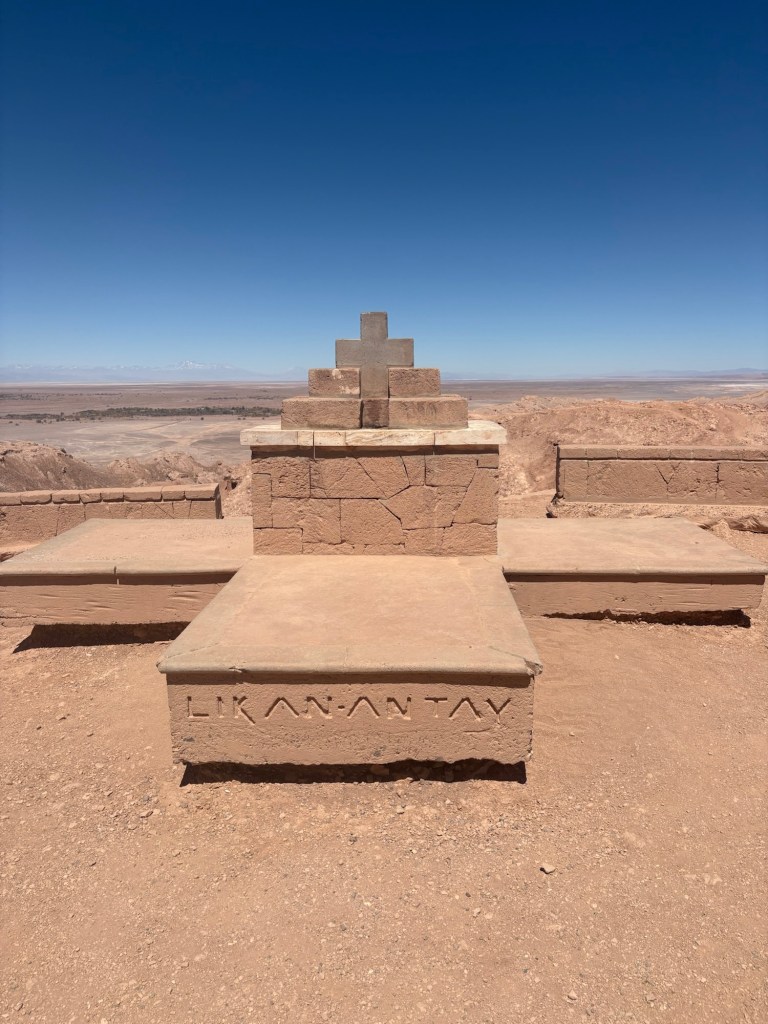
    I wish I knew the lore about this monument, but I don’t.

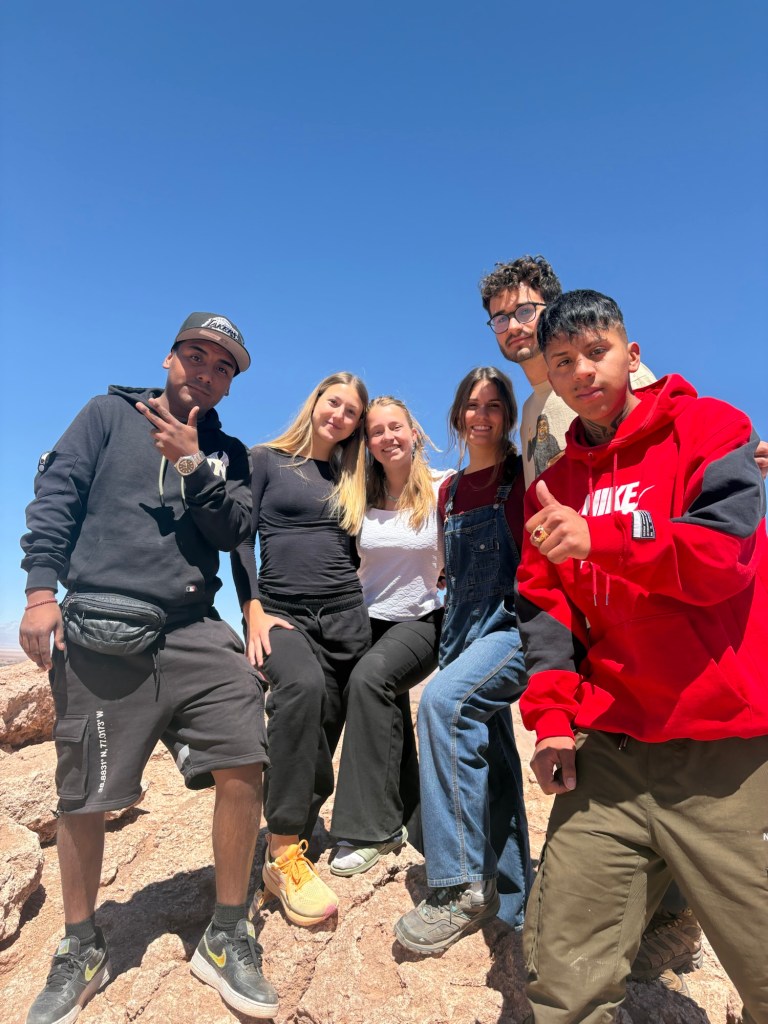
    At a certain point, two guys came up to us, asking to take a picture with Mette, Anna, and Elena. We weren’t entirely sure why, though it could have been because two of them were blonde, uncommon in Chile and doubly so in the north, which was phenotypically darker than the rest of the country. At any rate, we were obviously not from Chile, which probably drew interest. They were locals, from Calama, yet like us, it was their first time going to San Pedro de Atacama, despite the towns being two hours apart. Such were the economic realities for the area— Calama is a mining town, while San Pedro is a hub for tourists, more expensive than the rest of the region.

    I got in the photo too, which I don’t think they wanted, to be honest.

    Menu del Día:

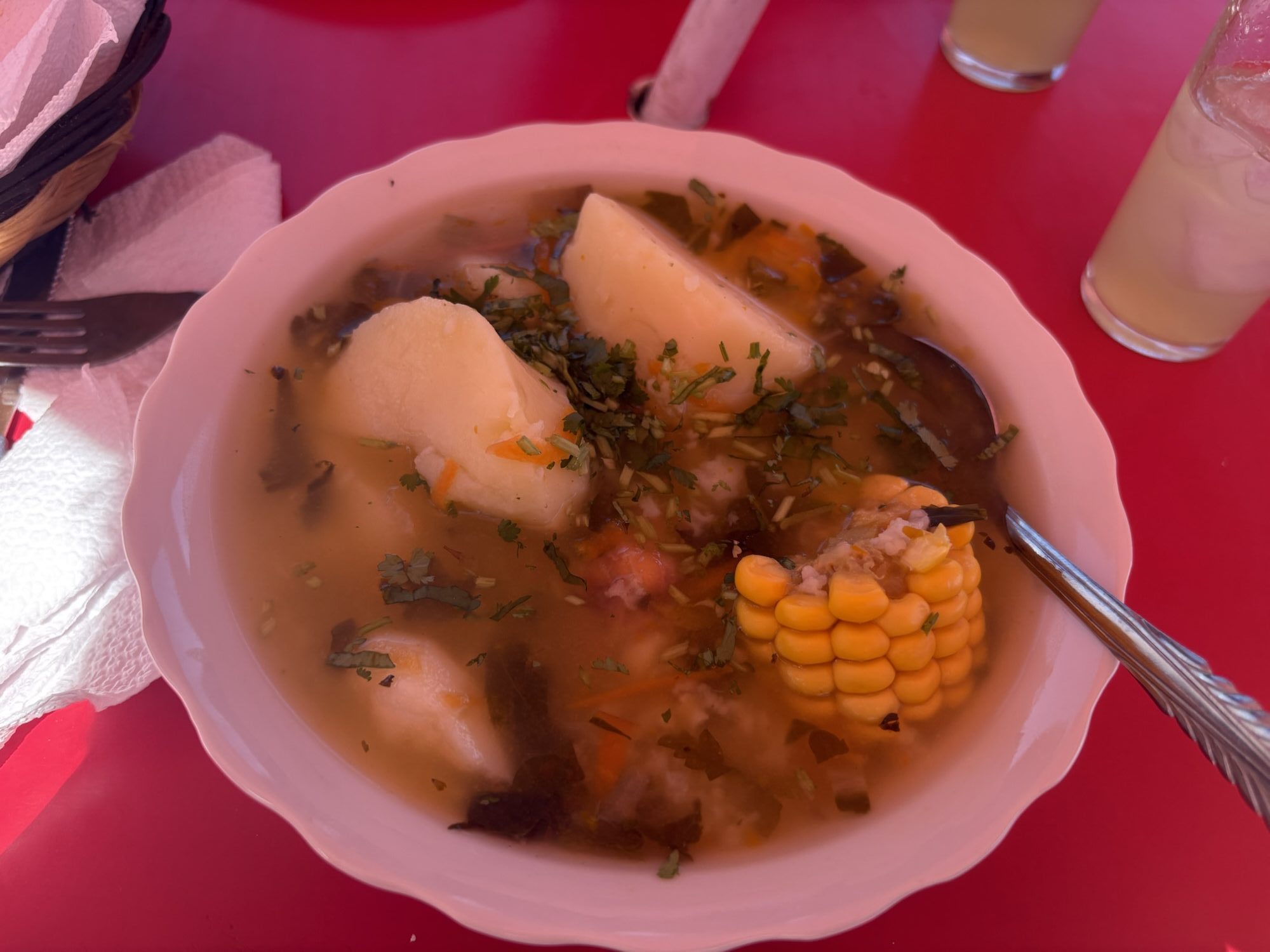
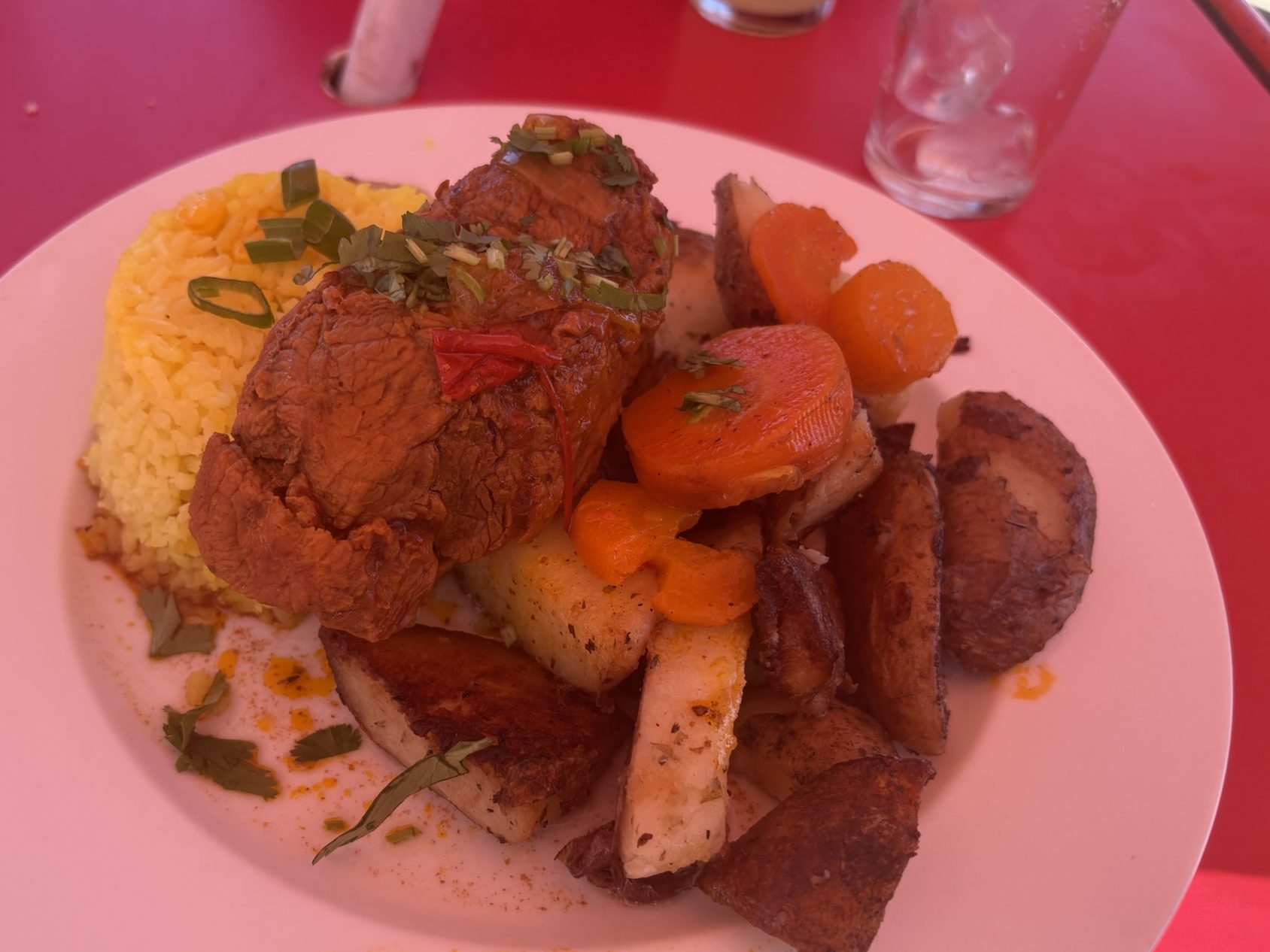
    Though when we arrived in San Pedro, tired, hungry out of our minds, we stumbled onto possibly the best culinary deal across all my time in Chile (outside of going to a feria and getting a kilo of produce for $1). As we drove in on one of the town’s dirt roads, the directions to the Airbnb wound up taking us right past a soccer field, and next to the soccer field were a bunch of little restaurants with signs for “Menu del Dia.” We didn’t hesitate. The Menu del Dia turned out to be a large starter, an entrée, and two sides for $7. And the portions were large; the starters would be like a large bowl of cazuela (a flavorful soup) or ceviche. Yes, ceviche is still good in the desert somehow—the principle I grew to adopt in Chile was if there is ceviche on the menu, you must order it.

    Cazuela: so good, although the one my friend Montse’s mom made was better.
    Carne jugoso. This with the cazuela was $7, not a bad deal at all.

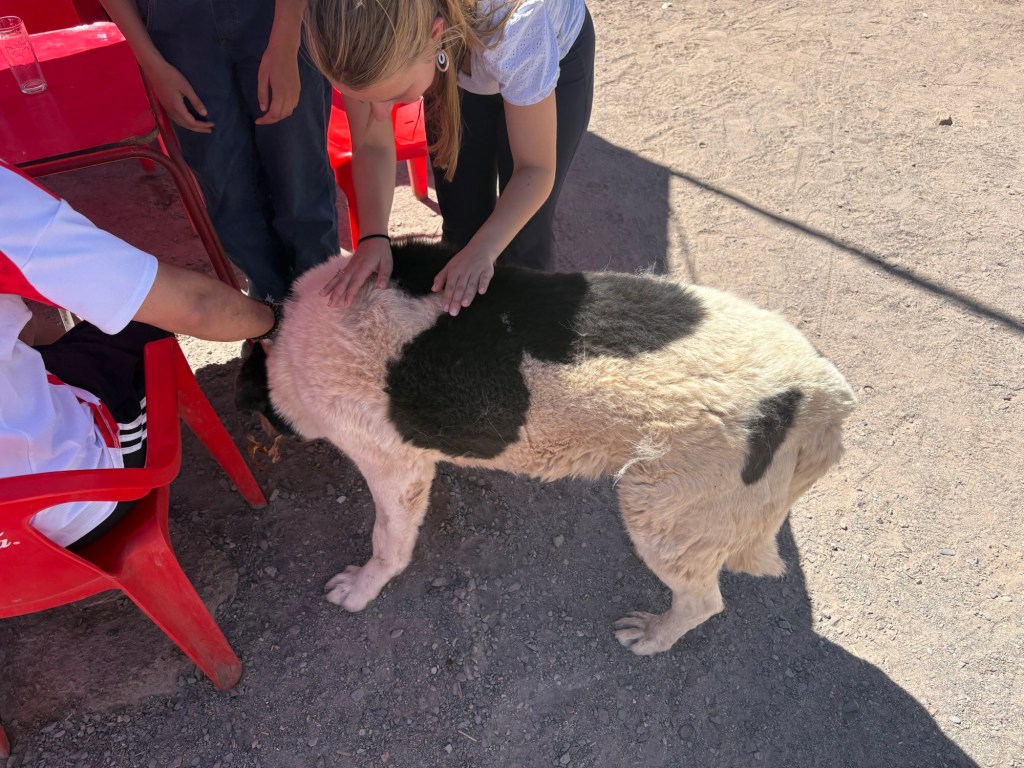
    We ended up going to the Menu del Dia three times for lunch on the trip, experimenting with different entrees and combos and occasionally throwing in a beverage, like the delicious honeydew juice. It was always a phenomenal experience: we would sink into the plastic chairs, exhausted from a day of exploring; make conversation until the food arrived (for some reason, usually something foul and raunchy that garnered us looks); and then the talking would be replaced by the noises of us inhaling our lunch. Dogs would come by to be pet—or really, for food, which was why the restaurant owners would shoo them away. One time, a man stopped by with a guitar, playing a song (badly, alas) that he said was typical to the region; it sounded a lot like “El Carretero”by Buena Vista Social Club.

    Dog, or cow?

    Airbnb:

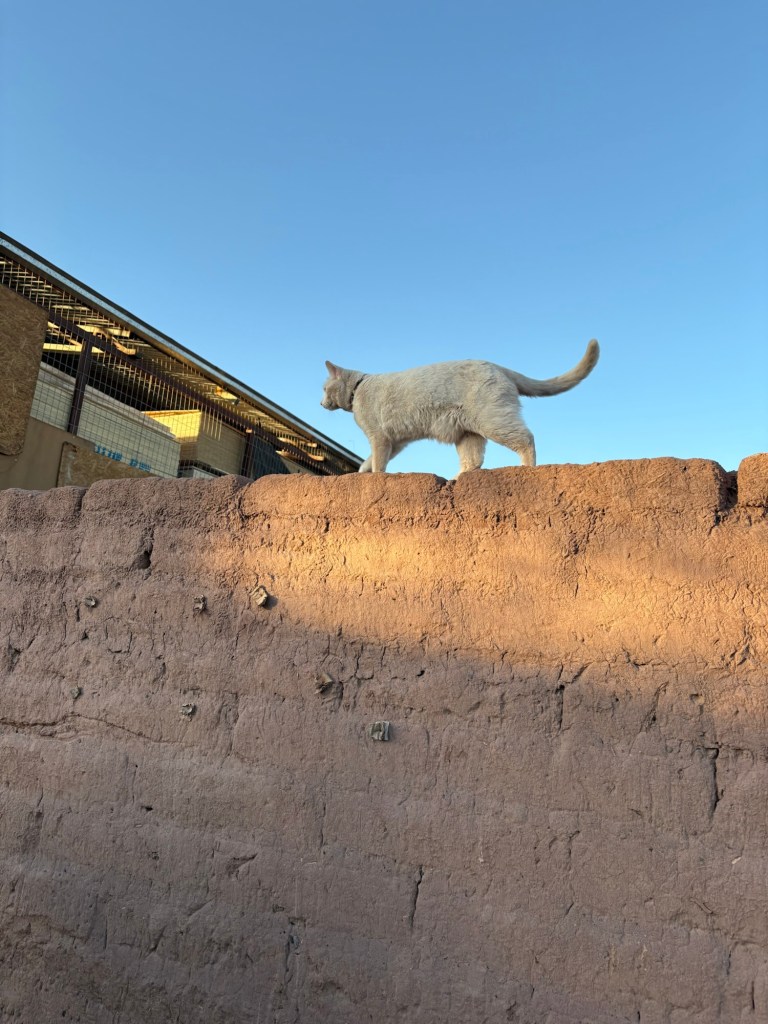
    Our Airbnb was just three minutes away, a small, shared unit with the owners next door. To fit both our car and their car into the narrow driveway, we had to do some maneuvering. Usually when we came back, there would be a dog or a cat roaming, and sometimes their kids would be kicking a soccer ball.

    ¡Mishi!

    Inside, there was just enough space for six people to exist. A bunk room for Anna, Mette, and Elena; another room for me and Hodei to share a bed (he kept waking me up in the middle of the night with strange and hilarious noises that I wanted to record but that also perturbed me enough to remain still), and space on the couch for Suditi. The shower had excellent pressure and was perfect for enjoying a post-hike beer.

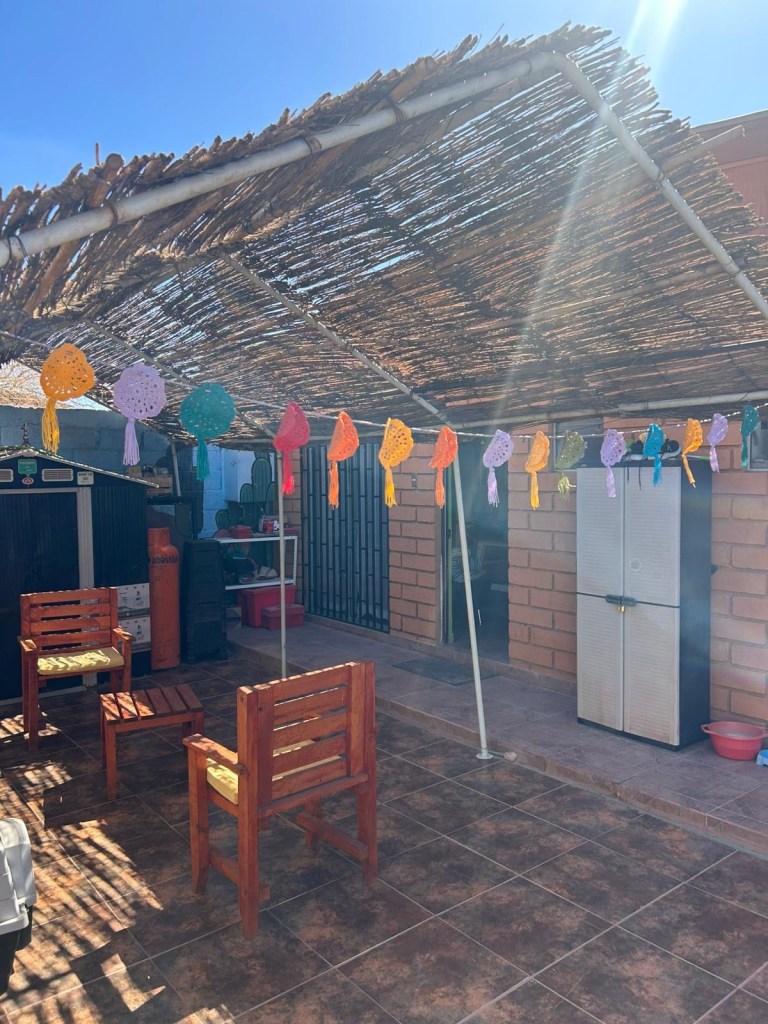
    We also got to enjoy this lovely patio.

    Over our stay, out of sheer bad luck, we broke three dishes. Every time it happened, we sent Hodei next door to talk to them because, as a literal Spaniard, he was the most fluent in Spanish. But the first time he did, our host gave him a blank look. We all thought this was hilarious; the meme in our house that he was impossible to understand because of his quick and low way of speaking, so this only added to the legacy.

    Fortunately, they were super chill about it, but we still felt bad, so one time when the kitchen sink got so clogged it just wouldn’t go down, instead of bothering them, we took the potentially disastrous course of action of trying to fix it ourselves. It was nearly overflowing; we called it a “tremendo poot caldo,” which was a combination of a few inside jokes. The main one was that poot was how Hodei pronounced “pool” for the first time in English—his English comprehension was C1 on the fluency scale, but his pronunciation couldn’t have been more than A2.

    Brief tangent here: we had a lot of inside jokes, as any friend group does, but perhaps more so because Spanish was a second or third language for most of us, and we were constantly making fun of each other’s speaking capabilities. For my first month, I couldn’t open my mouth without them making fun of my gringo accent(in Chile, gringo is specifically somebody from the U.S; it’s not race-based nor does it apply to any other nationality). Furthermore, because it wasn’t our primary language, I think that inside jokes were an easy way to achieve connection despite communication barriers.

    Poot, caldo, whatever you want to call it, we decided we would unclog it by unscrewing the bottom piping from the sink. The sludge that had built up below was truly unfathomable. I think I was the only one who even dared to touch it, collecting all the goop in a bucket while Mette took pots full of the upper water and dumped it into the road. It was mildly stressful but mainly hilarious doing it.

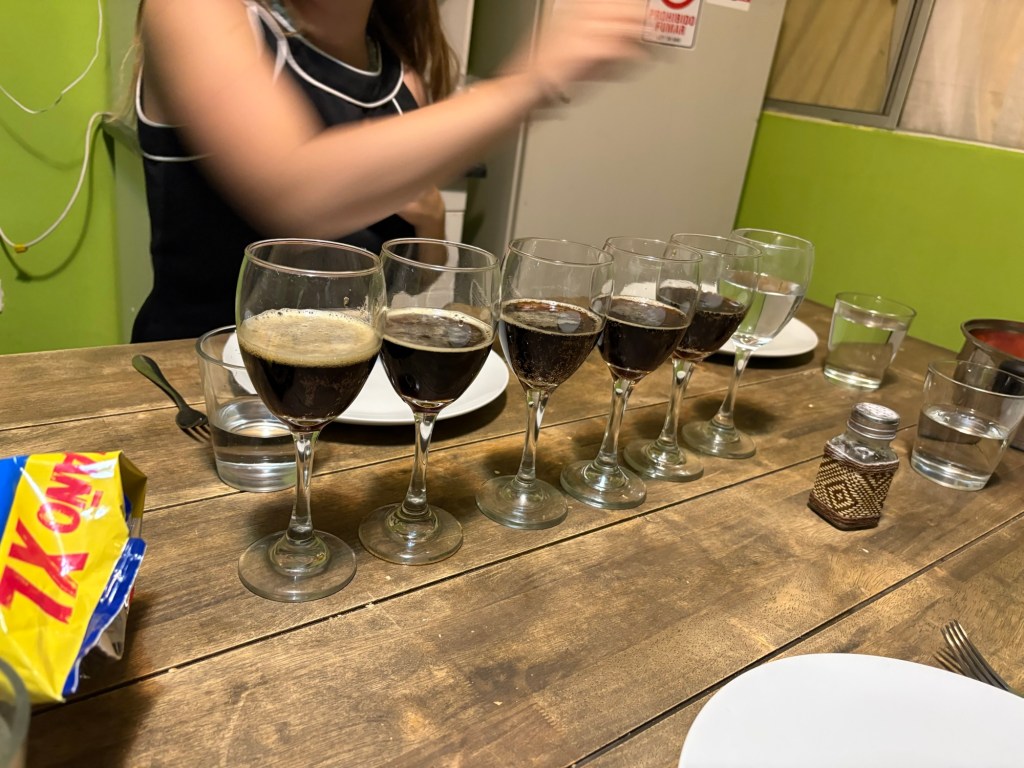
    Probably because we were drunk. After every single day of exploring, we would try a new artisanal beer, just one tallboy split among five wine glasses (Elena couldn’t, as she was celiac, a tough one in Chile) but since we were at 8,000 feet of altitude that would be enough for some tipsiness. Two would have you pretty lit, all things considered. I think that helped us, honestly, with the plumbing job, because we nailed it. Afterwards, I had to wash my hands a bunch of times over, but thankfully I had a functional sink to do it in.

    Beer (and Mette).

    I think that about tells the story of the Airbnb. We stayed five days; all in all, it was a lovely spot, it was mainly a home base. Most of the stories occurred outside of it, which I’ll get to in the next posts.

    Is there anything else to mention?

    Permit me two more moments. One time when everybody else was gone, Mette and I had a conversation about romance and study abroad. It seemed to us that every other exchange student we had met was either: A. In a serious relationship of several years, or B. Was leaving behind a new fling that had only just begun to crystallize. Somehow the former category seemed more active in pursuing romance than the latter. We reflected on the silliness of it all.

    The other thing wasn’t a moment, but rather something of note. Well, not even that, but I want to subject you to these details if you’ve made it this far. My hiking boots smelled so bad that I had to keep them far outside every day. Only later did I learn that I could take the insoles out to let them dry, which would have at least minimized the degree to which taking them off was an act of chemical warfare against the Geneva Convention.

    Departure:

    Of course, when we left San Pedro on the final day, we were behind schedule. Not me this time, though; I wouldn’t be flying back to Santiago with everybody else. From Calama, I would split off from my friends and go to the similarly named Caldera, a mere ten hours south of Calama by bus. I was going to visit my friends Raul and Montse to take part in some fiestas patrias activities, before taking another twelve-hour bus down to Santiago for dieciocho.

    My bus was at seven, so I wasn’t moving with too much haste in the hours before we had to go, exploring the markets one last time as I tried to find a small gift for Fer (his birthday was coming up soon). I also bought myself a nice hat and re-bought the bracelet that I had lost. As I was doing this, my friends found out that their plane was an hour (or perhaps a half-hour) earlier than they had realized, and suddenly we were in quite the rush.

    We had to drive two hours back to Calama and get gas and return the car and then get to the airport. Anna, of course, was our driver, as she had been for most of the trip. She’s Italian and drives like it, speeding by everything, ignoring the occasional stop sign or speed bump, and yelling cazzo, merda or va fan culo (I think I’m spelling those right) at the other drivers. She was undoubtedly a skilled driver, but I wasn’t always relaxed when she was behind the wheel.

    But she was born for today’s assignment. I’ve never seen any driver so locked in. I swear we didn’t go any less than one hundred seventy kilometers per hour the entirety of the stretch, which might be only a slight exaggeration. She was passing trucks and cars like nothing. While she pulled off a lot of maneuvers that were cutting it close, I knew she had faith in her abilities, so I wasn’t too terrified—except for one when she passed into a blind turn. Luck was on our side, but if it wasn’t, I wouldn’t be alive to write this right now.

    We also had six in the car, but that almost didn’t matter, because we were speeding anyway, so if there were carabineros, we were screwed regardless. We prayed they weren’t on the road and prayed we would make it and listened to Adele all the while as we hurtled back to Calama.

    Therapy, or driving this road at one hundred miles per hour?

    Thanks to Anna’s F1 abilities, we made it. They dropped me off at the hotel where it had all started. It was like Villarica all over again, with me hanging back to have my own little adventure—this time intentionally. I was excited. I love travelling with this group—we travel similarly, and nicely, together—but it’s so nice to also have your own moments to explore.

    First, though, I had to make my bus, which with my prior experience, was not a given. Especially in Calama, which was the least walkable town in Chile I visited. And while I felt completely safe, as I made it to the bus station, I felt eyes on me. People were watching; I stuck out as a gringo with two bags struggling to find the bus stop—I had to double-track myself on the sidewalk like four times.

    To be fair, it turned out to be a confusing situation: it was just an office, with a parking lot in the back and literally nowhere to sit. Everybody was sitting in the tiny room or on the sidewalk, so I decided I would wait somewhere better, as I had an hour and a half to kill. So I continued walking, passing a discoteca that was bumping even at six in the evening, and a rather suspect bar—no windows, with men at the outdoor tables being served by women in bikinis. Just further, though, was an ornately decorated Peruvian restaurant. I didn’t think twice.

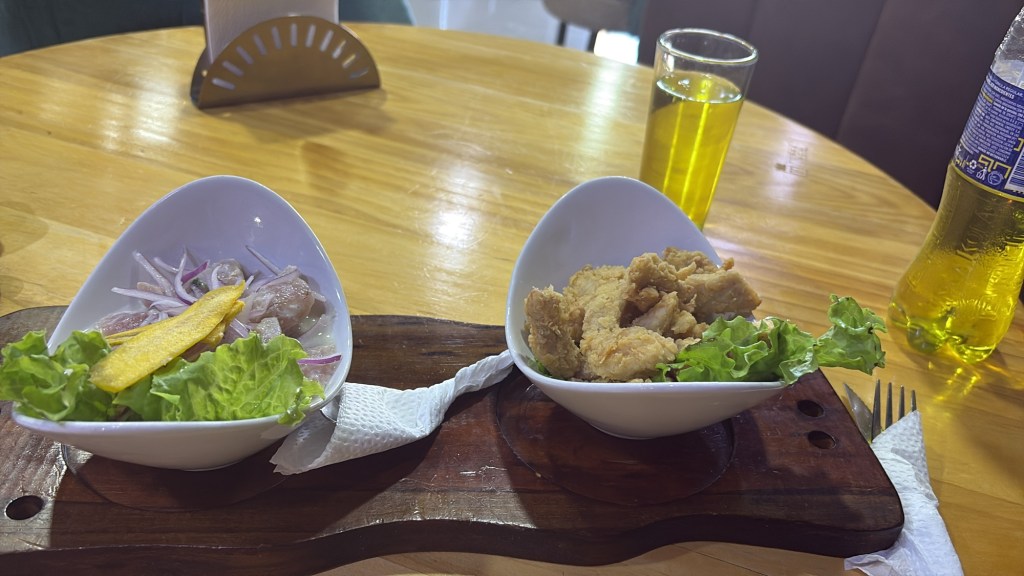
    I was the only one there, and I decided to treat myself to some expensive ceviche—like the cost of three Menu del Días. It was divine. Peruvian ceviche is different, with a more spicy and complex flavor profile than Chilean ceviche. I wasn’t sure what else to do as I waited, so I called my friend Sofia from back home. She’s fluent in Spanish, and for the first time I was able to have a proper conversation with her in the language. Here it was: tangible proof that my skills had really increased.

    Notice the Inca Kola in the background.

    Though I think the servers at the restaurant thought it was funny—a gringo talking in choppy Spanish to someone back home.

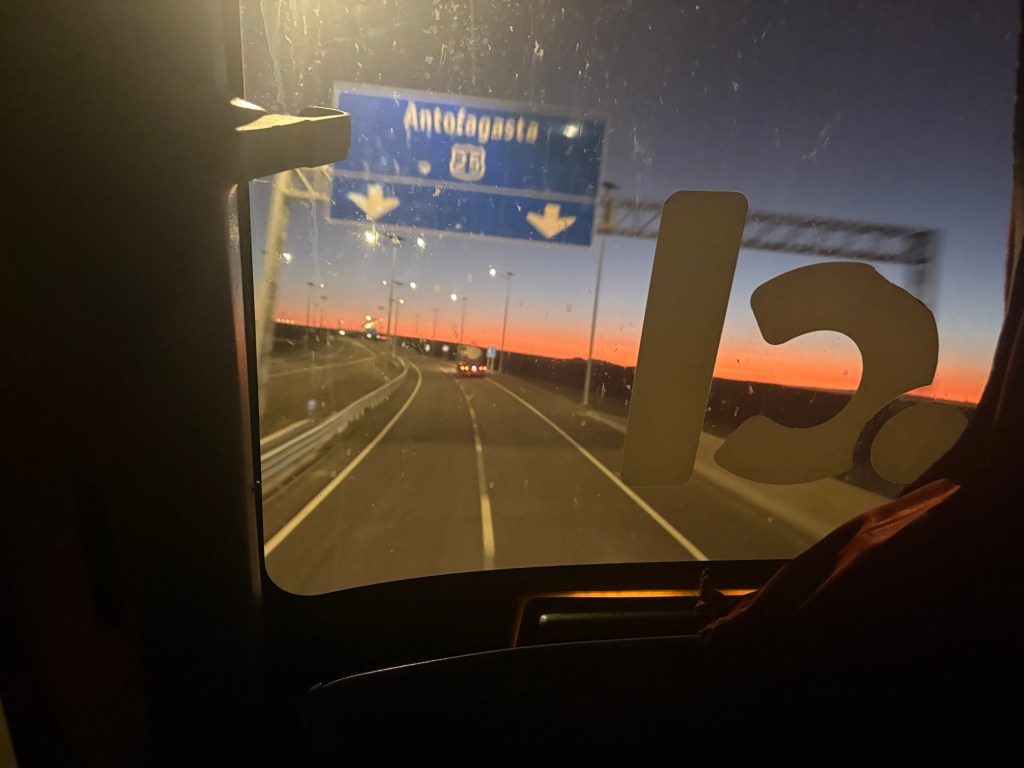
    Finally, I went to go to my bus. Of course, it came late, and I had the sinking feeling that I was about to be stranded once again. But just after I had double-checked with another passenger that I was in the right place, it arrived. My seat was a comfy semi-cama in the front row of the top of the bus, the best seat in the house. We drove off—literally into the sunset. It was the perfect way to say goodbye to San Pedro.

    I was too tired to hold the camera still for more than a millisecond.

    Next up was Caldera—although you, dear reader, will have to first make it through three more posts about San Pedro.