Tag: adventure

  • Chile #8: San Pedro, Part 1: Arrival and Departure

    Chile #8: San Pedro, Part 1: Arrival and Departure

    I’m going to preface this post by saying that I don’t know what I intended when I began to write about our trip to San Pedro de Atacama, but that the end result was a Word document of 24 single-spaced pages across a dozen or so anecdotes. I’ve struggled with how to best group them into a few (likely four) blog posts, and I don’t know if I’ve found the optimal solution or not. Perhaps that doesn’t matter. This opening post is an introductory one, the story of how we got to San Pedro, of our lunches, of the Airbnb, and of leaving at the very end. The next one will be focused on a coherent arc that took place in San Pedro, while the final two will be focused on the desert beyond the town. Please forgive the fractured chronology. Don’t worry; I’m not trying to be Christopher Nolan.

    Arrival:

    We all had slightly different plans for how to manage the 5am flight, from don’t sleep until the plane, to getting in bed at 8pm the night before, but the result was that we were all, once again, horribly sleep deprived. I was running on two to three hours as we reached the Santiago airport, well before any light did.

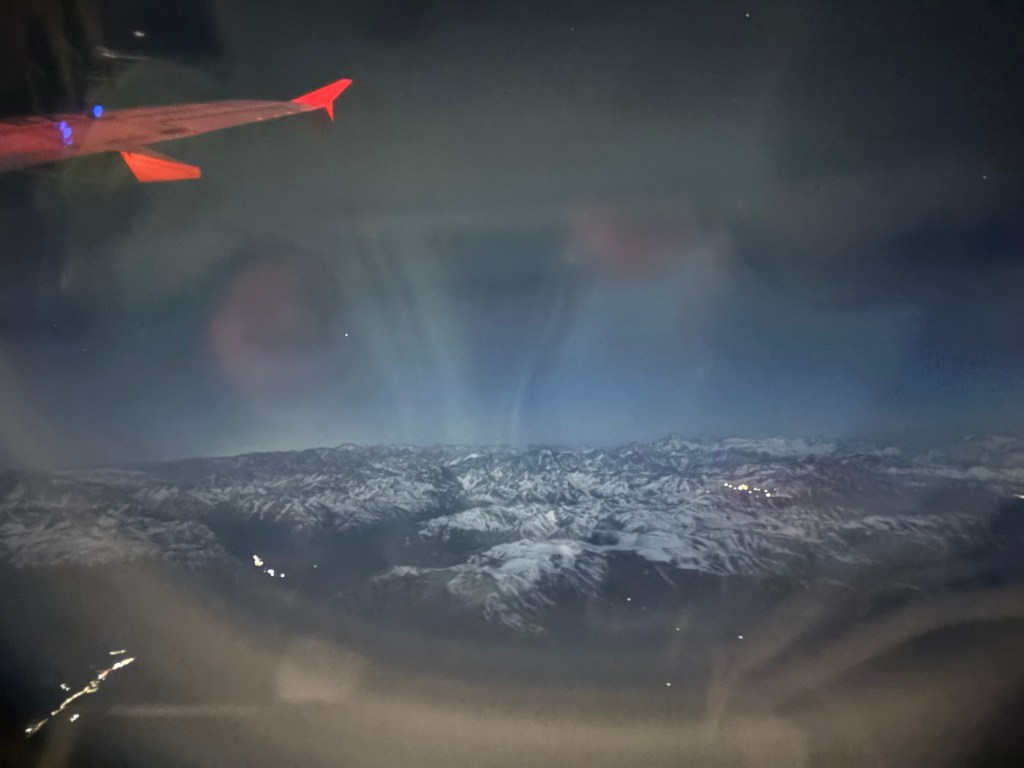
    We were flying to Calama, the closest big town to San Pedro de Atacama, a town in the north of Chile that served as the gateway to exploring the Atacama Desert. Our two-hour flight was relaxed, with nearly no other passengers, so we sprawled out and claimed our own rows. When flying north or south in Chile (the only possible directions to fly), since the country boasts the Andes as an eastern boundary, you will almost always have some utterly glorious mountain views. Though I wanted to sleep, my interest in witnessing the sun rise above the Andes, and in seeing beyond the first layer of the cordillera for the first time, superseded it. I was particularly eager for Aconcagua, the biggest mountain in the Americas. It ended up still being night as I beheld it all, making it seem even more wild and inaccessible, like the domain of some elevated species.

    The Andes make for one of the more definitive country borders I’ve ever seen. I hope I haven’t said that in an earlier post already.

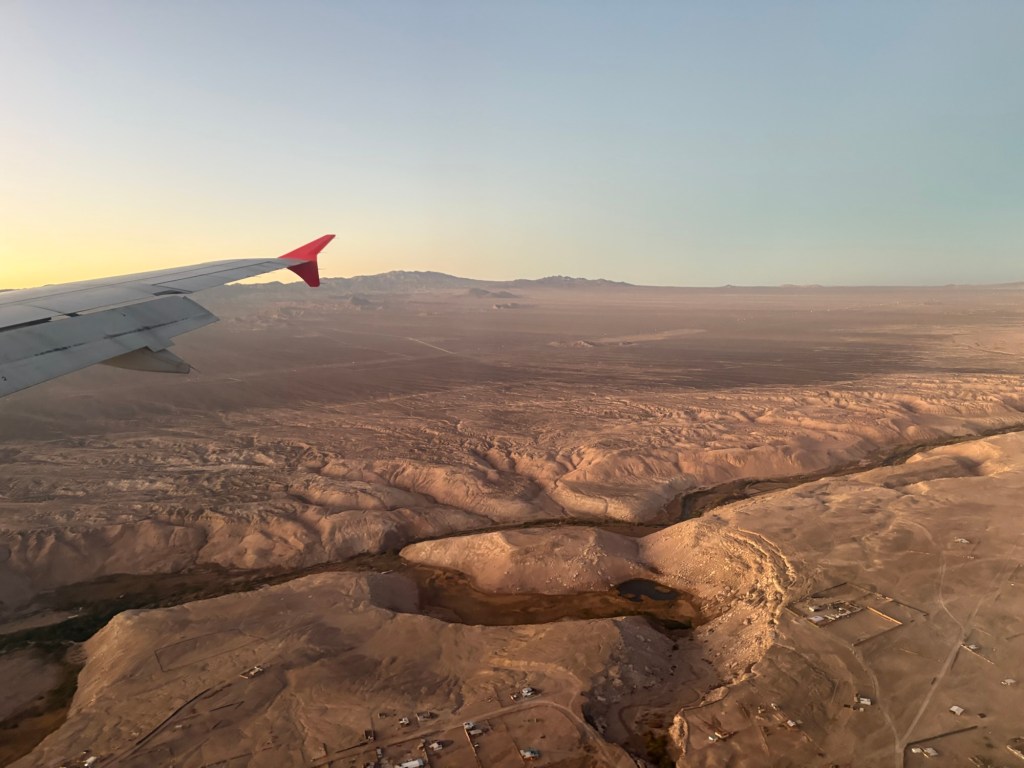
    At some point I did drift off into sleep, but Mette woke me up just before we touched down in Calama. She pointed out the window, where I was treated to a very different view: the first light over the desert. We could have been landing on Mars.

    Or on Tatooine, for that matter.

    Once again, we had tried to book the rental car the day before, but this time we had run into some trouble. Nothing seemed to line up with what we needed: September 11 to 15, cardholder under 25, automatic, and cheap. Not even Fer’s connection in Calama (it seemed he had an amigo or a primo in every hamlet of Chile and half of the ones outside of it) bore fruit. Finally, we had gotten something, but despite our early arrival, we couldn’t pick it up until 11am.

    So again, we waited in a hotel, although it couldn’t have been more different from the one in Pucón; it felt like a casino, maybe because we were in the desert and I implicitly associated it with Vegas. We arrived a good two hours before the pickup, and there was plenty of time to sleep on the couches and hope that the staff wouldn’t kick us out for being vagrants. This time around, I had made the reservation, so I handled the interaction at the front desk and was largely competent, nodding, smiling, and occasionally asking questions about the policy (and not telling her that my friend Suditi would be arriving that night, putting us up to six people in the car).

    We stopped at Jumbo, which is like the Chilean Walmart (except maybe the ratio of food to not-food is switched, and the actual Walmart-owned brand in Chile is Lider, so what am I even talking about really) and loaded up on food, as there were no supermercados in San Pedro. From everything we had heard, it was an expensive town. In the pursuit of cost-effectiveness, I got bamboozled by the classic 64 pack of Kirkland granola bars in the Internacional section, telling my friends about how clutch and how good of a deal they were. As there was no price tag, we only found out at checkout that they ended up being over $20—which ended up being the cost of three to four lunches in San Pedro.

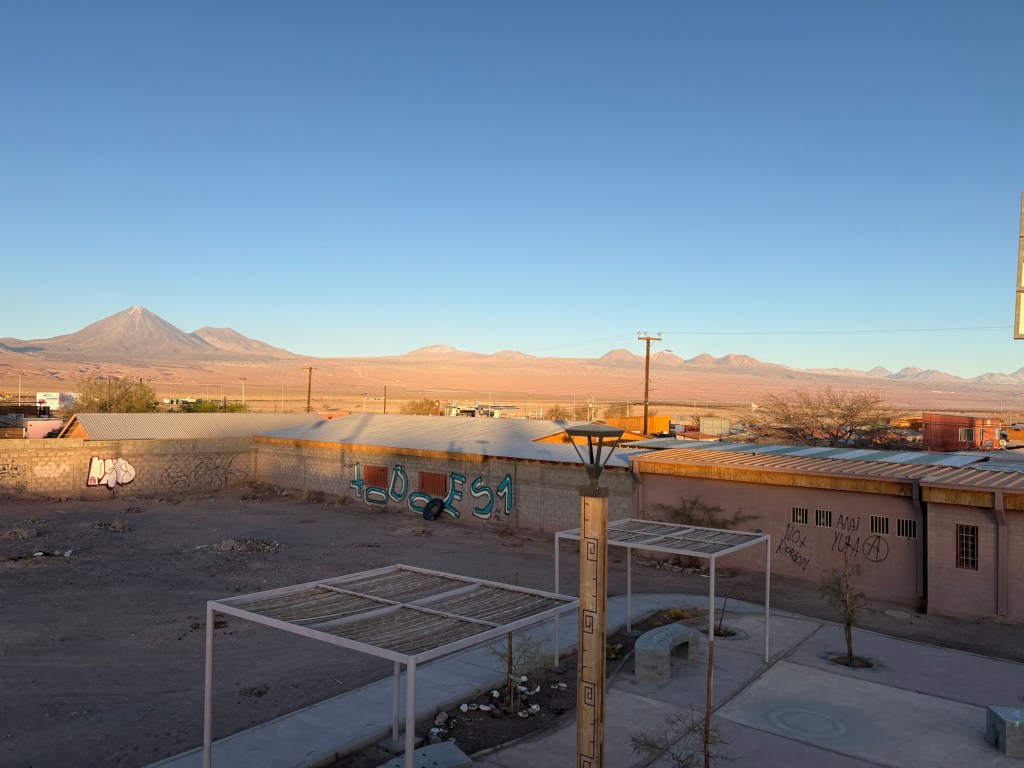
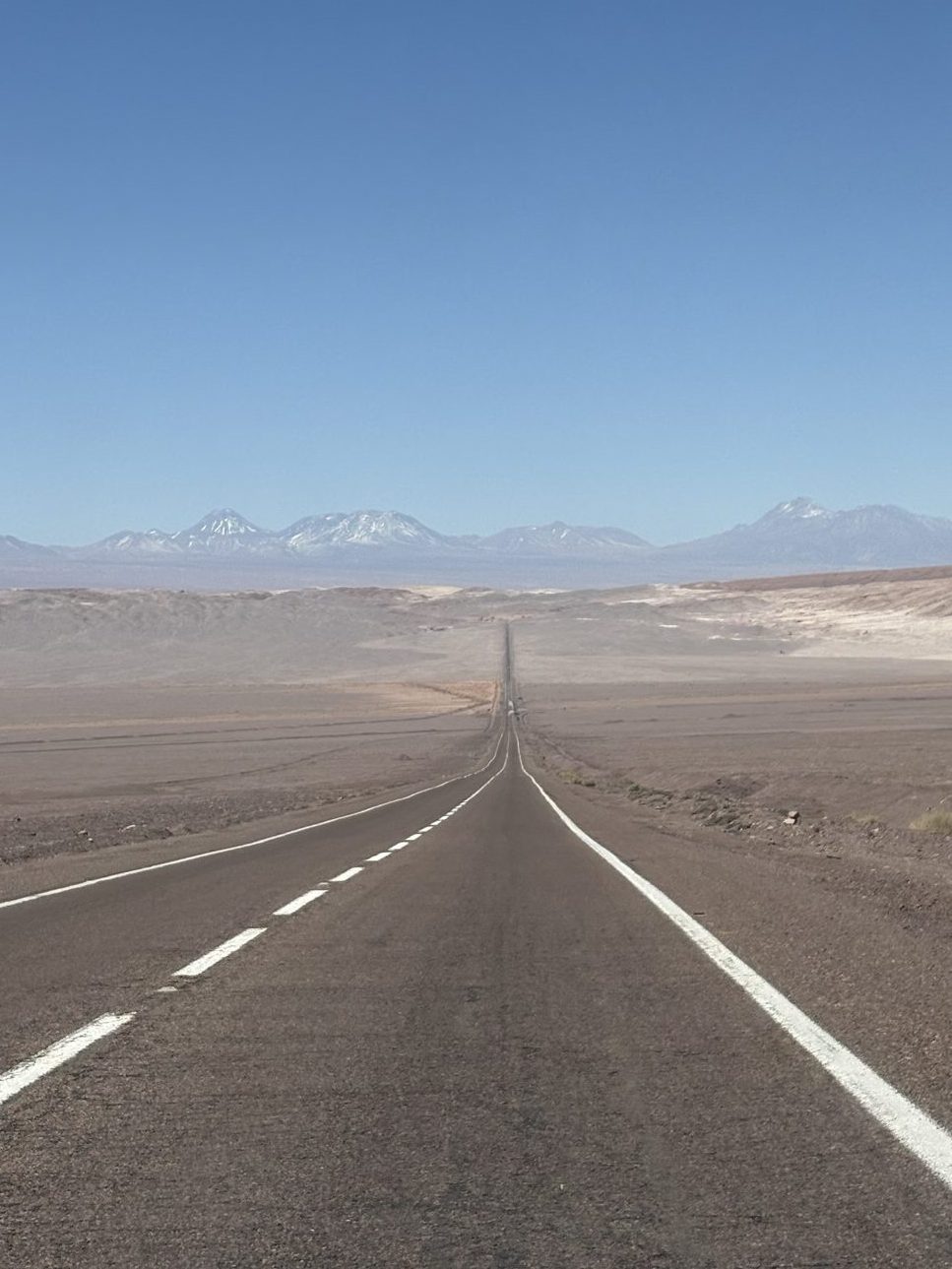
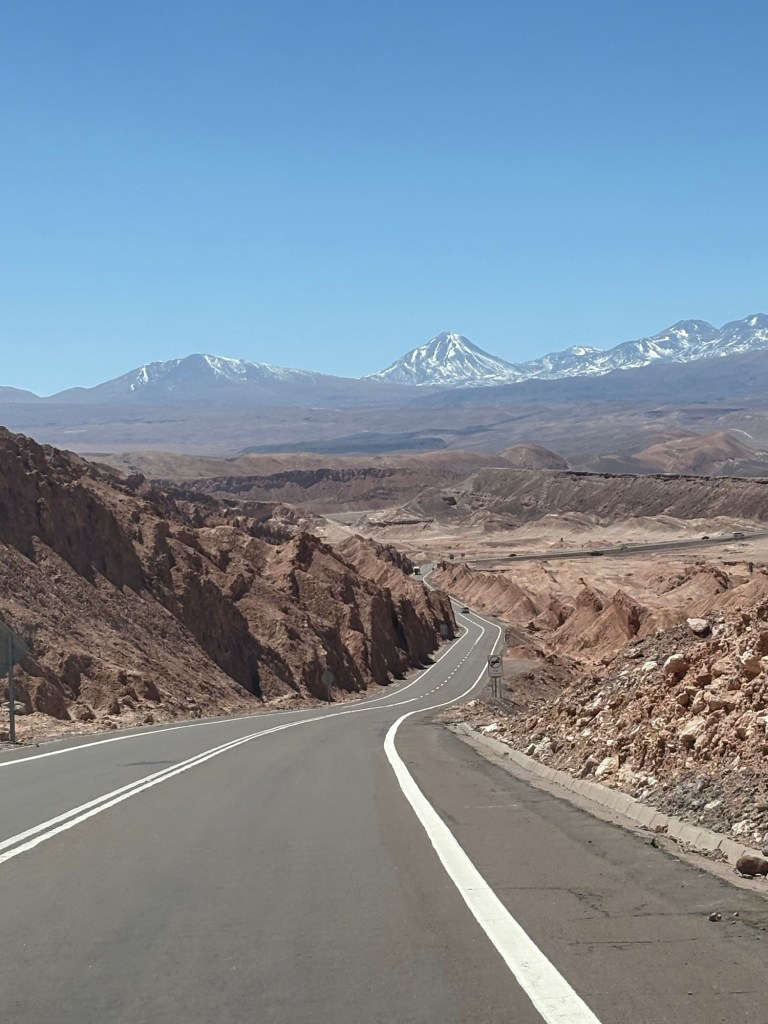
    Elena drove for the first leg, and I sat in shotgun, while I think everybody else passed out in the backseat. It was just under two more hours to get to San Pedro de Atacama, and we didn’t pass a single settlement the entire time, just the occasional roadside shrine with crosses and flowers. In the distance, 6,000-meter (20,000 feet!) volcanos loomed like fallen gods.

    I mean, like, holy shit.

    The Atacama is the driest desert in the world, because of the combination of the rain shadow of the Andes and the anti-cyclone off the coast of Northern Chile (which I had learned in my geography class two days prior). In some places it hasn’t rained in over 500 years, or at all. Looking out of the car window, it was impossible to even imagine rain here. I don’t think we had a single day with clouds, without the sun beating down on us—though because we were up at 2,500 meters of altitude it was never sweltering. In fact, it was quite cold at night. During the day, it would depend on how high up you were; it could be hot or cold, but always incredibly dry. Your clothes would dry out on the line in under two hours.

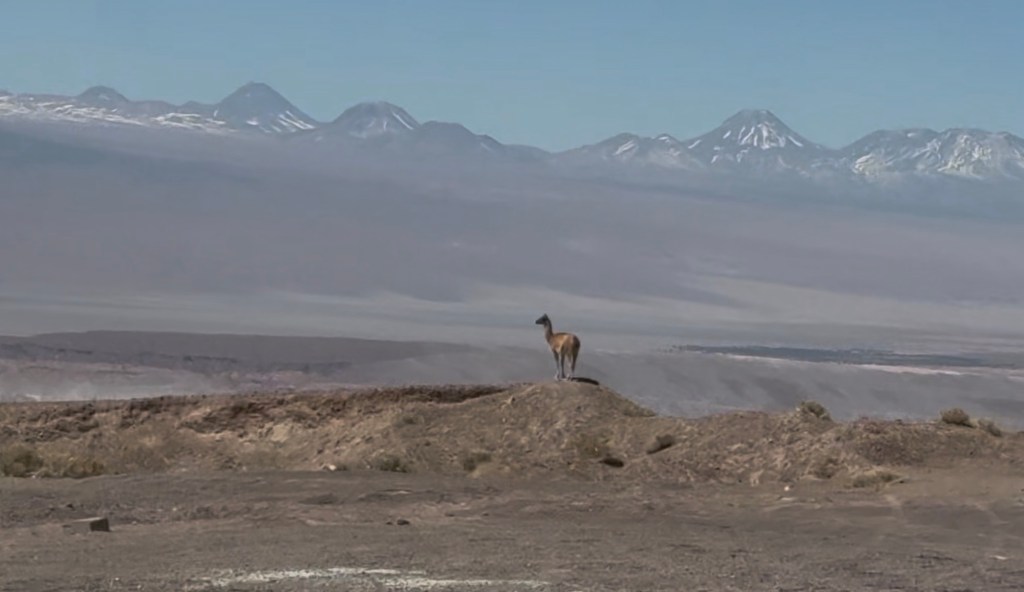
    At one point, as the road snaked left and right and winded up and down, we whizzed our way through a sort of chute, with walls of rock surrounding us—and as we emerged on the other side there was a llama waiting for us, standing tall on a little butte. It was crazy luck —but as it turned out, wildlife was common here; we would go on to see alpacas, vicuñas, and flamingos.  

    It’s a screenshot of a video (damn you WordPress Premium) so the quality isn’t great.

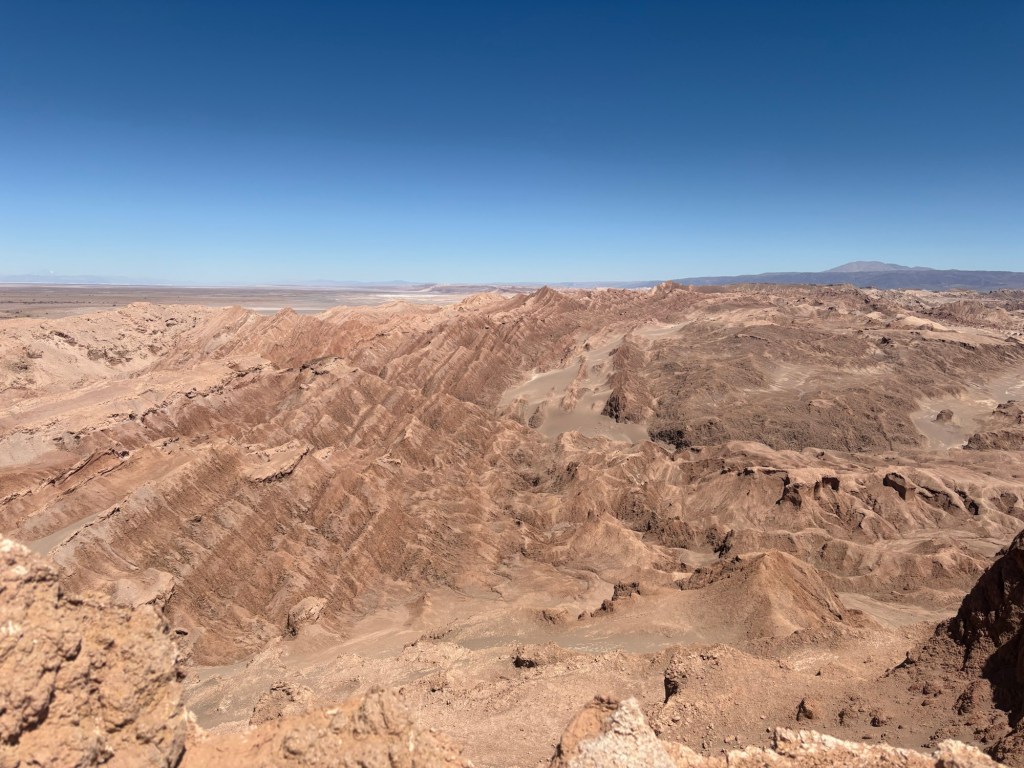
    The closer we got to San Pedro, the better the drive got; the road sloped further up and the volcanoes on the horizon were close enough that we could start to imagine they were real. By the time we were about ten minutes away, the rock formations had become simply outrageous (we were close to the Valle de la Luna, a famous part of the desert that we later explored, sort of), and there was no choice in the matter: we pulled over to a turnoff, stepped out of the car, and took a photoshoot like the tourists we were. That is, everybody but Hodei, who stayed asleep in the car.

    “Otherworldly” is so cliché when talking about the desert, but what else do you call this???
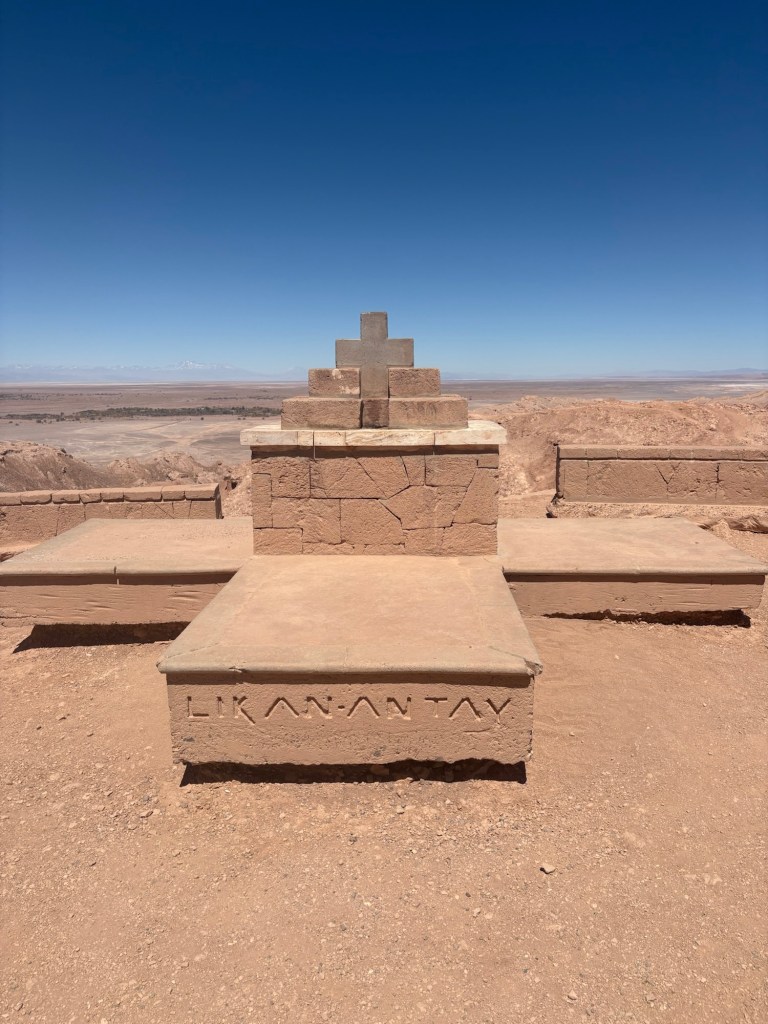
    I wish I knew the lore about this monument, but I don’t.

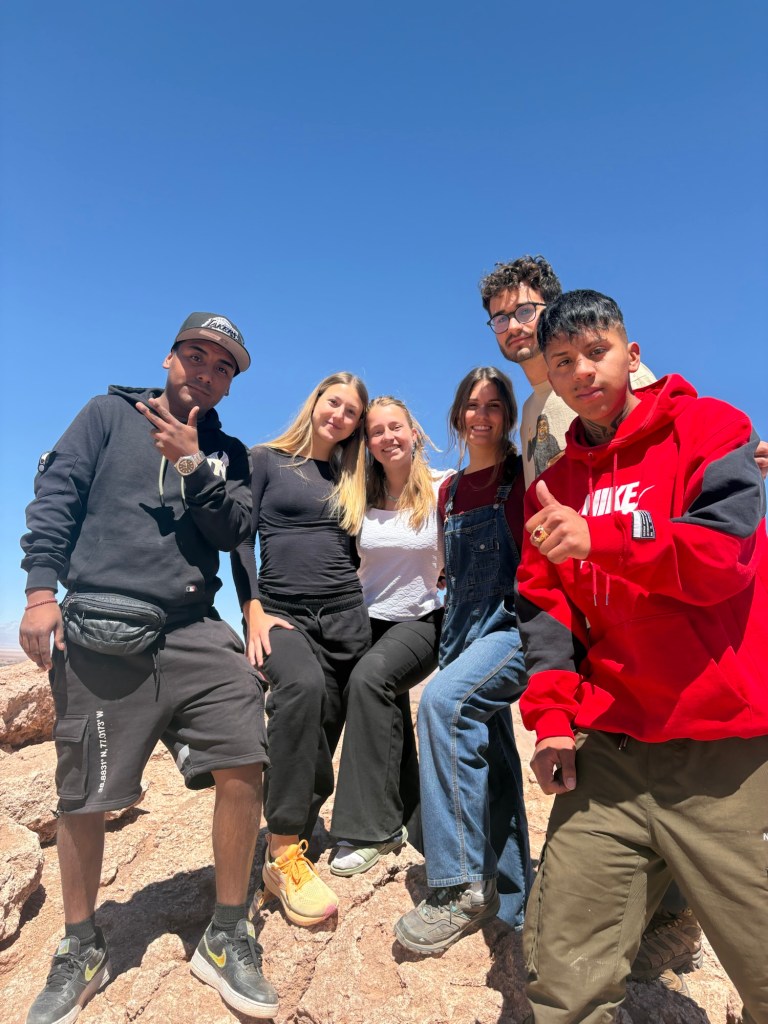
    At a certain point, two guys came up to us, asking to take a picture with Mette, Anna, and Elena. We weren’t entirely sure why, though it could have been because two of them were blonde, uncommon in Chile and doubly so in the north, which was phenotypically darker than the rest of the country. At any rate, we were obviously not from Chile, which probably drew interest. They were locals, from Calama, yet like us, it was their first time going to San Pedro de Atacama, despite the towns being two hours apart. Such were the economic realities for the area— Calama is a mining town, while San Pedro is a hub for tourists, more expensive than the rest of the region.

    I got in the photo too, which I don’t think they wanted, to be honest.

    Menu del Día:

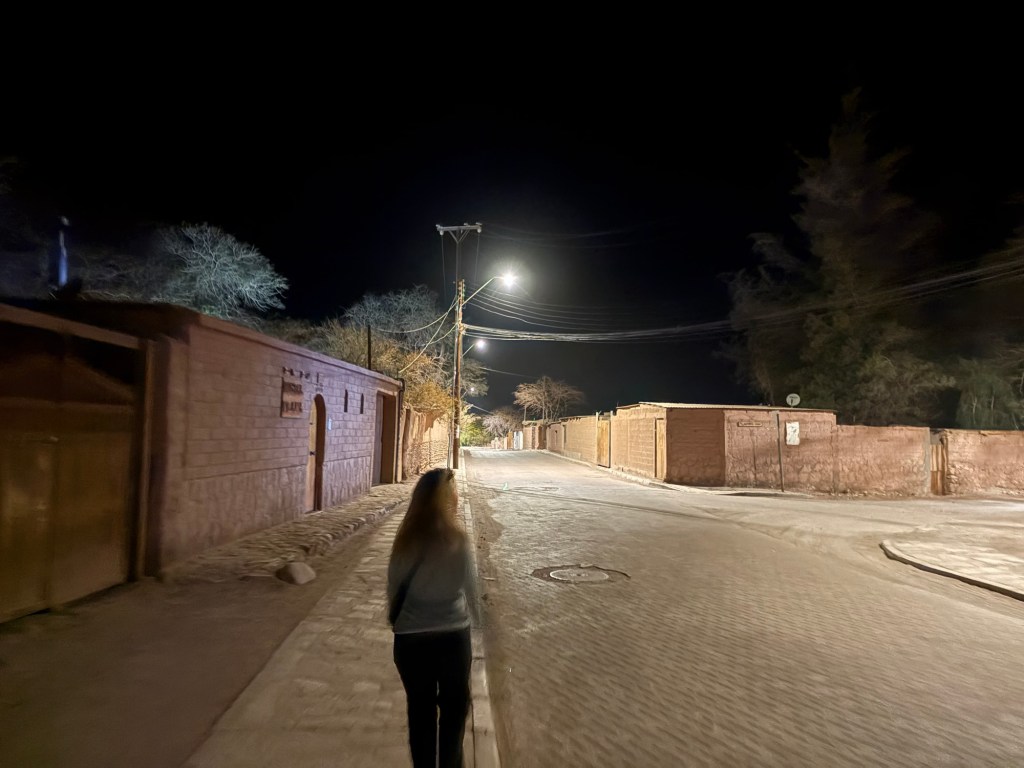
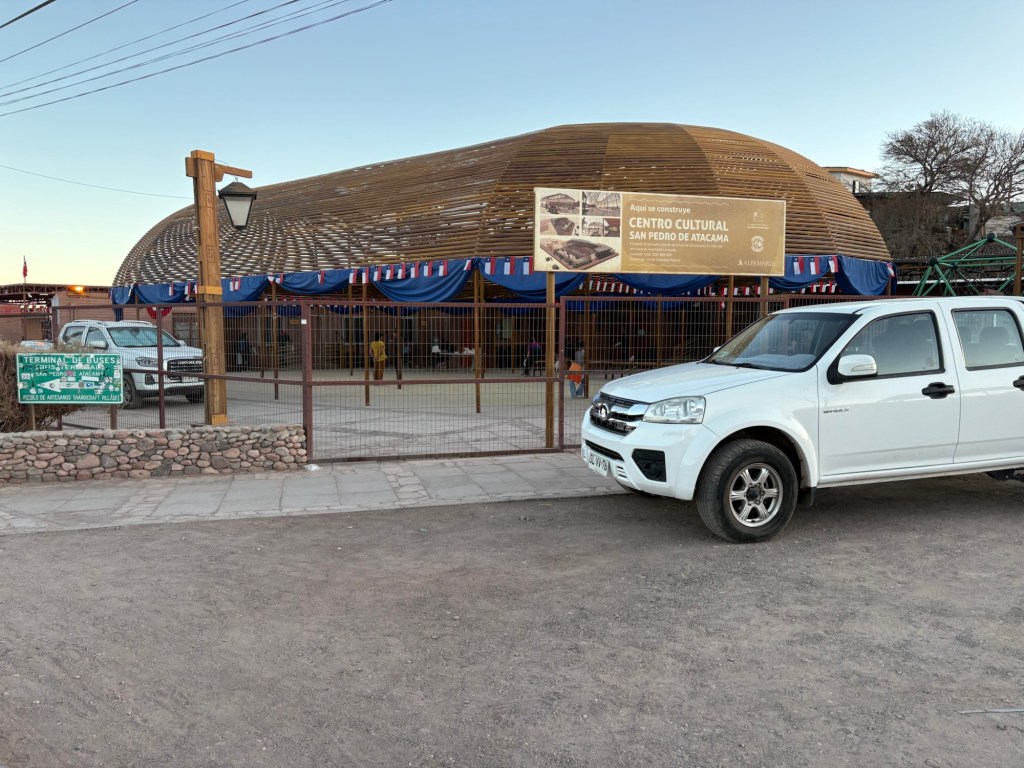
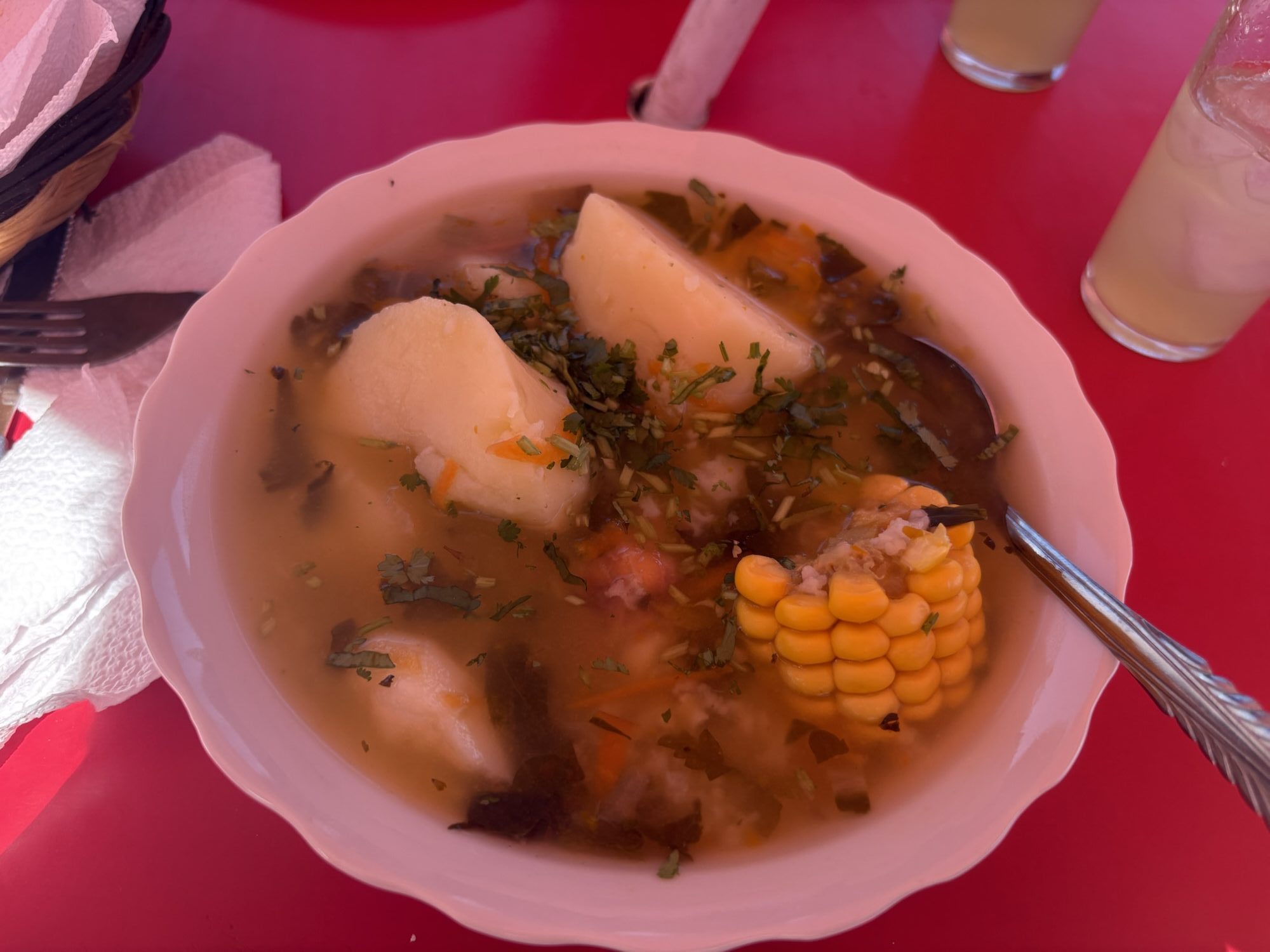
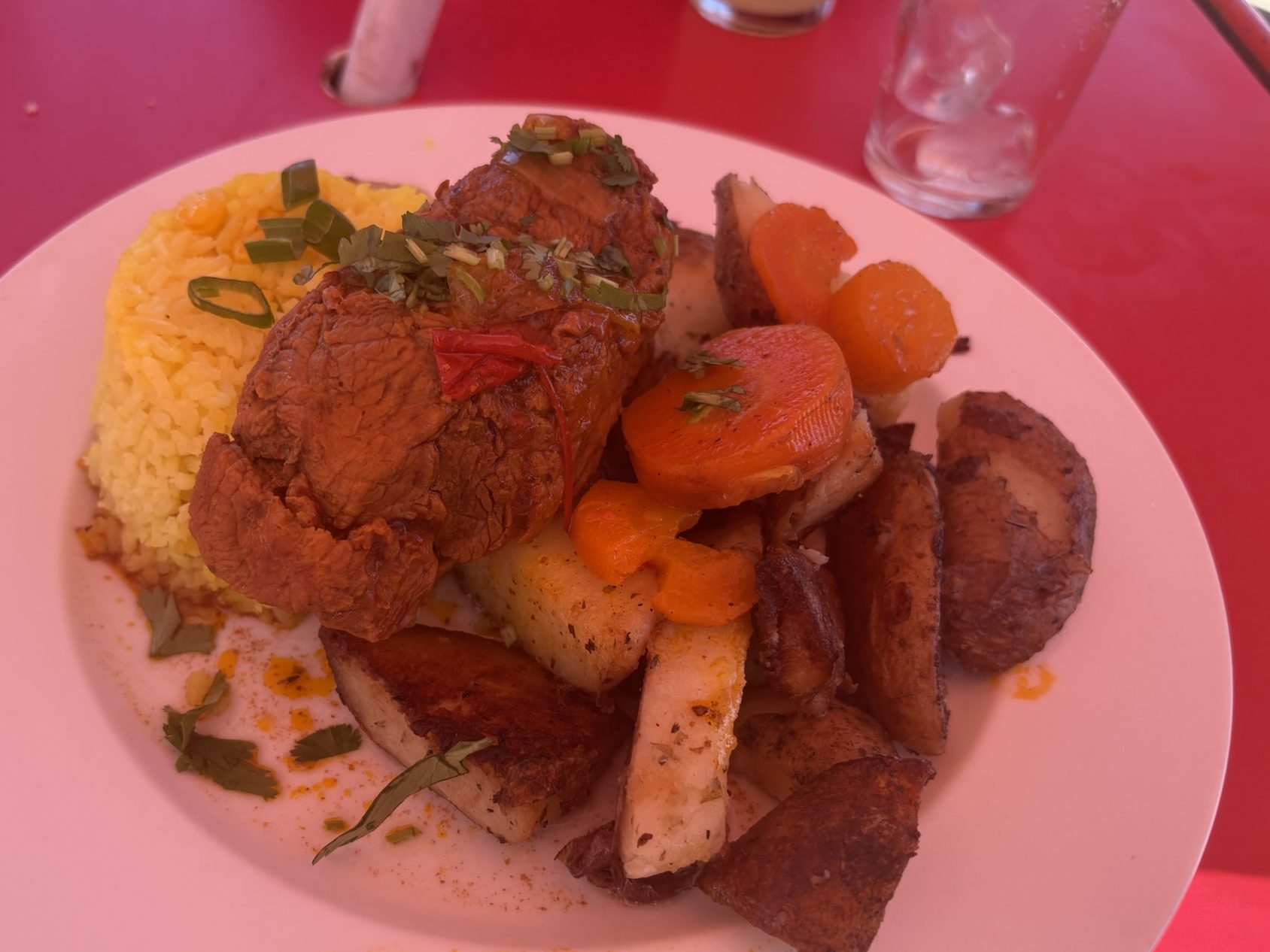
    Though when we arrived in San Pedro, tired, hungry out of our minds, we stumbled onto possibly the best culinary deal across all my time in Chile (outside of going to a feria and getting a kilo of produce for $1). As we drove in on one of the town’s dirt roads, the directions to the Airbnb wound up taking us right past a soccer field, and next to the soccer field were a bunch of little restaurants with signs for “Menu del Dia.” We didn’t hesitate. The Menu del Dia turned out to be a large starter, an entrée, and two sides for $7. And the portions were large; the starters would be like a large bowl of cazuela (a flavorful soup) or ceviche. Yes, ceviche is still good in the desert somehow—the principle I grew to adopt in Chile was if there is ceviche on the menu, you must order it.

    Cazuela: so good, although the one my friend Montse’s mom made was better.
    Carne jugoso. This with the cazuela was $7, not a bad deal at all.

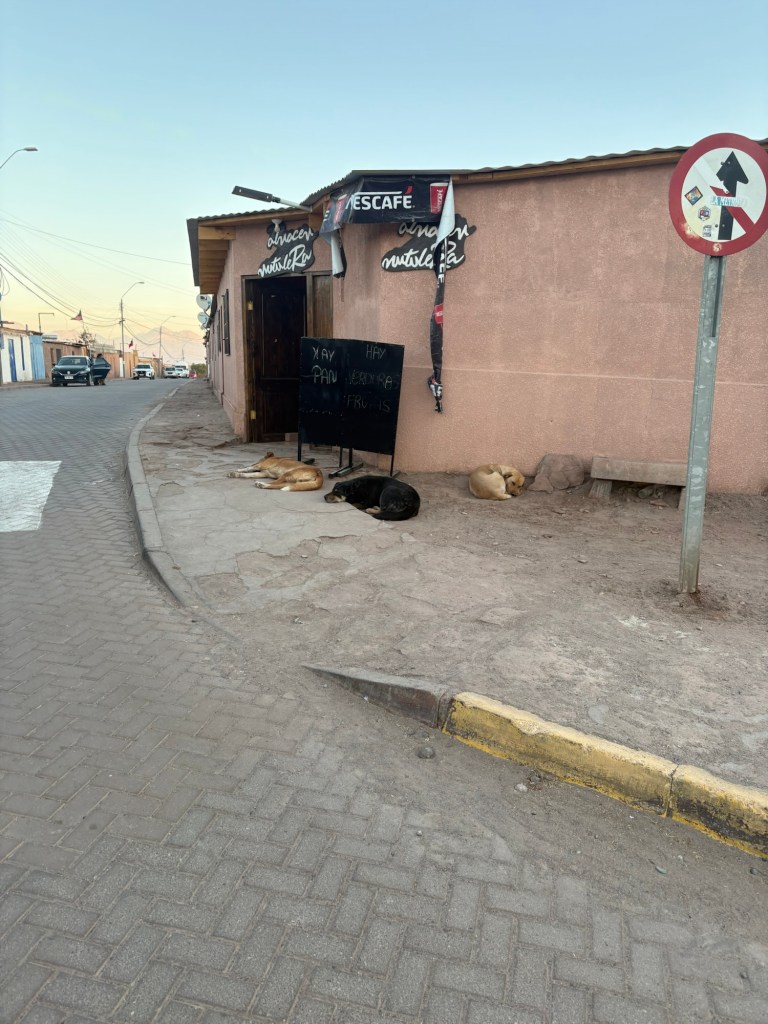
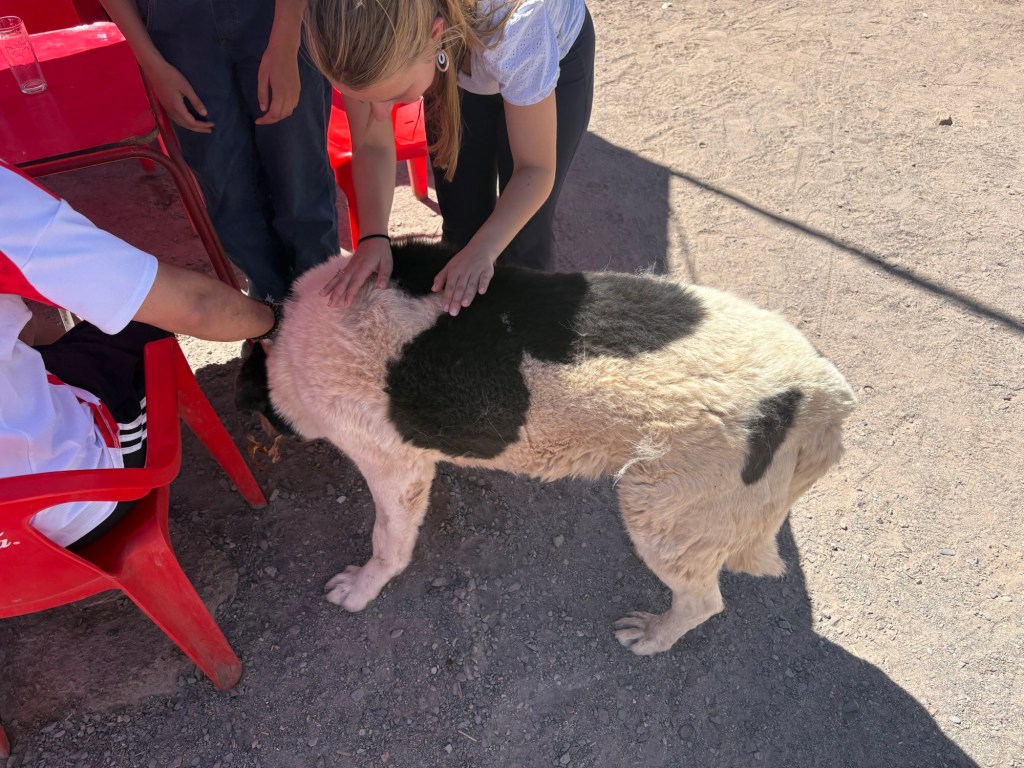
    We ended up going to the Menu del Dia three times for lunch on the trip, experimenting with different entrees and combos and occasionally throwing in a beverage, like the delicious honeydew juice. It was always a phenomenal experience: we would sink into the plastic chairs, exhausted from a day of exploring; make conversation until the food arrived (for some reason, usually something foul and raunchy that garnered us looks); and then the talking would be replaced by the noises of us inhaling our lunch. Dogs would come by to be pet—or really, for food, which was why the restaurant owners would shoo them away. One time, a man stopped by with a guitar, playing a song (badly, alas) that he said was typical to the region; it sounded a lot like “El Carretero”by Buena Vista Social Club.

    Dog, or cow?

    Airbnb:

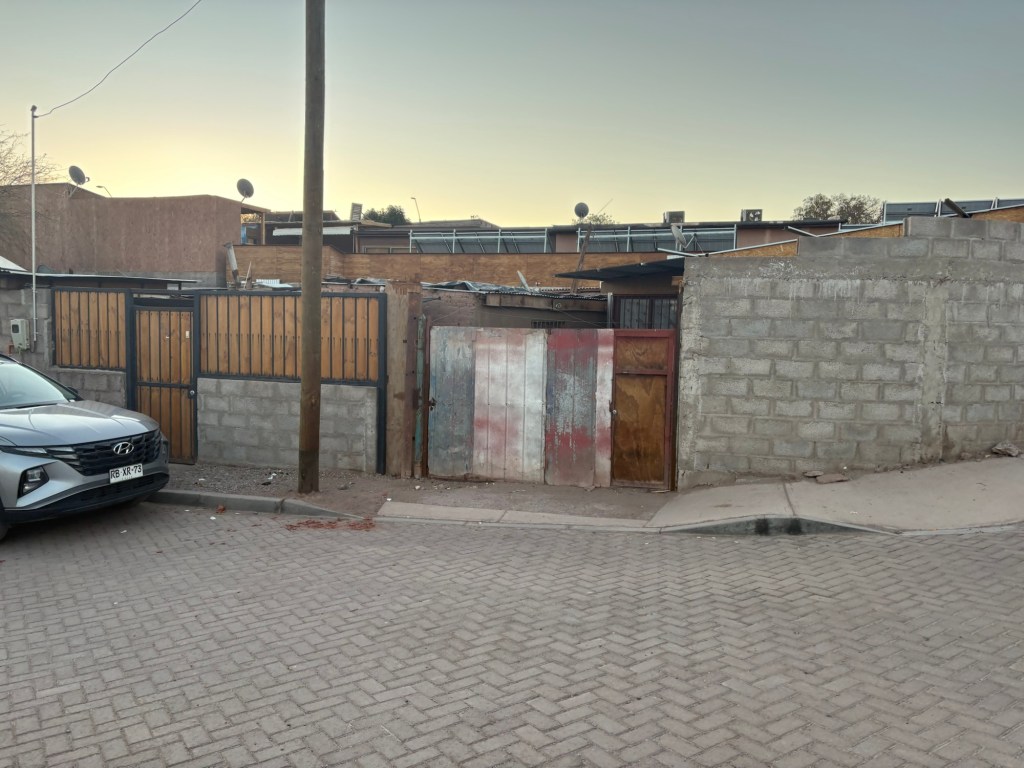
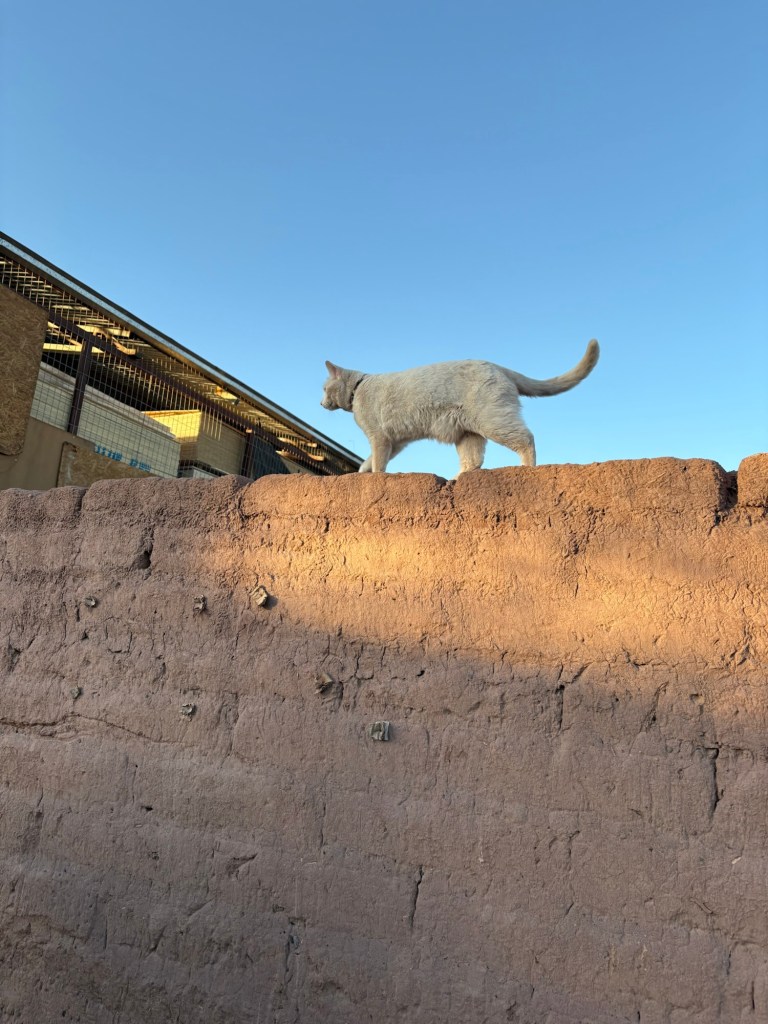
    Our Airbnb was just three minutes away, a small, shared unit with the owners next door. To fit both our car and their car into the narrow driveway, we had to do some maneuvering. Usually when we came back, there would be a dog or a cat roaming, and sometimes their kids would be kicking a soccer ball.

    ¡Mishi!

    Inside, there was just enough space for six people to exist. A bunk room for Anna, Mette, and Elena; another room for me and Hodei to share a bed (he kept waking me up in the middle of the night with strange and hilarious noises that I wanted to record but that also perturbed me enough to remain still), and space on the couch for Suditi. The shower had excellent pressure and was perfect for enjoying a post-hike beer.

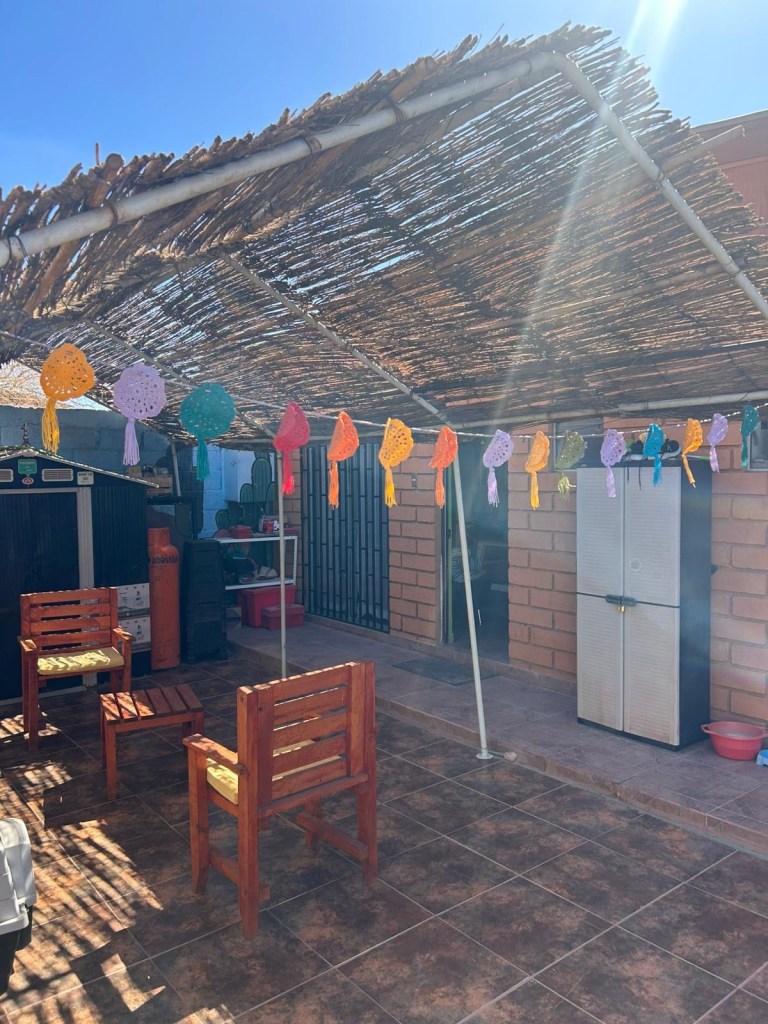
    We also got to enjoy this lovely patio.

    Over our stay, out of sheer bad luck, we broke three dishes. Every time it happened, we sent Hodei next door to talk to them because, as a literal Spaniard, he was the most fluent in Spanish. But the first time he did, our host gave him a blank look. We all thought this was hilarious; the meme in our house that he was impossible to understand because of his quick and low way of speaking, so this only added to the legacy.

    Fortunately, they were super chill about it, but we still felt bad, so one time when the kitchen sink got so clogged it just wouldn’t go down, instead of bothering them, we took the potentially disastrous course of action of trying to fix it ourselves. It was nearly overflowing; we called it a “tremendo poot caldo,” which was a combination of a few inside jokes. The main one was that poot was how Hodei pronounced “pool” for the first time in English—his English comprehension was C1 on the fluency scale, but his pronunciation couldn’t have been more than A2.

    Brief tangent here: we had a lot of inside jokes, as any friend group does, but perhaps more so because Spanish was a second or third language for most of us, and we were constantly making fun of each other’s speaking capabilities. For my first month, I couldn’t open my mouth without them making fun of my gringo accent(in Chile, gringo is specifically somebody from the U.S; it’s not race-based nor does it apply to any other nationality). Furthermore, because it wasn’t our primary language, I think that inside jokes were an easy way to achieve connection despite communication barriers.

    Poot, caldo, whatever you want to call it, we decided we would unclog it by unscrewing the bottom piping from the sink. The sludge that had built up below was truly unfathomable. I think I was the only one who even dared to touch it, collecting all the goop in a bucket while Mette took pots full of the upper water and dumped it into the road. It was mildly stressful but mainly hilarious doing it.

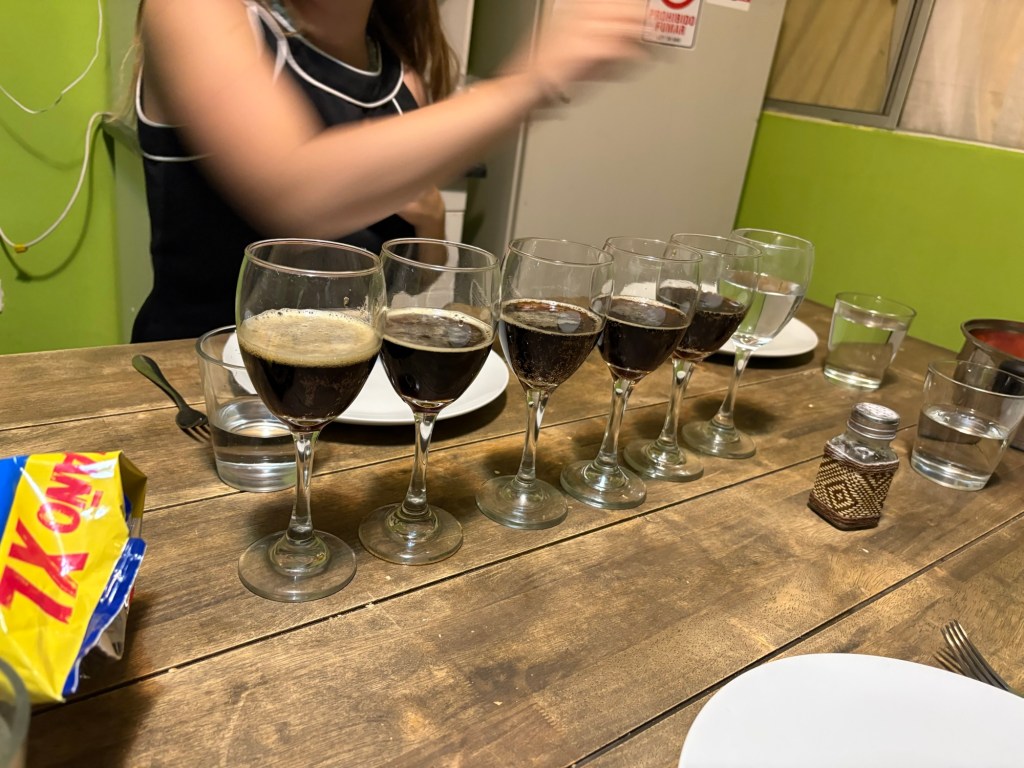
    Probably because we were drunk. After every single day of exploring, we would try a new artisanal beer, just one tallboy split among five wine glasses (Elena couldn’t, as she was celiac, a tough one in Chile) but since we were at 8,000 feet of altitude that would be enough for some tipsiness. Two would have you pretty lit, all things considered. I think that helped us, honestly, with the plumbing job, because we nailed it. Afterwards, I had to wash my hands a bunch of times over, but thankfully I had a functional sink to do it in.

    Beer (and Mette).

    I think that about tells the story of the Airbnb. We stayed five days; all in all, it was a lovely spot, it was mainly a home base. Most of the stories occurred outside of it, which I’ll get to in the next posts.

    Is there anything else to mention?

    Permit me two more moments. One time when everybody else was gone, Mette and I had a conversation about romance and study abroad. It seemed to us that every other exchange student we had met was either: A. In a serious relationship of several years, or B. Was leaving behind a new fling that had only just begun to crystallize. Somehow the former category seemed more active in pursuing romance than the latter. We reflected on the silliness of it all.

    The other thing wasn’t a moment, but rather something of note. Well, not even that, but I want to subject you to these details if you’ve made it this far. My hiking boots smelled so bad that I had to keep them far outside every day. Only later did I learn that I could take the insoles out to let them dry, which would have at least minimized the degree to which taking them off was an act of chemical warfare against the Geneva Convention.

    Departure:

    Of course, when we left San Pedro on the final day, we were behind schedule. Not me this time, though; I wouldn’t be flying back to Santiago with everybody else. From Calama, I would split off from my friends and go to the similarly named Caldera, a mere ten hours south of Calama by bus. I was going to visit my friends Raul and Montse to take part in some fiestas patrias activities, before taking another twelve-hour bus down to Santiago for dieciocho.

    My bus was at seven, so I wasn’t moving with too much haste in the hours before we had to go, exploring the markets one last time as I tried to find a small gift for Fer (his birthday was coming up soon). I also bought myself a nice hat and re-bought the bracelet that I had lost. As I was doing this, my friends found out that their plane was an hour (or perhaps a half-hour) earlier than they had realized, and suddenly we were in quite the rush.

    We had to drive two hours back to Calama and get gas and return the car and then get to the airport. Anna, of course, was our driver, as she had been for most of the trip. She’s Italian and drives like it, speeding by everything, ignoring the occasional stop sign or speed bump, and yelling cazzo, merda or va fan culo (I think I’m spelling those right) at the other drivers. She was undoubtedly a skilled driver, but I wasn’t always relaxed when she was behind the wheel.

    But she was born for today’s assignment. I’ve never seen any driver so locked in. I swear we didn’t go any less than one hundred seventy kilometers per hour the entirety of the stretch, which might be only a slight exaggeration. She was passing trucks and cars like nothing. While she pulled off a lot of maneuvers that were cutting it close, I knew she had faith in her abilities, so I wasn’t too terrified—except for one when she passed into a blind turn. Luck was on our side, but if it wasn’t, I wouldn’t be alive to write this right now.

    We also had six in the car, but that almost didn’t matter, because we were speeding anyway, so if there were carabineros, we were screwed regardless. We prayed they weren’t on the road and prayed we would make it and listened to Adele all the while as we hurtled back to Calama.

    Therapy, or driving this road at one hundred miles per hour?

    Thanks to Anna’s F1 abilities, we made it. They dropped me off at the hotel where it had all started. It was like Villarica all over again, with me hanging back to have my own little adventure—this time intentionally. I was excited. I love travelling with this group—we travel similarly, and nicely, together—but it’s so nice to also have your own moments to explore.

    First, though, I had to make my bus, which with my prior experience, was not a given. Especially in Calama, which was the least walkable town in Chile I visited. And while I felt completely safe, as I made it to the bus station, I felt eyes on me. People were watching; I stuck out as a gringo with two bags struggling to find the bus stop—I had to double-track myself on the sidewalk like four times.

    To be fair, it turned out to be a confusing situation: it was just an office, with a parking lot in the back and literally nowhere to sit. Everybody was sitting in the tiny room or on the sidewalk, so I decided I would wait somewhere better, as I had an hour and a half to kill. So I continued walking, passing a discoteca that was bumping even at six in the evening, and a rather suspect bar—no windows, with men at the outdoor tables being served by women in bikinis. Just further, though, was an ornately decorated Peruvian restaurant. I didn’t think twice.

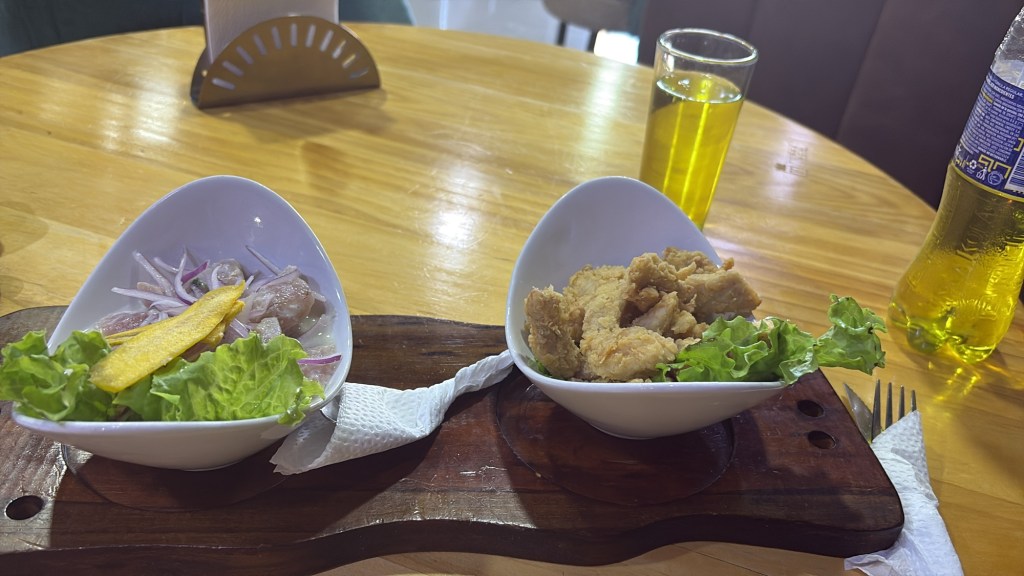
    I was the only one there, and I decided to treat myself to some expensive ceviche—like the cost of three Menu del Días. It was divine. Peruvian ceviche is different, with a more spicy and complex flavor profile than Chilean ceviche. I wasn’t sure what else to do as I waited, so I called my friend Sofia from back home. She’s fluent in Spanish, and for the first time I was able to have a proper conversation with her in the language. Here it was: tangible proof that my skills had really increased.

    Notice the Inca Kola in the background.

    Though I think the servers at the restaurant thought it was funny—a gringo talking in choppy Spanish to someone back home.

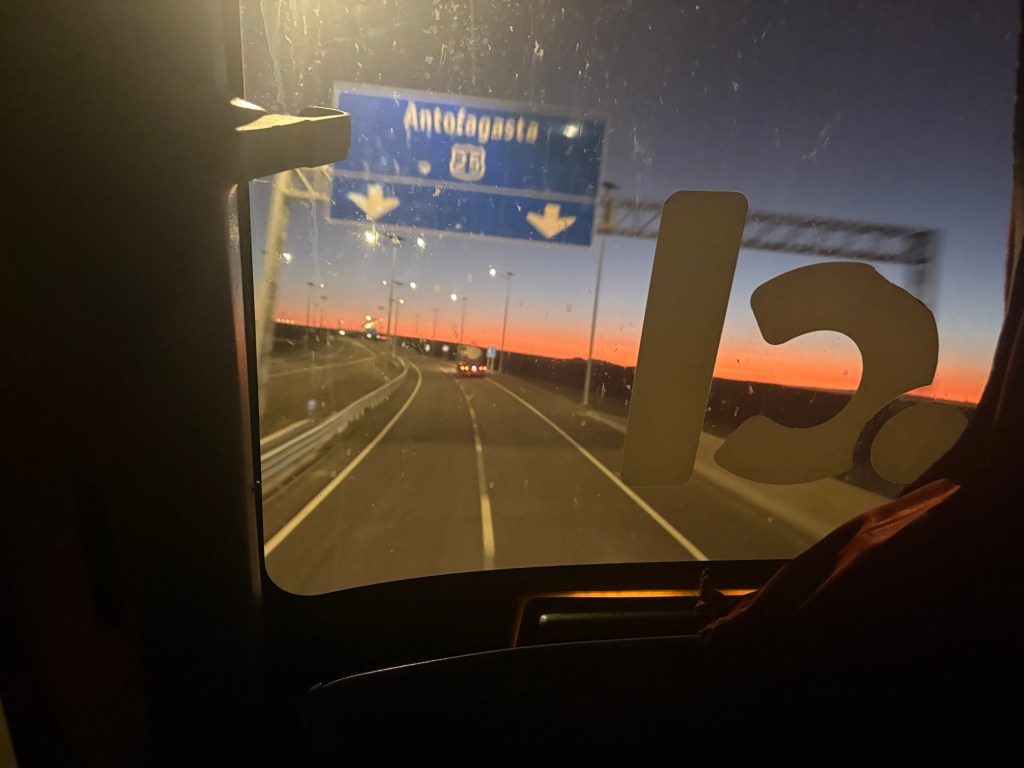
    Finally, I went to go to my bus. Of course, it came late, and I had the sinking feeling that I was about to be stranded once again. But just after I had double-checked with another passenger that I was in the right place, it arrived. My seat was a comfy semi-cama in the front row of the top of the bus, the best seat in the house. We drove off—literally into the sunset. It was the perfect way to say goodbye to San Pedro.

    I was too tired to hold the camera still for more than a millisecond.

    Next up was Caldera—although you, dear reader, will have to first make it through three more posts about San Pedro.

  • Chile #4: Pucón, Part 2: Volcán Villarica

    Chile #4: Pucón, Part 2: Volcán Villarica

    August 17, 2025:

    My alarm went off at 4:30 AM. Recently, it’s been Cornfield Chase, the Interstellar soundtrack, so that I can wake up with the sheer thrill of fiery inspiration coursing through my veins, of course. Though with two other people in the small cabin bedroom, I only was able to hear the first few seconds before turning it off.

    I had managed six and a half precious hours of sleep. Was I ready to explore the far reaches of outer space? Probably not. But I was optimistic for the day’s mission: Volcán Villarica, a more realistic 9.5 thousand feet above sea level.

    Silvia, God bless her, drove me into town to the tour agency. I was the last person registered for the tour because of the Wi-Fi and data issues I had yesterday, and I knew nobody on it except for a French guy I had met in my Social History of Latin America class two days before. Small talk to get to know everybody, though, was very limited, likely because it was 5:30 in the morning.

    There’s also the question of which language to use when meeting other extranjeros: English or Spanish? I always go for Spanish, but some stick to the more comfortable common tongue of English. It turns out, the answer for this group was French, so I didn’t have much luck either way.

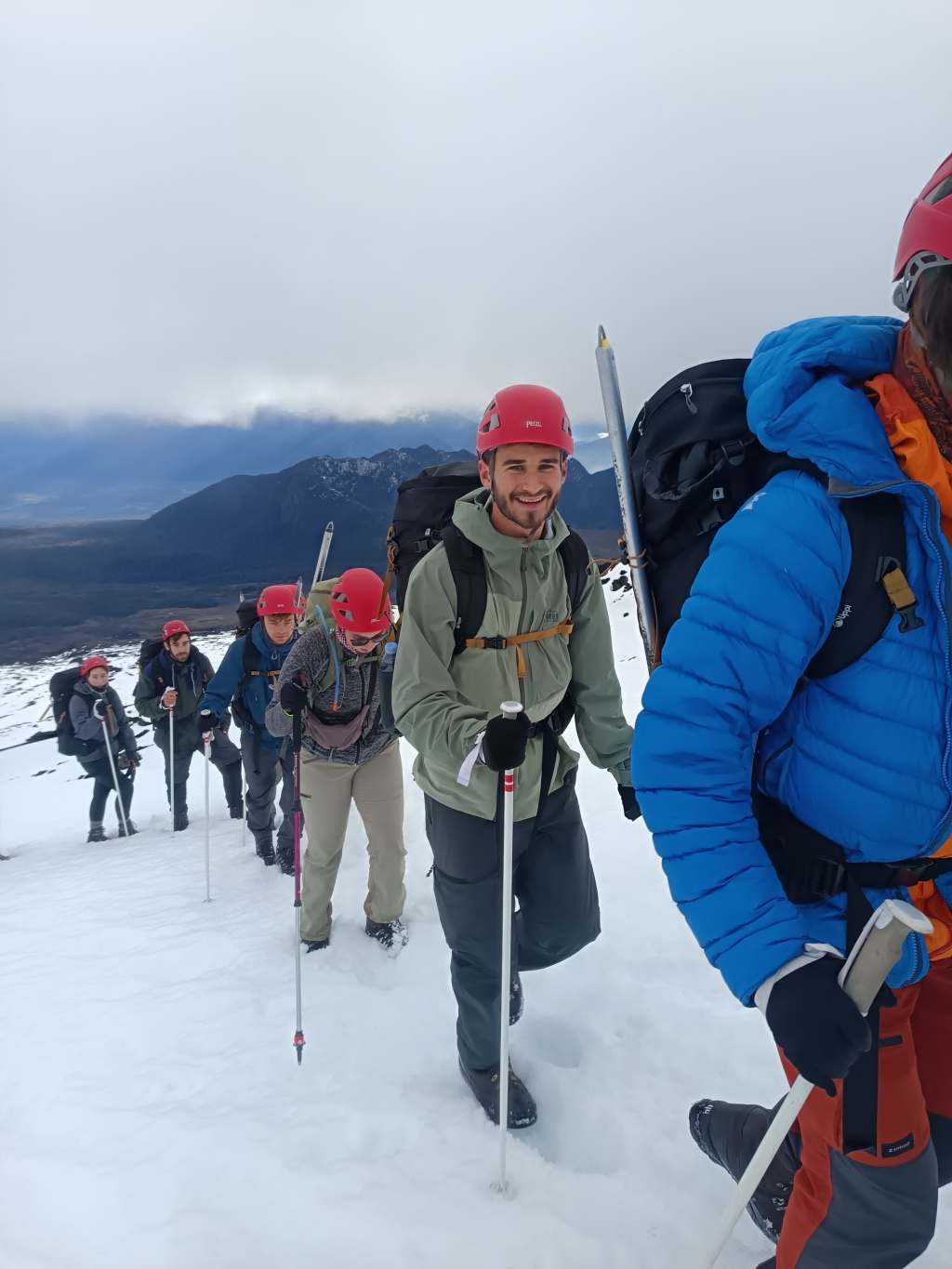
    We got fifteen minutes in the locker room to receive our backpack of gear and modify the packing arrangements how we saw fit. Everything included would theoretically be needed on the heavily glaciated active volcano: boots, crampons, ice axe, snowpants, down jacket, three pairs of gloves, ankle gaiters, helmet, sled, and gas mask.

    Yes, gas mask. It was necessary because apparently, the crater at the summit of the volcano—one of the most active in Chile—was toxic. Obviously, I was looking forward to this part.

    Now, when I travel, I’m usually not a “guided tours” person. I love to explore and figure things out on my own. But for a true mountaineering expedition like this, as much as I’d love to just say “fuck it, we ball” and throw myself out there, the simple fact of the matter is that I have no experience climbing glaciers, much less the gear; plus it’s not even legal to summit the volcano in winter without a guide.

    We piled into the bus, and off we went. I had packed five ham sandwiches and five protein bars, and I had two of each on the one-and-a-half-hour ride, in between trying to sleep and making forgettable conversation with the German couple in my row.

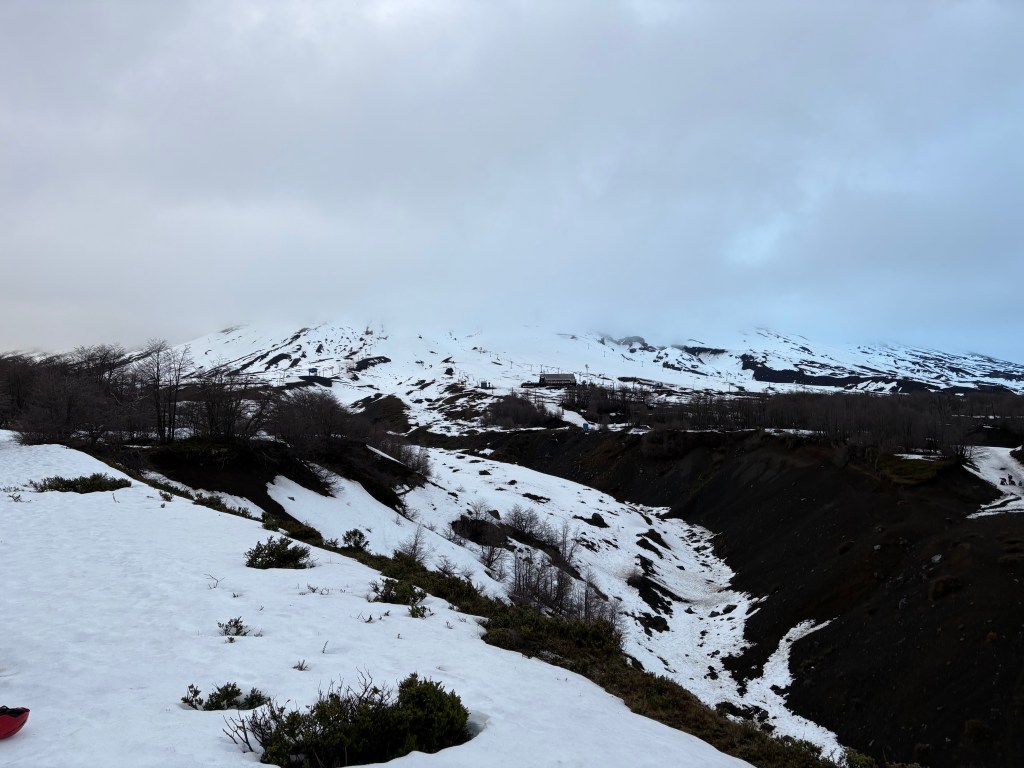
    After crossing the limits of Parque Nacional Villarica, the road became steeper and more laced with potholes as we approached the base of the volcano. The sun had risen, but the volcano was shrouded in clouds when we arrived. We were only able to see the very bottom layer, which was impossibly wide and just as impossibly steep. The top was somewhere way up high in the abyss of clouds, and soon, we would be too.

    The volcano was feeling shy this morning.

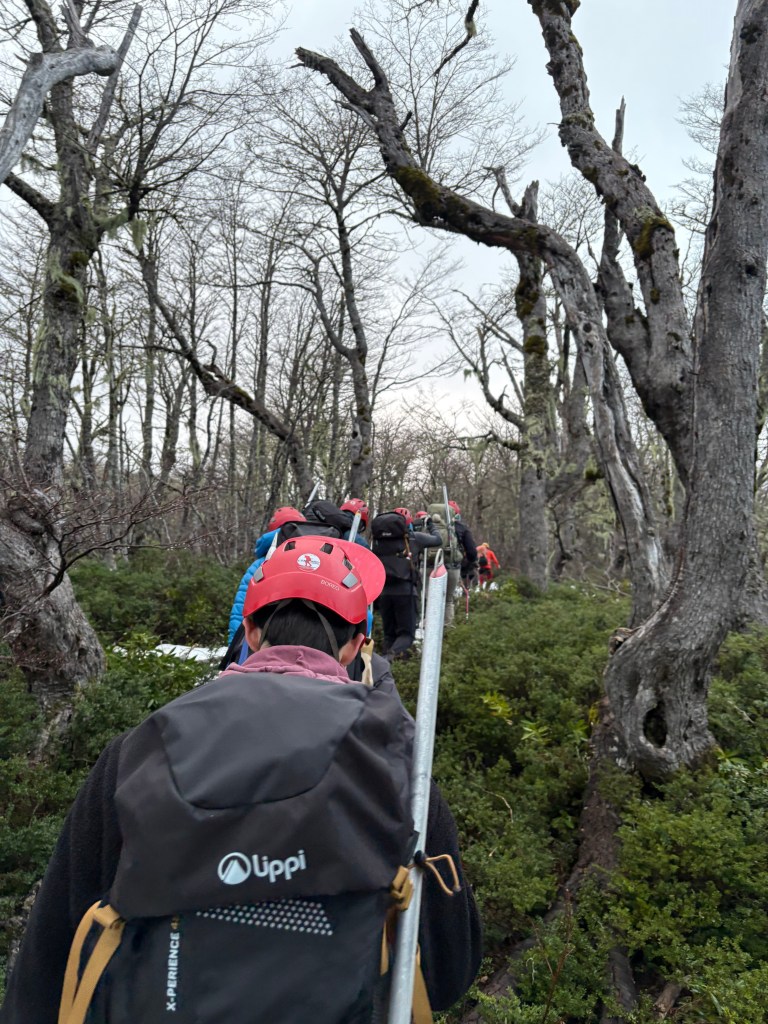
    It was much colder up here where we were starting, at 1200 meters, so I donned the big coat and put on some gloves for the first part of the trek, a largely horizontal stretch save for some rolling hills. As we winded through trees which felt straight out of the Lorax, I began to warm up and was profusely thankful for the fact that I had remembered to wear a bunch of layers. Layer management became a big theme of the trip as we ascended, and the temperatures descended below zero. I was surprisingly hot while walking but needed to put on another jacket and gloves at every break.

    Okay, maybe the trees weren’t that Lorax-esque, but I thought they were interesting.

    The plan that the guides laid out was in increments: an hour of walking, a ten-minute break. Rinse and repeat five or six or seven times; I honestly can’t remember how many were necessary to reach the top. It was a climb from 1200 meters to 2800 meters, which is pretty much exactly one mile of ascent, as my cross-country and track people might know.

    Soon we reached the part where terrain switched from level to inclined, and the abrupt difference was comical. At a certain point, the gentle path just becomes monstrously steep, and the higher you go, the worse it gets. For the first hour, on rock but with sections of snow, we were able to walk directly up. After that, we needed to zigzag to mitigate the slope.

    A beautiful view of the lesser mountains nearby, which didn’t quite reach the clouds.

    I’m in reasonably decent shape, so the going wasn’t brutal, but it was definitely a mental challenge. The scenery doesn’t change much, because we were already well above the tree line (the farther south you go, the lower it gets). You can’t make much conversation, because it’s windy as hell, you’re breathing hard, and you need to stay in single file behind the guide. It’s just up, up, up.

    For some of the guides, though, it was a literal walk in the park. One woman was on the phone with her family for most of it; I’m not sure how she even had data. Another man, who was about sixty, told us that he had been working here since the 90s and that he had summitted the volcano three thousand times.

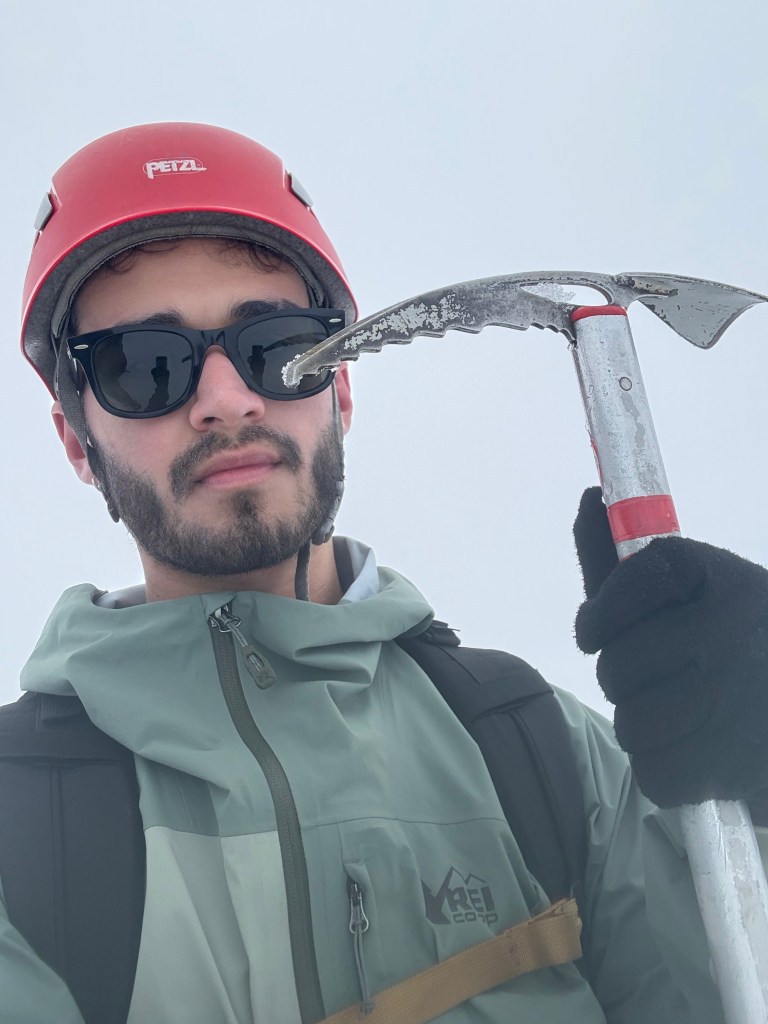
    The second pass was more of the same, except the snow was much higher, and we had to put on our ankle gaiters so that none of it got in our boots. On the third pass, we were taught how to use our ice axes, which were basically another walking stick, but more importantly the only thing keeping you from sliding down the mountain if you fell. The idea was you would jam it into the slope as an anchor.

    Just a boy and his trusty ice axe.

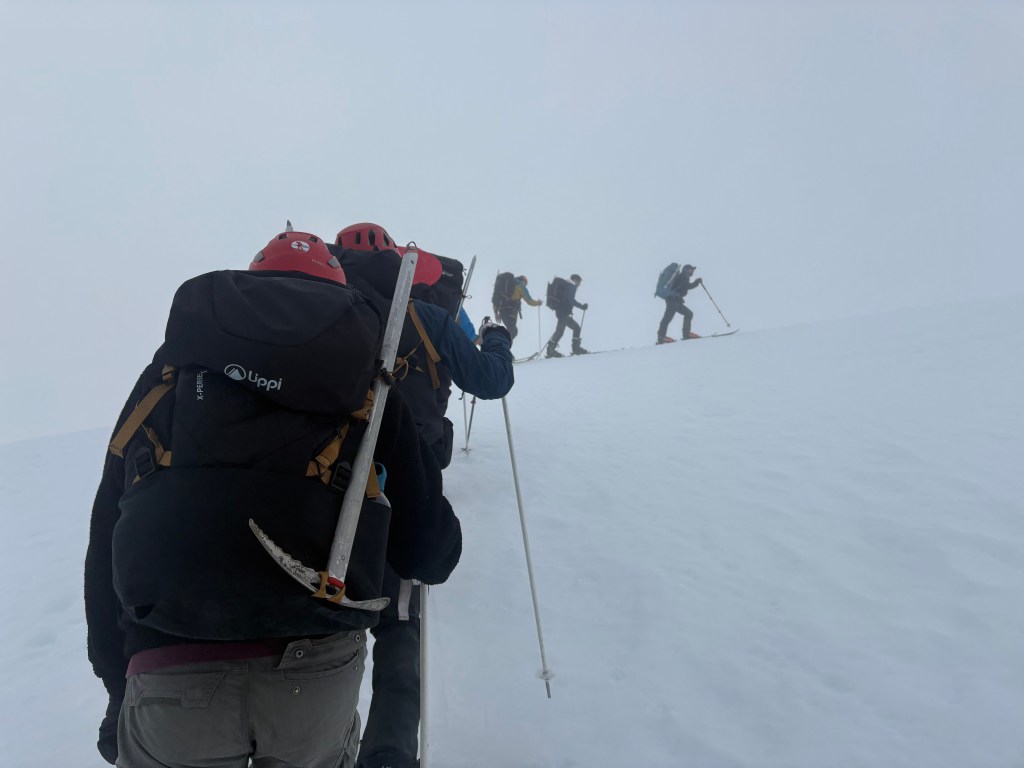
    I had been hoping for better weather. The forecast had said that by mid-morning, the clouds would clear, but instead they seemed to thicken. We still couldn’t see the top half of the volcano, and once we entered the clouds, we couldn’t see anything at all.

    These conditions made the experience way more fun, in my opinion.

    It was surreal. Snow in the air whirled around us, the wind stung at the few parts of our face that were exposed, and everywhere was completely white. Looking around, it was impossible to differentiate sky from mountain beyond a few meters. Our expedition had split into two sections based on speed, and at times I couldn’t even make out the other group, who were a minute or two behind us.

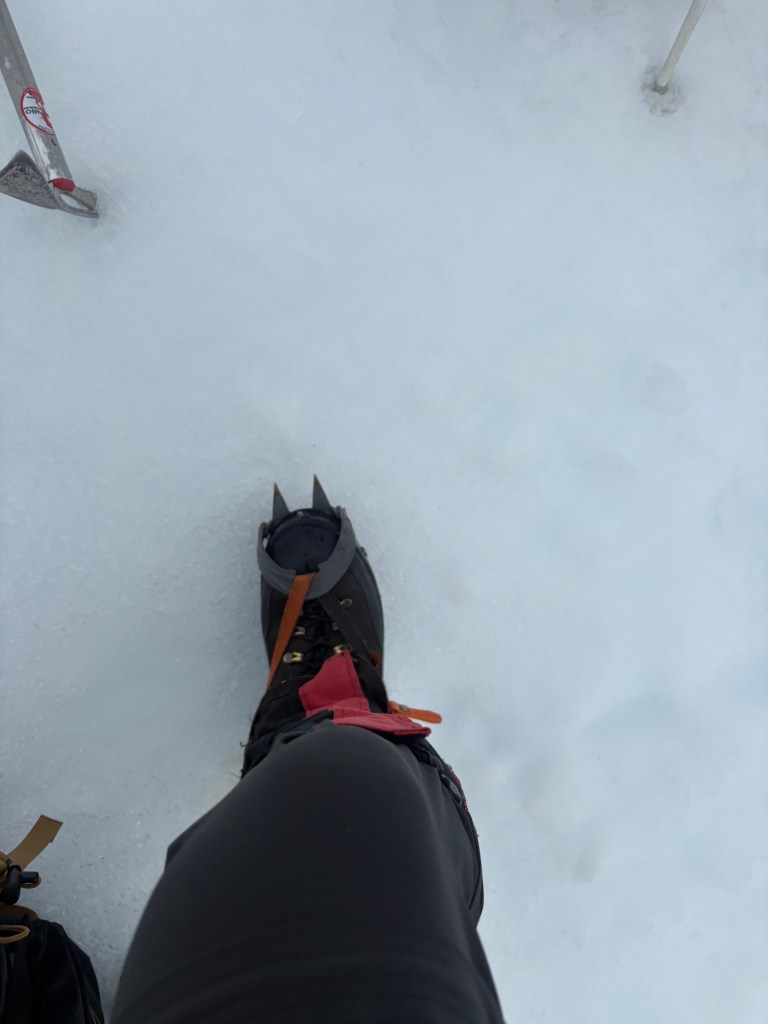
    Soon (or maybe it wasn’t soon, but the time seemed to blur because of the same-ness of the ascent) we reached the glacier, somewhere in the vicinity of 2000 meters or so. Here we put on our crampons, which go over your boots and give you spikes to dig into the ice. Every step we took with them crunched in a satisfying way.

    Crampon-ed up.

    I’m not sure what the angle of the volcano was, but it had gotten steep. A part of me wants to say 45 degrees, which must be entirely outrageous, but seeing the volcano from afar, it doesn’t seem all that unreasonable. The best way to explain it was that it felt a whole lot steeper than the black diamond I had tried in Valle Nevado, a ski resort outside of Santiago. When I fell down that, I slid quite literally hundreds of feet down the slope, face first. Here, you didn’t want to fall. Especially the times when we walked right beside a slippery cliff face.

    The weather continued to worsen as we climbed, which gave me a bit of a thrill, as a person always seeking a proper quest. But by the time we reached 2600 meters, only 200 meters from the top, the winds were really blowing, and it was difficult to see anything. Our guides stopped us here and began to talk amongst themselves, then on walkie-talkies, then amongst themselves again.

    We had to wait here, they told us. It was too dangerous to keep going. There were sections in the glacier where snow disguised deep wells, and they would be impossible to see in these conditions.

    Here, on the side of the mountain, so close to the top, we waited. I ate another sandwich and another bar. Soon, without moving, I got so cold that I had to put on all three layers of gloves. But ten minutes passed without the weather changing. After twenty, it had only gotten worse.

    At thirty minutes, they delivered us the news: we wouldn’t be able to summit today.

    The highest point we reached on our expedition—clearly a remarkable spot.

    I was definitely disappointed. I was looking forward to donning the gas mask. Also, of course, because I wanted to conquer the damn thing. But as my classmate Corentin from history class put it, sometimes the mountain wins, and that’s okay.

    Actually, there’s something comforting in that.

    To be a total nerd and reference Brandon Sanderson, journey over destination.

    Besides, it wasn’t over yet. As we began descending, the storm picked up ever more. The guides’ demeanors changed from relaxed to urgent. Our group leader wasn’t even video calling her daughters. There was no dilly-dallying, no stopping to take pictures. They wanted us to get down the glacier, fast.

    Finally, ice turned to snow, and we were all able to take it easy again. More than that, in fact. Here, the fun began.

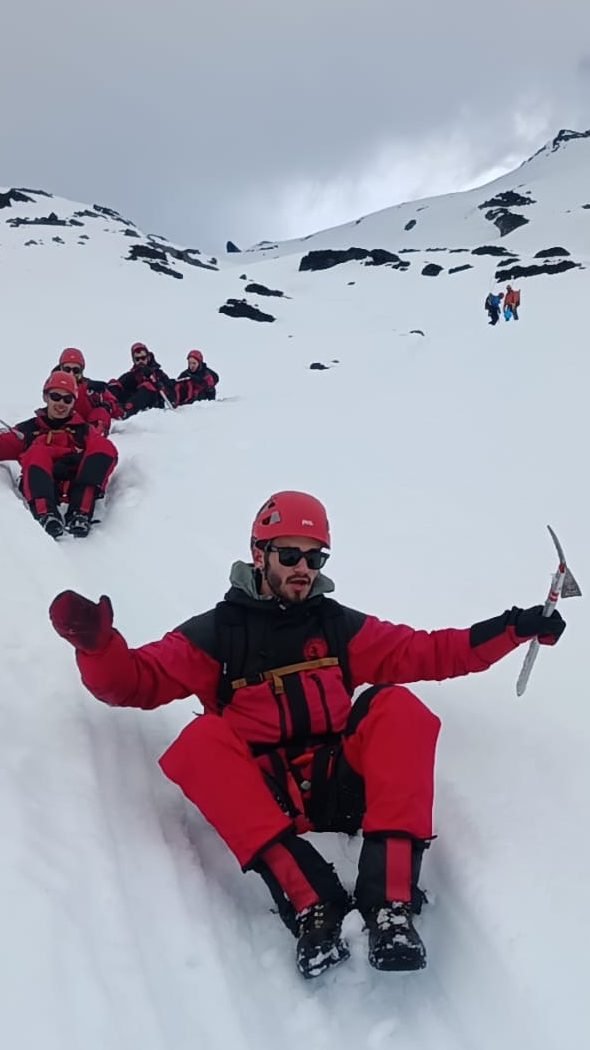
    Inside every single one of our backpacks was a small sled, so tiny there wasn’t even even enough space to cover your entire butt. But these thin pieces of plastic, which clipped to our jackets and backpacks and went in between your legs in a quite ingenious system, were enough to get us sliding down the mountain real fast. It was like during snow days when I was younger, and Mom would take me and Mick to Agawam golf course with our sleds. Except here, the hill was a hundred times higher, and you just kept going and going until you reached a bump that you either stopped at or went over to get some air.

    Sledding. The ice axe doubled as a brake, not that I used it.

    I will admit to becoming somewhat enraged the few times that I got stuck behind somebody slow (the German couple usually) and all the momentum that I had gained from not breaking was for naught. But despite this ire, and even though we hadn’t summitted, I was in a great mood. The combination of endorphins, the sky opening as we descended, and the fact that I was literally on the side of a volcano in Southern Chile was working wonders.

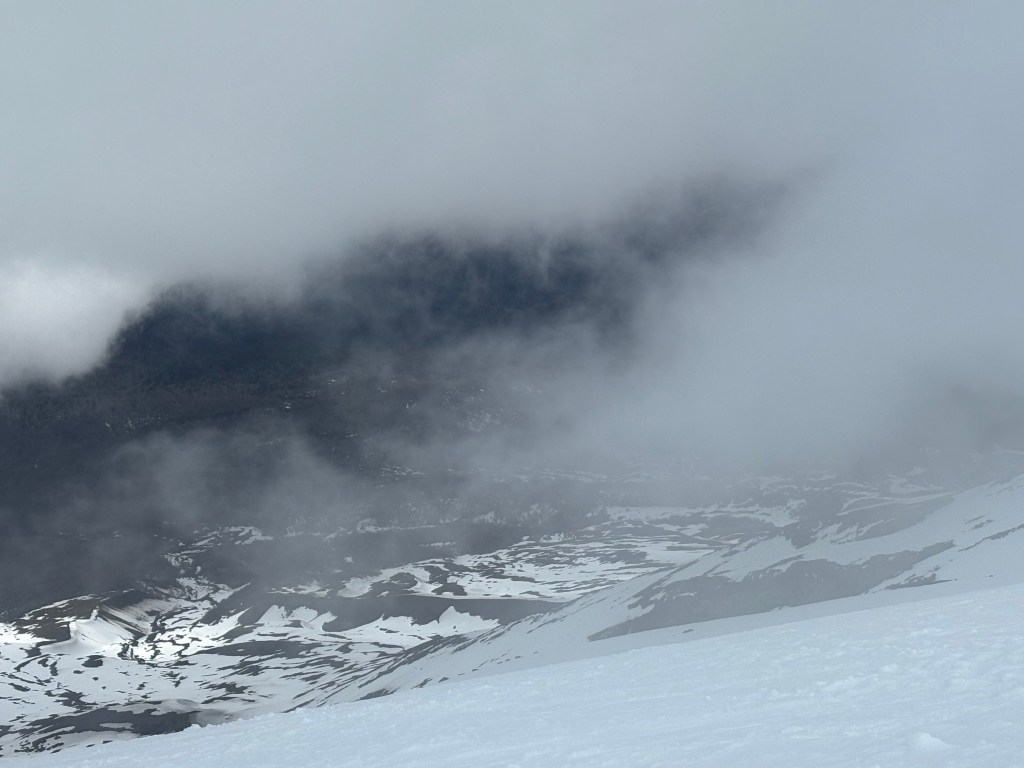
    Coming out of the clouds was pretty rad.

    That’s the thing about study abroad: it’s easy to let the “big picture” contextualize whatever happens, in a good way. Oh no, I got a bad grade on a homework assignment, or I missed my bus (foreshadowing) or something. At least I’m in Chile making lifelong memories.

    We finished the end of the hike quite rapidly, and when we returned to Pucón, there was a lovely cheese platter—and beer—waiting for us. After socializing with the group, with whom there were finally some conversational breakthroughs, and eating all the chips in the bowl in the most respectful and discreet way I possibly could, that was that. A quest that I had been looking forward to for months, and had envisioned as some massive venture, had been knocked out in my first few weeks of the program.

    What could possibly be next? The unknown of the future has always been something I’ve looked forward to (and dreaded, in terms of my career) but it never feels so incredible as after an adventure like Volcán Villarica.

    Of course, the day after had pristine conditions.

    Epilogue:

    For the very near future, the answer to that question was more beer. My friends were still out and about, and I had no clue what to do next. So, as any reasonable person would do in my situation, I went to the bar. After a few drinks and some joking around with the bartender (not to mention some Spanish issues on my part) I left to explore Pucón for the last hour or so of daylight.

    You honestly can’t beat wandering around small towns alone in Chile, especially when you’re slightly drunk. Unlike the small towns of the United States, they’re constructed on a grid system and are gloriously walkable. There are always people (and dogs) out and about, and a town square, or a cool church, or a pop-up concert awaits around every corner.

    I meandered my way to an artisanal market, where I lost in ping-pong at the table in its center to a kid that couldn’t have been more than fifteen. Not to generalize by nationality or anything, but I have found Chileans to be damn good at ping pong.

    Next was the Plaza of Armas—a much more peaceful, and clean, iteration than that of Santiago—where kids were out and about on giant tricycles and their parents watched them on benches with ice cream.

    I finally ended up at the hotel from the day before where we had rented the cars. As families strolled on the promenade and boys kicked a soccer ball around on the sand and couples got into it like they were in the comfort of their own home, I sat on the wall with a book and my journal, lazily reading and writing while the sun set. My friends were almost back in town, and we were going to get dinner soon, but for now, I enjoyed the perfect conclusion to my day.

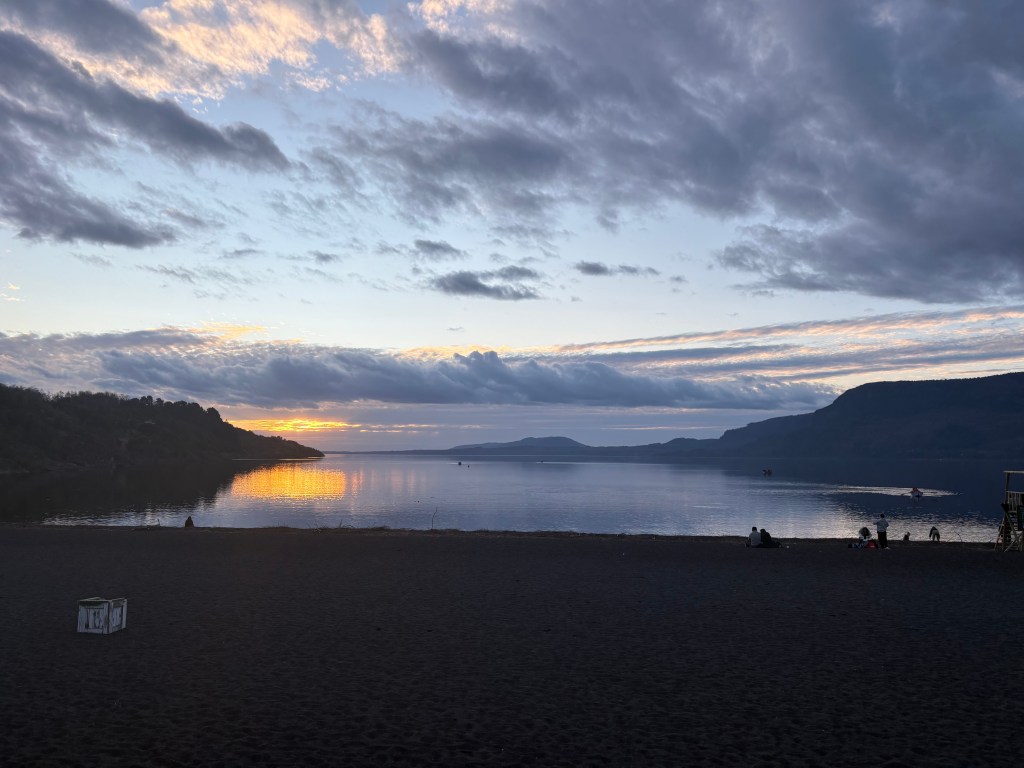
    Sunset over Lago Villarica.

    8 responses to “Chile #4: Pucón, Part 2: Volcán Villarica”

    1. leahhetteberg Avatar
      leahhetteberg

      Mountaineering 4 laps around a track sounds like the work I would only expect from Sam Healey.

      Love the “sometimes the mountain wins” philosophy! You’ve got stories to tell and pictures to show and that’s what counts!

      As I’m struggling to compile a simple concert-review blog post for KCSB that I was contracted for I am becoming increasingly more admiring of the efforts of this project (not that I wasn’t already in extreme awe before).

      Also I just love how you write, Sam. It’s like reading a novel but the subtle one-liners and distinct voice are from your best friend. It’s so fun to read.

      Sledding sounds sick asf.

      Liked by 2 people

      1. dutifullyjolly61cbf073df Avatar
        dutifullyjolly61cbf073df

        “Lee-yah, Lee-yah!” 🫡💪🏼🔥

        Liked by 2 people

    2.  Avatar
      Anonymous

      Sounds a bit terrifying at times–which I know you loved. So glad to read this weeks after it happened–having FaceTimed with you since–knowing you are alive. Love, that lady who took tubing at Agawam

      Liked by 2 people

    3. dutifullyjolly61cbf073df Avatar
      dutifullyjolly61cbf073df

      A big experience, Chum — nicely conveyed! 🇨🇱🥇👍🏼

      Liked by 1 person

    4. Kristen Avatar

      Enjoyable to read and I can hear your voice in my head. Also, I love the word crampons.

      Liked by 1 person

    5.  Avatar
      Anonymous

      Love this, Sam. Sick that you got to sled down it, and unfortunately the mountain does win sometimes…

      Personally I steer clear of any hikes involving gas masks. But I say you go back and conquer it. Don’t let the mountain win again.

      Liked by 1 person

      1.  Avatar
        Anonymous

        Oh, this is turning amigo Julian btw

        Liked by 1 person

    6. Chile #5: Parque Nacional Huerquehue – Sam Healey Avatar

      […] from the Lord of the Rings soundtrack. Halfway up the hike, you get beautiful views of Volcán Villarica and the surrounding scenery. Not that I wasn’t ever before, but during Chile I really was […]

      Like

    Leave a comment

  • Chile #3: Pucón, Part 1: Lakes and Sleep Deprivation

    Chile #3: Pucón, Part 1: Lakes and Sleep Deprivation

    Around a month and a half ago (as you can see, I am very behind in my writing, and yet I’m surprised it was only a month and a half ago), I went on a trip with my friends to Pucón, a town in the south of Chile. It was a lovely trip with some twists and turns, although first I figure I should explain that description “in the south of Chile” because with a country so endowed in latitude, that can mean just about anything.

    Pucón is in the southern half of Chile, though by no means in the southern third. Yet it’s quite far south for the part of Chile that is reasonably populated, not including the city of Punta Arenas thousands of kilometers further. Nor including the few people in between from the Aysén region, whom I know exist because my housemate Kevin is one of them.

    I suppose I’ve complicated this matter more than it needed. What’s important is that it’s south of Santiago, which you can think of as the origin, or point (0,0) of Chile, if Chile were a coordinate plane with a compressed x-axis and a heavily elongated y-axis. Santiago is basically the center of everything, in geographical and especially in political and economic terms.

    And again, I’ve complicated things.

    What matters for the story is that it’s ten hours south by bus. We left Thursday night to arrive bright and early on the morning of August 15th, which was a feriado, or holiday, here in Chile: El Día de la Asunción de la Virgen.

    The overnight buses here are quite accommodating and have become a mainstay in my adventures—as well as a source of them, as you might read in a future post. The basic seat offered is a semi cama, which is usually spacious enough, depending on the company, and reclines to 150 degrees. The salon cama, a slightly more expensive option, reclines a further ten degrees. I have yet to try the elusive full cama.

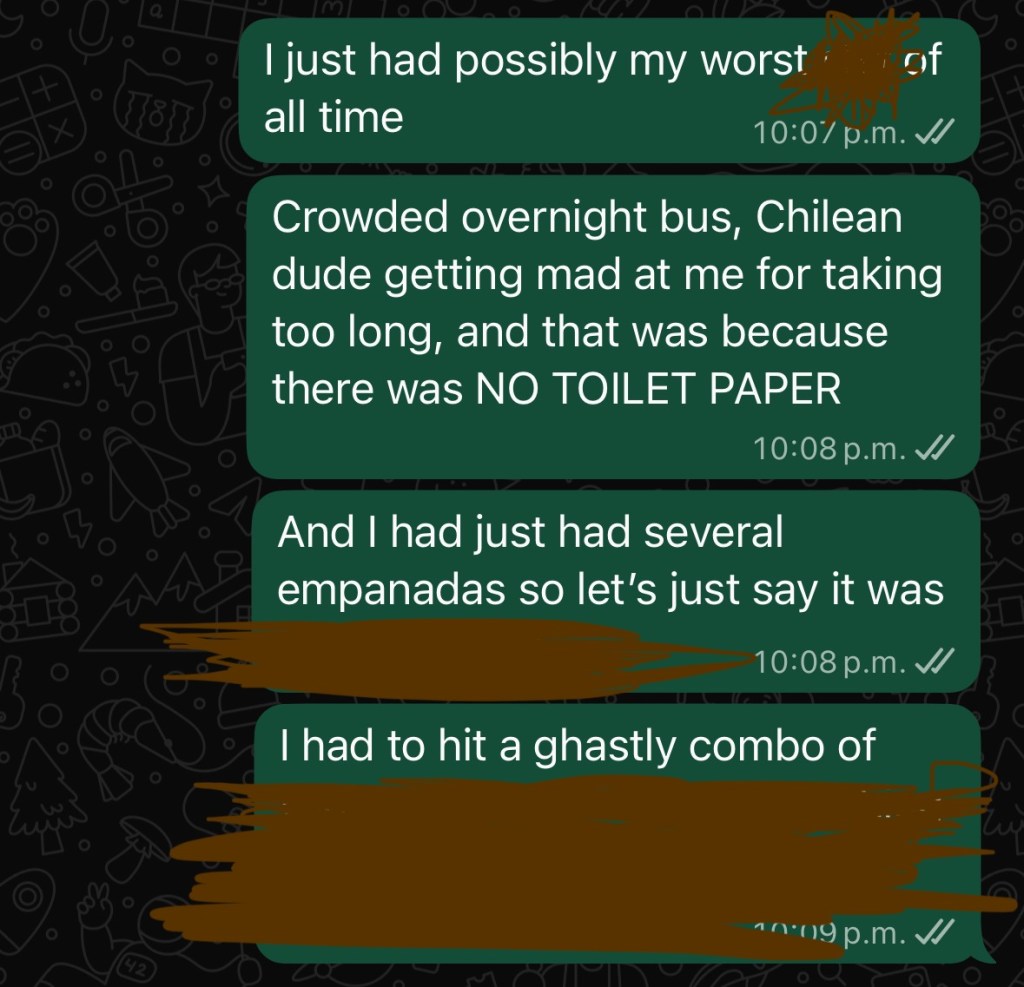
    There are also bathrooms, but the toilets are strictly for urination, and they don’t stock toilet paper. If, hypothetically, you find yourself in a situation where you have learned these details too late, and a man is yelling at you to hurry up, know that there are solutions, though unseemly, available to you. Hypothetically, they would not be pleasant, especially if you had to deploy them at the very start of your trip.

    Censorship is bad, but this method needs to be discovered organically. I also probably shouldn’t TMI everybody even more than I already have.

    Like a plane ride, or certain types of fungi, the overnight bus (the bus by day is a different matter) is teleportative in nature, although its nature is not particularly fast. You enter from the nocturnal chaos of a scrum of bodies at a busy Santiago terminal, pass ten hours in the dark—whether your curtains are drawn or not, you won’t see beyond your window—and emerge in a small town starkly different in climate, culture, and pace.

    The machine of teleportation, also known as the bus.

    As you traverse this liminal space, you have several options to entertain yourself: reading, music, contemplating the void. The one I opted for on this particular night was sleep.

    Unfortunately, sleep didn’t opt for me, and upon arrival, I was operating somewhere in between the world of the living and the world of the dead. Putting one foot in front of the other required all of what little cognition remained.

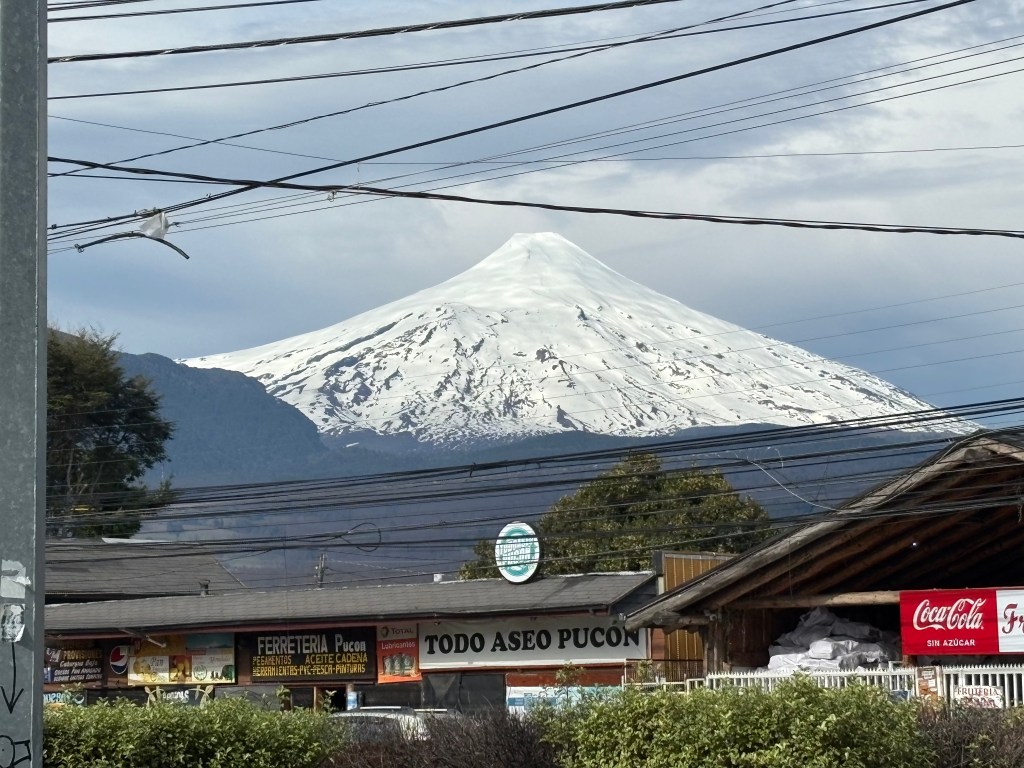
    Our bus had taken us to Villarica, a bigger city (although “bigger” is quite relative) on the other side of Lago Villarica. From here, we could catch our first glimpses of the similarly named Volcán Villarica, one of 2,000 volcanoes in Chile, but among the most active. For me, the opportunity to scale this monster was the main attraction of the trip.

    Volcán Villarica peeking out in the background. It’s 2,847 meters tall (9,341 feet).

    Pucón awaited us 30 minutes away, on the volcano side of the lake. Apparently, we could have gone straight from Santiago to Pucón without the need for the transfer, but our planning could be characterized only by its lack of anything resembling the word. Plus, when confronted with a million different bus options that all seem somewhat similar, sometimes it’s easiest to just pick the cheapest one and see what happens.

    This philosophy extended to our rental car and housing selection, which we hadn’t arranged before leaving Santiago. The idea was that these things would just sort of work out.

    When we did arrive in Pucón, we had to wait until 9 AM to be able to get the rental cars (at some point between last night and this morning Elena had evidently booked them), which left us with an hour and a half to kill walking around, a good portion of which we spent helping a man in a wheelchair get across town to the grocery store. With him in tow, our overfull backpacks screaming “tourist,” and numerous stray dogs trailing us, we must have made for an interesting sight for the locals on their way to work, though just as likely we could have been entirely unremarkable.

    As it was, the only other locals we saw were on a construction site—where we found the man in the wheelchair—and in my hazy state every sight was interesting, and unremarkable.

    The car rental office was in a luxurious, old-fashioned lakefront hotel that felt Wes Andersonesque. It’s always an interesting feeling stepping into one of these establishments when you didn’t, and will never, book a room.

    I ended up returning, rather spontaneously, to this lobby twice more throughout the trip. This is foreshadowing for Parts 2 and 3.

    While it’s obvious we didn’t belong, they didn’t stop us from exploring, so I wandered my way past the lobby, walked out the double glass doors into a courtyard that reminded me of the Breakers (that Vanderbilt mansion in Rhode Island of middle-school-field-trip fame), and jumped down the stone wall that led to the beach. I must have passed a half-hour or two sitting on the lifeguard tower with Mette, admiring the view.

    Lago Villarica is really big. I mean, not as big as one of the Great Lakes, but I’m not swimming across this thing.

    There were seven of us, so we got two rental cars: a sedan and a sedan-sized pickup truck. I say “we,” but it was really Elena, Silvia, and Anna that ironed out the details; in my state I was little more than glorified ballast. But after a café trip and a double shot of espresso, I committed to the fact that I would just sleep that night, and that conversationally, today wasn’t going to be my best performance.

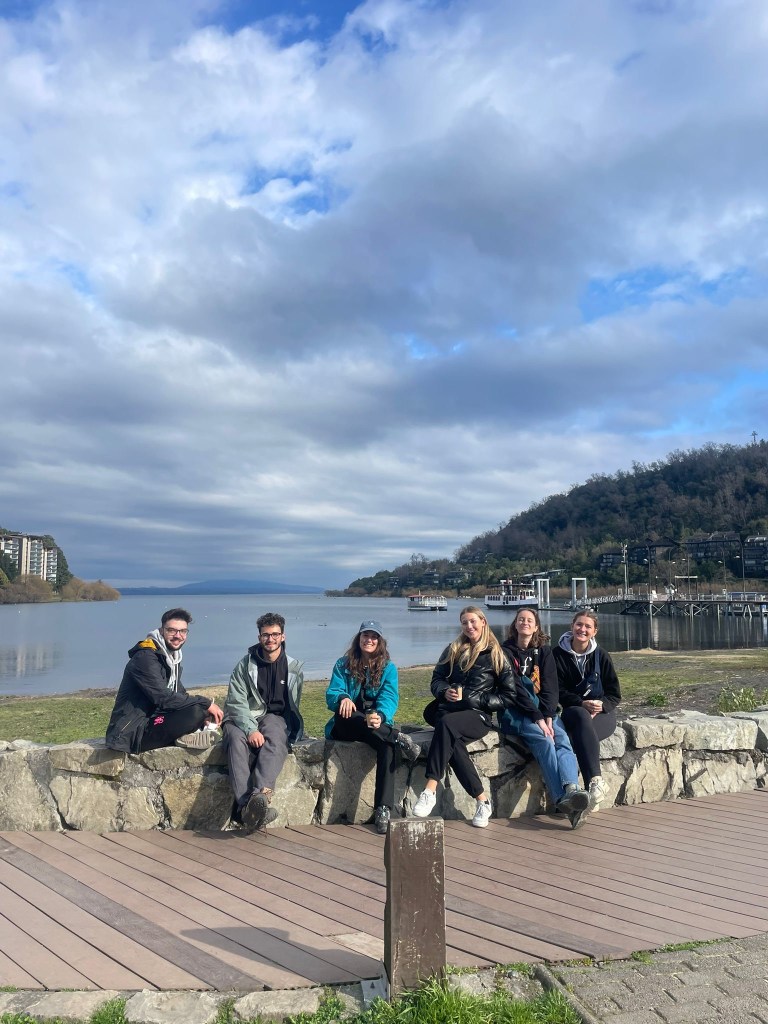
    Post-coffee group photo. Left to right: Hodei, me, Anna, Elena, Silvia, Carla. Mette behind the camera.

    The Airbnb was, once again, the cheapest option possible, some turnoff along the main way out of town, deep in a forested labyrinth of dirt backroads where there were more animals than people. Mette had booked it some hours before. There was no WiFi or heat, and the wood stove lacked kindling, so we had to get creative both nights because both days we forgot to buy any. The owner’s dog was possibly the largest I’ve ever seen; he could play fetch with large rocks. Thankfully, he was quite friendly.

    The only photo I took of the Airbnb is of this fellow.

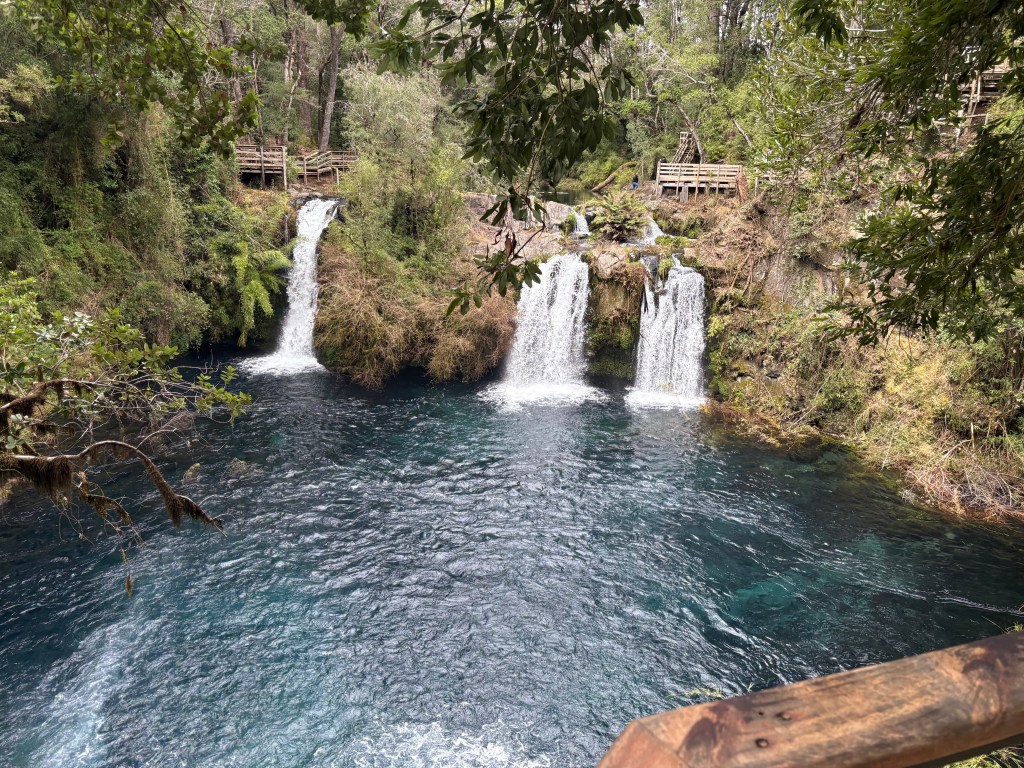
    The first stop of the day was Ojos de Carbugua, a multi-tiered waterfall park like what I had seen in Costa Rica, except the rainforest was temperate rather than tropical. The network of paths allowed us to circumnavigate the falls and see them from at least ten different viewpoints, which probably would have been glorious to a one-year-old without object permanence. With my lack of sleep, that’s essentially what I was, so it was perfect.

    The only photo of Ojos de Carbugua I took that doesn’t include one of us doing something stupid for the camera.

    The entry was only two thousand pesos (approximately two dollars) per person, which is quite good in a country that seems to put a gate in front of every natural attraction. That’s a pessimistic, and not entirely accurate viewpoint, as there are more free things than you could see in a lifetime in Chile, but it’s true that if you want to see a lineup of heavy hitters, you’ll have to pay up at some point.

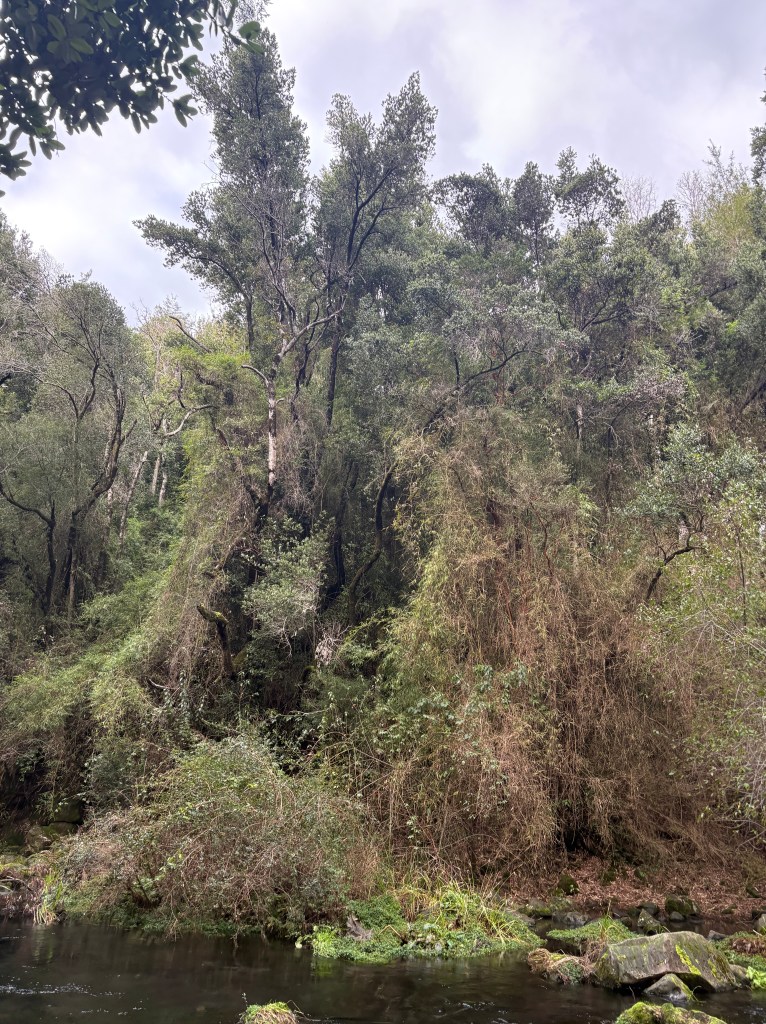
    For only ten hours south, the climate had changed a lot from the dry Mediterranean scrub in the valley of Santiago. The skies were cloudy, constantly threatening rain. It was considerably colder and considerably greener, forested everywhere—a difference I noticed especially on the roads between attractions. On the drive to, say, Valle Nevado, a ski resort just east of Santiago, you’ll have an open view the entire way up. Here in Pucón, the wide-open expanses were much less frequent, making them all the more magnificent.

    In general, way more stuff grows here than in the areas near Santiago.

    Next on the day’s menu (figuratively, of course; the literal menu, for me, was the near-twenty slices of ham that I had bought at the Lider on the outskirts of town) was Lago Carbugua.

    Pucón is in what some unofficially call the Los Lagos region of Chile, hence all of the lakes. Officially, it is in the Araucanía region, which is a Mapuche word that reflects their continued presence and importance in this part of the country.

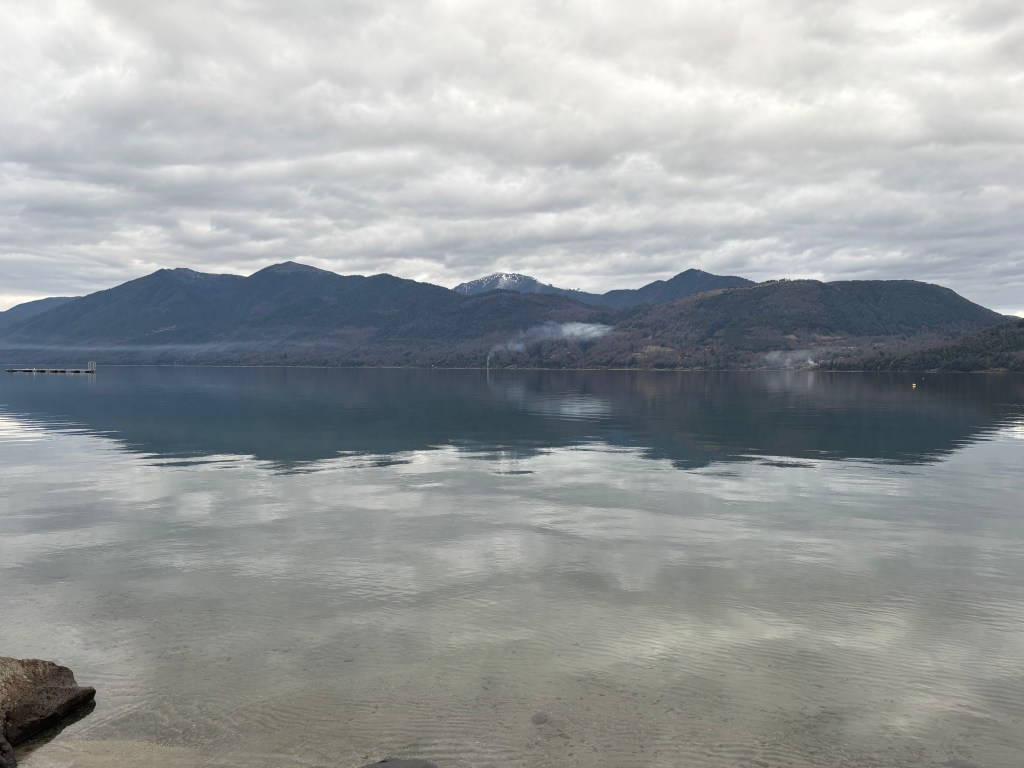
    The gloom in the air lended Lago Carbugua a melancholy sort of beauty. The beach was wide and at such a gradual angle that if you wanted to submerge yourself you had to run a good twenty meters out.

    Smoke in the distance: logging? A home furnace? A guy from Santa Cruz, California?

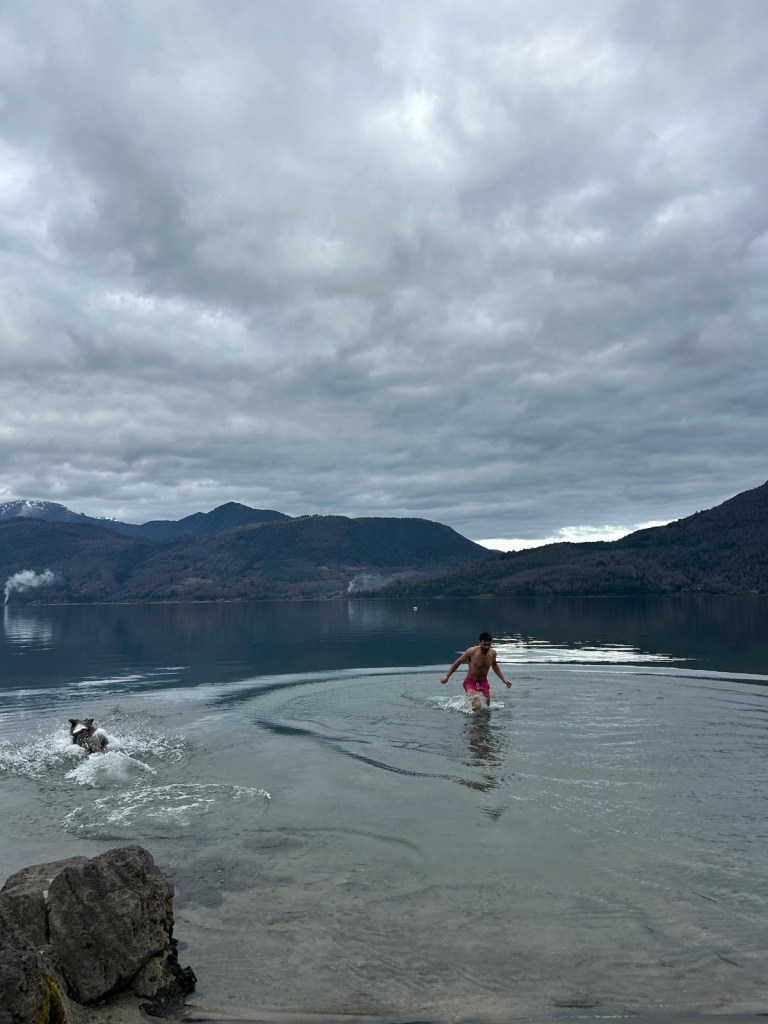
    Which, of course, I did. I have a principle that if I see a lake, and if it’s not teeming with seaweed or chemicals or crocodiles, I will jump in. Despite the cold, I had to follow through for the sake of my own ethos. Although maybe I was just doing it to get the final jolt to keep me awake until we headed back to the Airbnb.

    Thankfully, another principle that I have is that I never regret jumping in said lake, and today was no different. Not to get all pretentious, of course, but you do feel more alive after an icy plunge, and more connected to the nature around you besides. This principle also applies to swimming in the ocean, to going on hikes, and to buying somewhat fancy cheese.

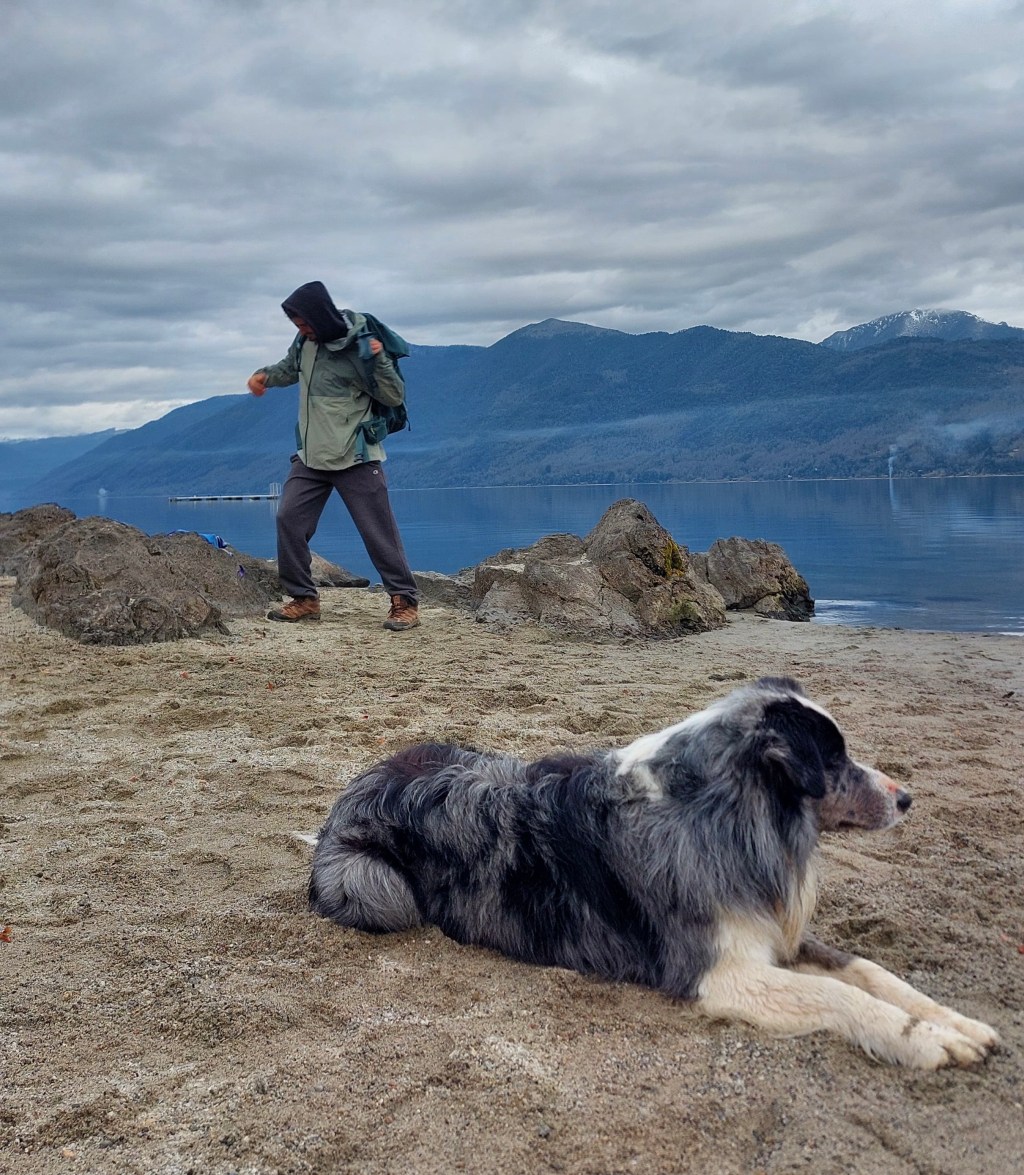
    We stayed until dark. I jumped in again. We passed the time making ridiculous conversation, I’m sure. The only thing I can concretely remember is meeting perhaps my favorite stray dog that I’ve encountered in all my travels in Chile, and I have encountered a lot. His special talent was that if you tossed a stick high into the sky, he would catch it every single time. Here are some photos of us both being animals.

    Yes, he could actually catch this large-ass branch.
    I was far less resistant to the bitter cold of the lake than our new friend.

    We returned to the Airbnb in varying degrees of exhaustion. At this point—some continuous 30-odd hours of being awake—my Spanish had entirely left me, and my English was not far behind. But I had one task ahead of me: a friend from my history class was in town, and his group had booked with an agency to summit the volcano tomorrow morning. In an Airbnb with no Wifi, on a phone without cellular service (we were in an area so rural it laughed at the idea of an E-Sim), signing up for the tour was quite the hassle. But in true buzzer-beating fashion, I succeeded, thanks to Hodei’s hotspot, just before the window closed.

    A few minutes after dinner, a delicious soup that Elena had chef-ed up, I went to bed. I had to be up at 5 AM; seven precious hours, then, to try and make a dent in my sleep debt before the volcano.


    Note: I think I’ve made peace with the fact that my experiences are going to vastly outpace my time, ability, and motivation to write about them. I’ve finally found a good routine that lets me write on most weekday mornings, but I’ve got a good ten or fifteen more posts in the works just to catch up to this point in the semester, and if each one is as detailed as this one, I’ll be finishing them in 2026. Maybe I’ll change things up and be less thorough—but probably not. We’ll see. Regardless, enjoy the sporadic content. Leave a comment or question below, and be sure to subscribe.

  • Chile #2: A Stroll Up Cerro Santa Lucia

    Chile #2: A Stroll Up Cerro Santa Lucia

    I’ve hiked, climbed, ski-lifted, and crampon-ed, if that’s a word, up a lot of hills recently, big and small. What I’ve found is that sometimes a small hill is just as worthwhile as a true mountaineering expedition at altitude, and a lot less expensive and time-consuming, too.

    Last Saturday, I went with some friends to Cerro Santa Lucia, a hill in the middle of Santiago. It’s the baby sibling of the massive Cerro San Cristobal, which dominates the skyline. But even that larger hill is the runt of the geological litter of the Andes towering over the eastern outskirts of the city.

    All of these comparisons are a roundabout way to say that Cerro Santa Lucia measures in at a “lowly” 68 meters, or 223 feet for the free (an adjective that seems to land awry these days, if it didn’t ever before). It’s small enough to be entirely surrounded by downtown Santiago, but rises drastically enough above the otherwise flat valley floor that it remains unsettled, an island of nature hemmed in between the urban hubbub of Barrio Lastarria, Bellas Artes, and Avenida Alameda.

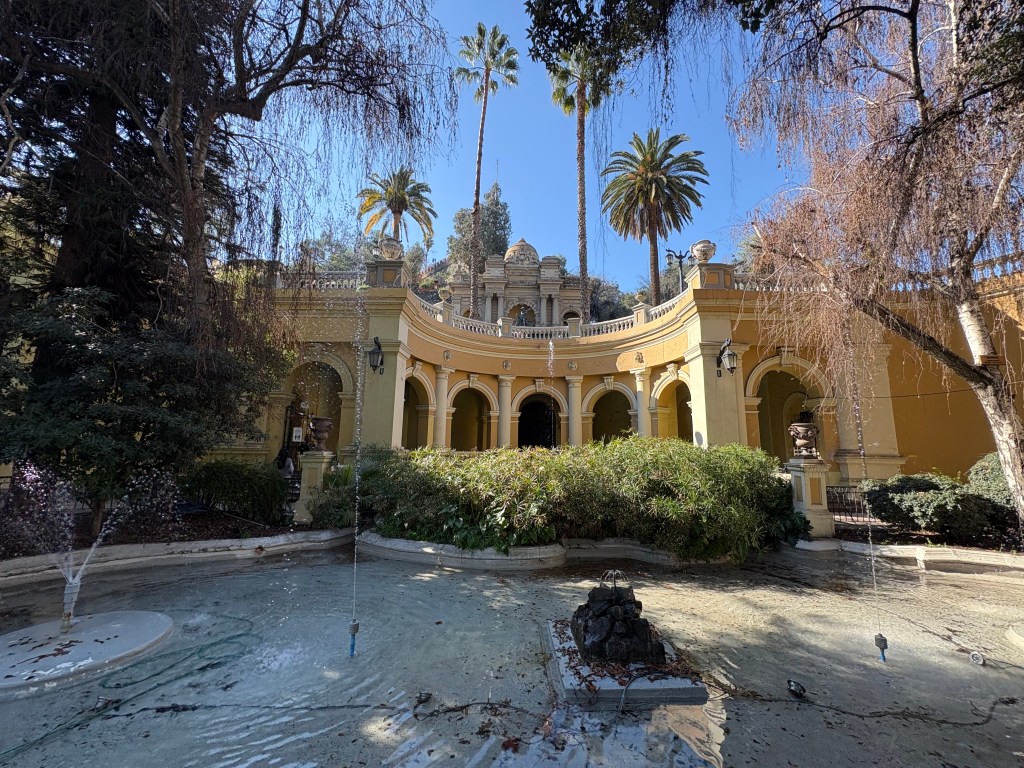
    It’s a steep way up. None of it is straightforward, either. For a seemingly petite outcropping, Cerro Santa Lucia still manages to be labyrinthine. Around its base, the park can’t seem to decide whether it’s open for roaming or fenced-in, and for this reason there seem to be countless entrances, though maybe only a few that go anywhere. At any rate, if you want to ascend, you’ll eventually be corralled onto a cobblestone road and pass by a lively fountain in front of a gorgeous building.

    From here, you have two options: keep following the road, which inclines at a barely-perceptible angle and spirals around the hill—perfect for horses wheeling a carriage fifty-plus years ago, maybe—or you can take a series of jagged switchbacks, which slice their way up with sharp intention.

    For my impatient self, there was only one option. Besides, I had sandwiched this quick outing right in between my midday climbing session and a homemade ceviche night that awaited back at the house. I was able to do so because I’m lucky enough to live close enough to downtown that Cerro Santa Lucia is only forty minutes by walking, thirty minutes by metro, or, best for me, twenty minutes by micro, the term for the hundreds of bus lines that crisscross Santiago.

    While somewhat exerting, the hike to the top wasn’t too bad. It had rained the day before, so in places mud squelched underneath our shoes (a piece of cake, though, compared to the mud in Parque Nacional Huerquehue a week prior). As we climbed, the path occasionally opened up to a beautiful viewpoint here, a charming garden there. Close to the top, a lovely terrace beckoned us with its inviting benches.

    To reach the summit, a platform atop a tower perched at the highest point of the hill, we had to file up a crowded set of stairs. From what I had seen on my way up, I had a feeling the view was going to be something special.

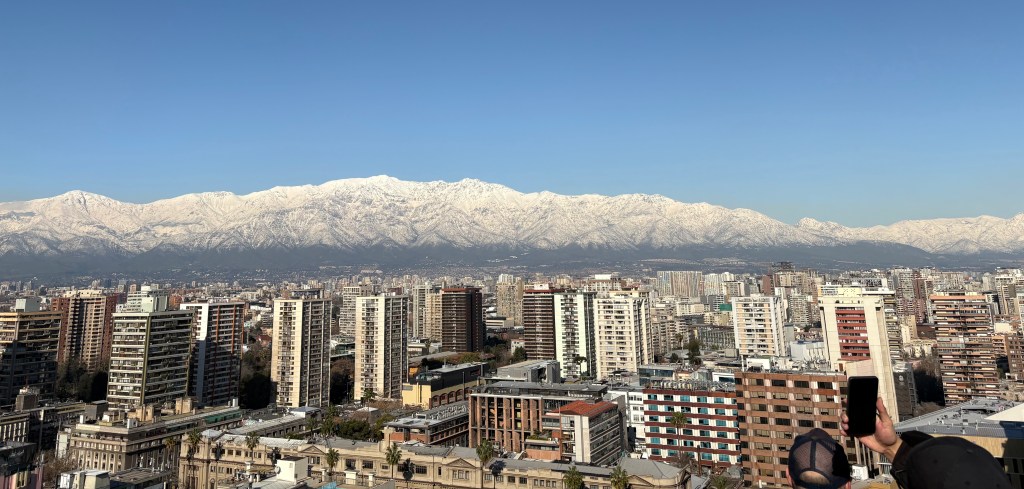
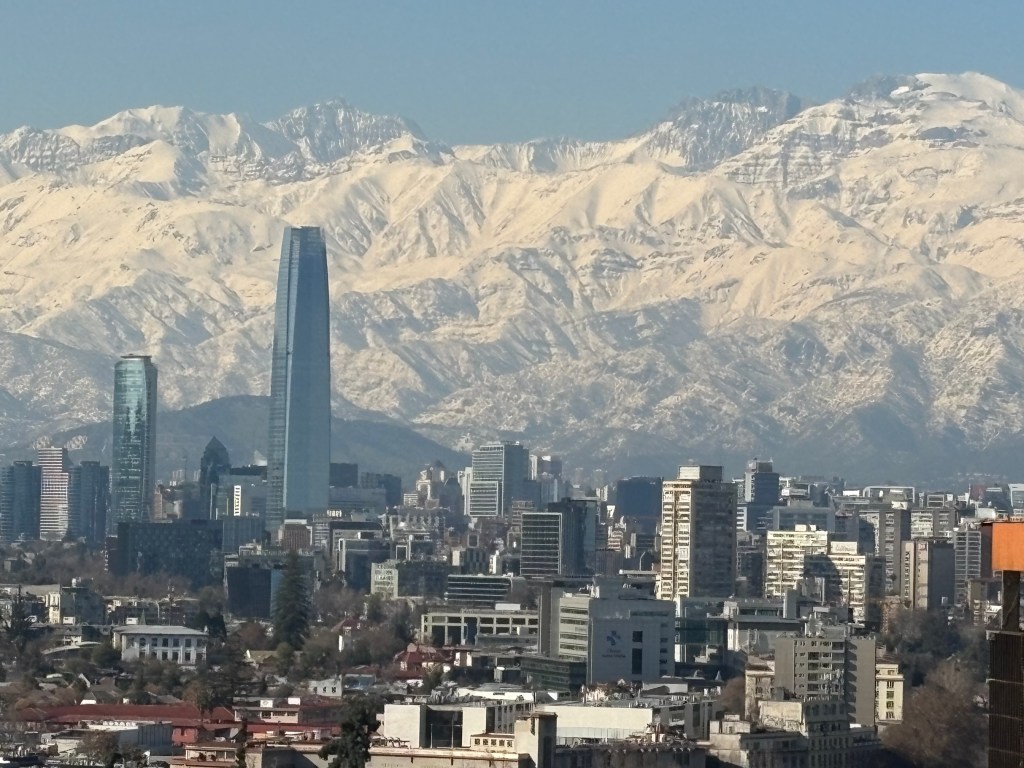
    Special it was. Yesterday’s rains had cleansed the smog and dumped snow on the cordillera, and the result was truly breathtaking. I had seen the city from above from several vantage points, but never like this, with such clarity in the air, with the mountains looming so large, with the ability to turn in any direction you please and see for dozens of kilometers.

    From this lookout, you realize just how large of a city Santiago is. There are nearly eight million people here, the same size as New York City, but usually, while it feels and breathes and lives like a metropolis, it never feels so aggressively, in-your-face massive as the Big Apple. Atop Cerro Santa Lucia, though, on a raft in a sea of endless high-rises, it’s hard not to be overwhelmed by the sheer number of settlements. Some of the buildings are older, just below the level from where you stand; some of them are modern, stretching above you. In the distance, the Costanera proves that it is indeed the tallest building in Latin America.

    Once again, WordPress won’t let me add videos. Instead of my 360-degree panorama, this picture will have to do, because I don’t want to pay extra.

    I can’t think of anything quite like this view. In its sprawl, it’s kind of similar to looking out over Los Angeles from Mulholland Drive, except that you’re in the heart of downtown, and you didn’t need a car to get there. It’s not like Christ the Redeemer, or for that matter, Cerro San Cristobal, because you’re not so high above it all as to be removed from it. You can still hear construction and music and buses and cars honking at each other. You can still taste the life of the city; you can still place your finger on its pulse.

    And, of course, there are the Andes.

    These are mountains with a capital M. These are mountains that you have to see to believe. These are mountains that once you see, you’ll never really believe, so big they make the skyscrapers next to you feel like an ornate carpet on the valley floor. I’ll put it this way: the smartphone camera is commonly accepted as the great humbler of all mountains, rendering proud peaks smaller than they’ll ever be in your eyes or in your memory, but see for yourself. The Andes refuse to be humbled.

    The big building in the back is the Costanera.

    Descending back into the commotion, strangely, you feel less insignificant. You may be one person among 8 million; the city may be a mere speck next to one of the defining features of our planet, positioned on one of its most active fault lines, but you have people to meet, goals to chase, a life to get back to. As you weave your way back into the quilt that, for one hour, you had detached yourself from, you feel that you are an important thread. You are undaunted by all of those tall buildings. In fact, you hardly notice them.

    One of the great and peculiar qualities of my experience in Santiago has been that, unlike in some other cities, I’ve never felt like an ant, like one tiny unimportant being scurrying among a swarm of countless others, readily crushed at any moment. Or rather, I’ve never felt that way except for when I was at the top of Cerro Santa Lucia.

    I suppose, then, it would be rather apt—and proportionally accurate—to call it the anthill of the cordillera.

    Note: I know it’s been a few weeks since the last post. I haven’t forgotten about the blog; I’ve actually been working on a bunch of different posts. With so much happening every day, it’s hard to find the time, much less keep up with everything. I think my new strategy will be to keep things very focused to a specific theme, moment, or place.

    Feel free to leave a comment or subscribe!

    6 responses to “Chile #2: A Stroll Up Cerro Santa Lucia”

    1.  Avatar
      Anonymous

      Me gusta Serro Santa Lusiaaa!!!🤓

      Like

    2.  Avatar
      Anonymous

      Can’t wait to hike it with you again…?!

      Like

    3. leahhetteberg Avatar
      leahhetteberg

      The pic of the Andes goes crazy, one can only dream of what a good DSLR could do out there. Glad to see you’ve well adapted the Sam Healey schedule into your new environment. Exciting stuff! Can’t wait for the next one ❤

      Like

    4.  Avatar
      Anonymous

      Hola Sammy,

      Ese es el hormiguero más hermoso que jamás he visto. Y gracias por recordarme que debo apreciar los momentos más pequeños, no siempre tiene que ser la montaña más grande que tienes que escalar para tener una buena experiencia… aunque Serro Santa Lucia es gigante!!! Que vista maravillosa!!! GUAUUUU

      Te extraño muchísimo!

      Like

      1.  Avatar
        Anonymous

        Y me alegra que ya estás escalando en el gimnasio también!

        Like

    5.  Avatar
      Anonymous

      hi sam! I am reading your blog as I take my flight from Atlanta to Santiago. Traveling from San Diego to Atlanta was one thing, but leaving the country during this flight is a cumbersome feeling. It is one that my heart is not ready to processs quite yet. I take your words with me as comfort and can’t wait to catch up over a pisco or two. See you soon 🫶🏻

      Emily h

        Like

      Leave a comment